A successful electrofusion joint forms the vital backbone of a leak-free, high-pressure pipeline network. When installed correctly, these systems perform flawlessly for decades. However, a single failed joint often results in costly excavation, severe system downtime, and significant safety hazards for your crew. Operator guesswork has absolutely no place in modern high-density polyethylene (HDPE) welding. Reliable infrastructure requires strict adherence to standard operating procedures to guarantee structural integrity.
Without rigorous protocols, even premium materials will fail under operational stress. This guide provides an industry-compliant, step-by-step installation framework designed specifically for field technicians. We structured this resource to remove subjectivity from the assembly process. You will learn how to minimize fusion failure risks while supporting robust quality assurance documentation.
We cover every critical phase of the process. You will explore essential pre-weld preparation, environmental controls, and precise heating cycles. Furthermore, we detail final visual inspection techniques and compliance audit logging. Follow these guidelines closely to ensure your next installation meets the highest engineering standards.
Key Takeaways
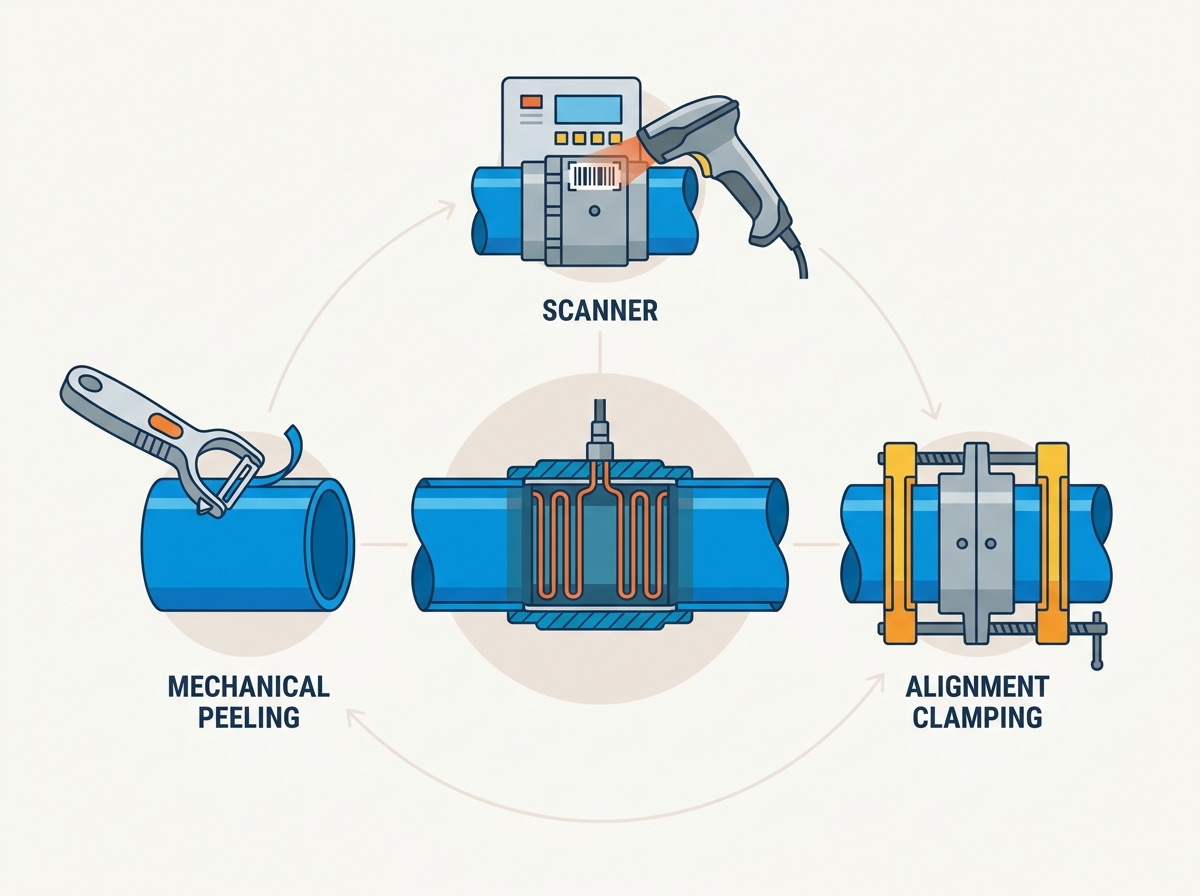
Mechanical control: Rely on rotary peelers and alignment clamps rather than manual scraping and holding to ensure exact tolerances.
Cooling discipline: Clamps must remain fully engaged until the manufacturer’s specified cooling time is strictly met; premature stress compromises the polymer chain integration.
Vendor traceability: Standardizing on couplers with ISO-compliant barcode traceability simplifies the fusion process and supports long-term infrastructure audits.
Pre-Installation: Tooling, Environment, and Site Preparation
Creating a flawless weld starts long before you apply power to the fitting. Field environments constantly introduce unpredictable and uncontrollable variables. You must control these elements through meticulous site preparation and strict tooling protocols. Missing a single preparation step exponentially increases the risk of joint failure.
Essential Tooling Inventory
Technicians must arrive on-site fully equipped. Never substitute specialized equipment for makeshift tools. The following inventory represents the mandatory baseline for a compliant installation:
Electrofusion processor: An automated control box capable of barcode scanning and data logging.
Rotary pipe peeler: Essential for continuous, uniform material removal.
Alignment clamps: Required to immobilize the assembly during the heating and cooling cycles.
Rotational pipe cutters: Ensure perfectly square cuts across the pipe axis.
Weather plays a significant role in polymer fusion. Rain, high humidity, and wind severely degrade the integrity of the weld pool. You must deploy weather-resistant welding tents during inclement conditions. Wind quickly cools the external fitting housing, which alters the internal heat distribution.
Moisture represents your biggest threat. Even trace amounts of water on the fusion zone will vaporize during the heating cycle. This rapid expansion creates voids within the molten polymer layer. Temperature compensation limits also matter. Modern control boxes automatically adjust energy delivery based on ambient temperatures. Always ensure the processor's temperature sensor remains shaded from direct sunlight.
Pipe Assessment
Inspect the HDPE or PE100 pipe ends thoroughly before committing to the weld. Examine the exterior surface for deep gouges. Any scratch exceeding 10% of the pipe wall thickness requires you to discard that section. Check the pipe for ovality, which often occurs during transit or stacking. Extreme ovality prevents the fitting from sliding over the pipe smoothly. Finally, assess the pipe for severe UV degradation, typically indicated by a chalky, discolored surface layer.
Precision defines the mechanical assembly phase. You must execute each physical action methodically. Skipping steps or taking shortcuts guarantees a compromised joint.
1. Cutting and Measuring
First, cut the pipe ends perfectly square. Always use a rotational pipe cutter to achieve a clean, 90-degree face. Uneven or angled cuts leave the internal heating coils exposed inside the fitting. Exposed coils overheat, short circuit, and cause catastrophic blowouts.
Next, measure the precise insertion depth. Place the fitting alongside the pipe end and mark exactly half the length of the fitting. Use a highly visible, non-greasy marker. Grease-based markers contaminate the weld zone. This mark acts as your primary visual indicator to ensure the pipe seats fully inside the fitting.
2. Scraping (Oxidation Removal)
HDPE pipes develop an oxidized microscopic layer immediately after manufacturing. Oxygen and UV light alter the surface polymer structure. You must remove this oxidized layer to expose the virgin polyethylene underneath. The fusion process cannot fusion bond degraded polymer chains.
You typically need to remove 0.2mm to 0.3mm of material. We heavily emphasize the use of mechanical rotary peelers over basic hand scrapers. Hand scraping creates an uneven, faceted surface. A rotary tool ensures a continuous, uniform ribbon of material peels away, maintaining precise pipe tolerances.
3. Cleaning and Alignment
After scraping, clean the prepared area thoroughly. Apply high-purity isopropyl alcohol to clean, lint-free wipes. Wipe the scraped pipe ends and the internal surface of the fitting. Allow the alcohol to flash dry completely. Once cleaned, treat this as a strict no-touch zone.
Carefully slide the Electrofusion Couplers onto the pipe up to your visible insertion mark. Immediately secure the entire assembly using heavy-duty alignment clamps. Clamps prevent shifting and correct minor pipe ovality. Without clamps, expanding polymers will push the pipe out of the fitting during the melt phase.
4. The Fusion Process
Connect your processor control box leads to the terminal pins on the fitting. Use the processor's optical scanner to read the barcode. This barcode dictates precise voltage levels and heating times based on factory testing. Barcode scanning prevents manual data entry errors.
Initiate the weld cycle. Once started, step away and stand clear of the immediate area. Molten plastic can erupt if a severely contaminated joint fails under pressure. Monitor the processor screen closely for voltage drops or error codes. Document any warnings immediately.
Integrating an Electrofusion Flange for System Transitions
Pipeline networks rarely consist entirely of one material. Eventually, you must connect continuous HDPE lines to external infrastructure. Engineers specify specialized transition points to handle these mechanical changes safely.
Use Case
You typically integrate an Electrofusion Flange when transitioning to mechanical components. Common applications include connecting HDPE lines to flanged gate valves, industrial pumps, or legacy steel piping. The flange adapter provides a secure, leak-proof mechanical face that mates perfectly with standardized metal bolt patterns.
Installation Nuances
Flange installations demand extreme attention to alignment requirements. You must orient the bolt holes perfectly to match the mating valve or steel pipe before initiating the weld. Once the polymer fuses, you cannot rotate the fitting.
Furthermore, you must complete the entire fusion process and the full cooling cycle before making the mechanical connection. Never bolt the flange face to the mating component while the joint remains warm. Tightening the bolts introduces severe rotational stress on the warm polymer. This premature stress fractures the newly formed molecular bonds, ensuring a hidden failure later.
Common Mistake: Rushing the connection. Operators often bolt the flange while the polymer remains soft to save time. This permanently warps the flange face and guarantees a future leak path.
Quality Assurance and Post-Weld Compliance (QA/QC)
Verification separates professional installations from amateur attempts. Quality assurance ensures the joint meets specific engineering standards before the pipeline goes into active service. You must log and verify the data systematically.
Cooling Time Enforcement
Understanding cooling phases prevents premature joint stress. You must enforce two distinct timelines. First, observe the "clamp time." This dictates how long the assembly must remain locked securely in the alignment clamps. Removing clamps early breaks the cooling polymer chains.
Second, observe the "pressure test time." This is a significantly longer duration. It defines the absolute minimum time required before you can introduce internal testing pressure to the pipeline network. Consult the manufacturer barcode data, as these times vary widely by diameter and ambient conditions.
Visual Inspection Indicators
Once cooled, perform a thorough visual inspection. Check the primary melt indicators, commonly known as witness pins. These small plastic columns rise from the fitting body during the heating cycle. Raised pins confirm the internal melt pool achieved sufficient expansion pressure. However, they do not guarantee a perfect weld on their own.
Next, inspect the edges of the fitting. Ensure no melted polymer has extruded completely outside the fitting boundaries. Excessive extrusion indicates overheating, extreme pipe misalignment, or a failure to securely clamp the assembly.
Data Logging
Modern infrastructure projects require absolute traceability. Utilize the processor's onboard memory system. Export the digital weld data after completing the site work. This logs critical parameters including the operator ID, ambient temperature variations, and the exact voltage delivered. Project managers use these reports for official project handover and strict compliance audits.
Common Failure Modes and Mitigation Strategies
Understanding why joints fail helps technicians avoid costly mistakes. Most failures share common operational roots. We can categorize these into predictable patterns. Recognizing these patterns allows you to enforce targeted mitigation strategies.
Below is a quick reference summary outlining the core issues field teams encounter.
Failure Mitigation Chart
Failure Mode
Root Cause
Physical Result
Primary Mitigation
Inadequate Scraping
Leaving oxidized UV-degraded layer intact.
"Cold joint" where melt pools fail to fusion bond
properly.
Mandatory use of mechanical rotary peelers.
Contamination
Oil from skin, environmental dust, or moisture.
Vaporization creates distinct voids and structural bubbles.
Strict >90% alcohol wipe protocols and enforced "no-touch" zones.
Misalignment
Pipe bending stress during heating/cooling phases.
Internal wire shorting or highly uneven melt zones.
Non-negotiable use of heavy-duty alignment clamps until fully cooled.
A cold joint represents the most deceptive failure. The fitting looks perfect from the outside, but the internal surfaces never truly bonded. Mandatory mechanical peeling eliminates this specific risk entirely. Contamination failures often reveal themselves during pressure testing as pinhole leaks. Maintaining a clinical approach to cleanliness prevents this. Misalignment usually results in immediate processor error codes as the internal heating coils touch and short out.
Evaluating and Shortlisting Electrofusion Vendors
Sourcing reliable materials drastically impacts your project success rate. Procurement engineers should evaluate vendors based on strict technical criteria rather than initial purchase price alone. High-quality fittings reduce installation times and prevent catastrophic failures.
Traceability and Data
Prioritize vendors offering smart barcodes fully compliant with ISO 12176-4 standards. This ensures seamless integration with any modern processor box. Barcode traceability means you can track a specific fitting back to its exact manufacturing batch. If a defect emerges years later, you can proactively identify other at-risk joints across your network.
Manufacturing Tolerances
Evaluate the internal design and dimensional stability of the fittings. Look closely at the heating wire arrangement. Superior designs feature molded-in heating coils. The polymer encapsulates the wires, preventing them from snagging when you insert the pipe. Exposed wire designs pose a high risk. A sharp pipe edge can easily catch an exposed wire, dragging it out of position and causing a fatal short circuit.
Technical Support and Availability
A vendor must act as a technical partner. Assess their ability to provide project-specific cooling and heating charts. Can they supply on-site training support for your technicians? Reliable inventory lead times also matter immensely for enterprise-scale rollouts. Delays in material delivery cripple project timelines.
Conclusion
Successful electrofusion is a strictly engineered process, never a subjective skill. Operators achieve consistent success by systematically removing environmental and mechanical variables. Adhering to rigorous preparation protocols guarantees the structural integrity of your pipeline network.
Investing in proper training, strict standard operating procedures, and high-quality traceable fittings delivers immense long-term ROI. You drastically reduce excavation costs, system downtime, and severe safety incidents by doing the job right the first time.
Project managers and procurement engineers should evaluate their current material standards today. Contact your technical sales team to review detailed coupler specifications, request comprehensive sample data sheets, and schedule site-specific installation training for your field crews.
FAQ
Q: Can I reuse an electrofusion coupler if the power cuts out during the cycle?
A: No. Manufacturer guidelines strictly prohibit re-fusing a partially melted joint. Power interruptions alter the polymer state and permanently displace the internal heating coils. Attempting a second fusion cycle almost guarantees a wire short circuit or a catastrophic blowout. Always cut out the aborted fitting and start fresh.
Q: Do I still need to scrape the pipe if it is brand new?
A: Yes. Oxidation occurs immediately upon manufacturing as the hot polymer contacts the air. UV degradation also begins instantly during shipping and outdoor storage. Scraping remains a mandatory step to expose the active virgin polyethylene, regardless of the pipe's age.
Q: How long do electrofusion couplers take to cool?
A: Cooling times vary strictly based on the specific pipe diameter, the SDR (Standard Dimension Ratio), and current ambient temperatures. You must read the exact cooling duration directly from the fitting's barcode or the manufacturer's provided data sheet. Never guess or rush this phase.
Q: Is manual scraping acceptable for large-diameter HDPE?
A: No. Manual scraping introduces an unacceptably high risk of failure on large-diameter pipes. Hand scrapers create uneven gouges and fail to maintain consistent tolerances across large surface areas. We strongly recommend using dedicated mechanical rotary peelers to ensure uniform material removal.

 English
  العربية
  Français
  Русский
  Español
  Português
  Deutsch
  italiano
  日本語
日本語  한국어
한국어  Nederlands
  Tiếng Việt
  ไทย
ไทย  Polski
  Türkçe
  አማርኛ
አማርኛ  ພາສາລາວ
  ភាសាខ្មែរ
  Bahasa Melayu
  ဗမာစာ
ဗမာစာ  தமிழ்
தமிழ்  Filipino
  Bahasa Indonesia
  magyar
  Română
  Čeština
  Монгол
  қазақ
қазақ  Српски
  हिन्दी
  فارسی
فارسی  Kiswahili
  Slovenčina
  Slovenščina
  Norsk
Norsk  Svenska
  українська
  Ελληνικά
  Suomi
Suomi  Հայերեն
  עברית
עברית  Latine
  Dansk
Dansk  اردو
اردو  Shqip
Shqip  বাংলা
বাংলা  Hrvatski
  Afrikaans
  Gaeilge
  Eesti keel
  Māori
Māori