Engineers and procurement teams face a critical choice every day. You must specify the correct grade of high-density material for fluid transfer. This particular scenario requires you to balance pressure requirements, hydraulic flow, and overall project budget. PE80 and PE100 are widely used classifications in modern infrastructure. They have similar basic chemical compositions. However, their different molecular structures have profound effects on field performance. Changes in these materials alter everything from the required wall thickness to long-term hydrostatic strength.
Our goal is to provide a clear, evidence-based comparison. We will examine mechanical performance, installation realities, and lifecycle value metrics. This guide helps project stakeholders make defensible procurement decisions. You will understand how density affects welding compatibility. We will also demonstrate how the right choice can reduce logistical burdens and extend pipeline life.
Key Points
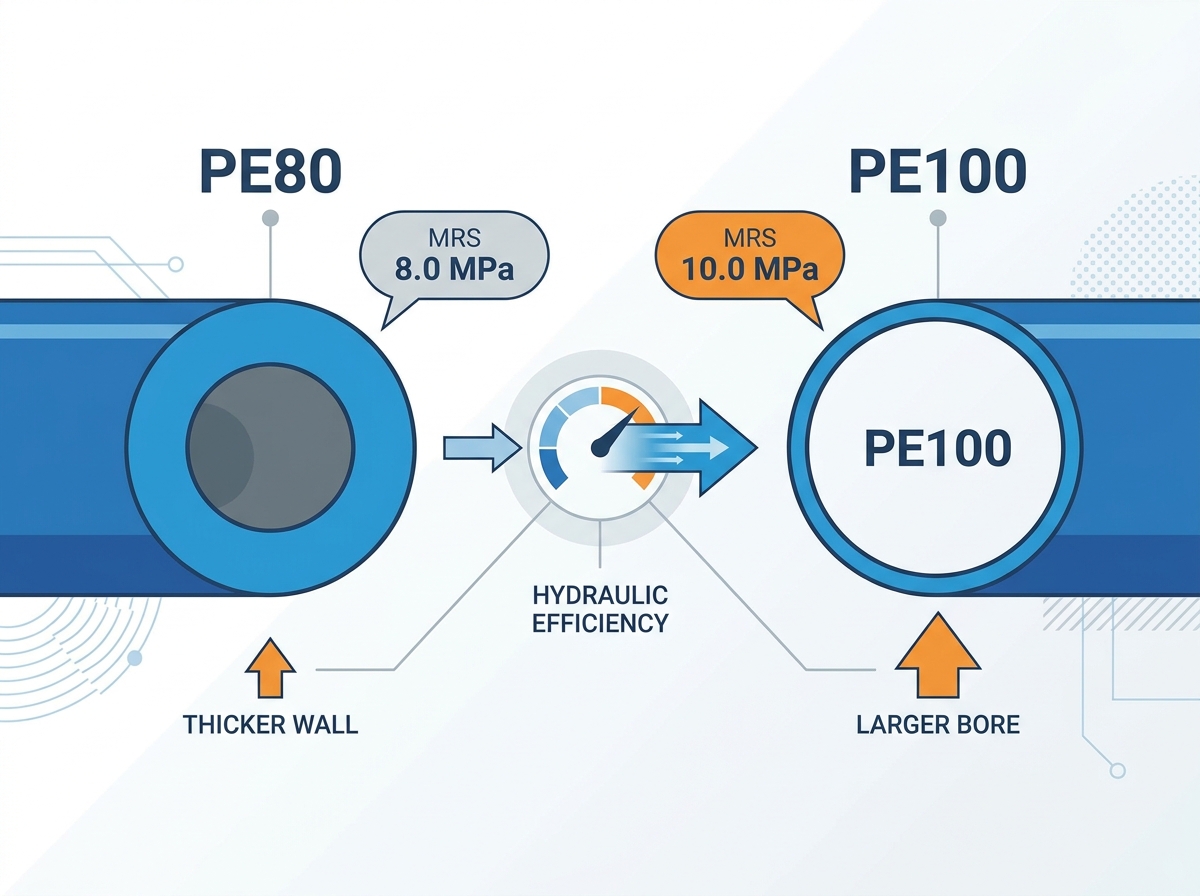
MRS Specification: The Minimum Required Strength (MRS) of PE100 is 10.0 MPa, while the MRS of PE80 is 8.0 MPa.
Hydraulic Efficiency: At the same operating pressure, PE100 allows for thinner pipe walls, increasing internal diameter and improving flow capacity.
Weight and Logistics: Thinner walls of PE100 reduce the total weight per meter, lowering transportation and handling costs.
Installation and Welding: Both materials can be welded, but combining PE80 and PE100 requires specific technical protocols and compatible fittings to prevent joint failure.
Fundamental Differences: MRS and Molecular Density
Defining Minimum Required Strength (MRS)
The core distinction between these materials lies in their Minimum Required Strength. Engineers use the ISO 9080 standard for pressure testing to determine this value. This rigorous framework assesses the long-term hydrostatic strength of materials. Technicians immerse samples in water and apply different internal pressures at 20°C. They plot failure points over thousands of hours. Finally, they extrapolate these data to predict 50-year performance.
The resulting MRS determines the maximum long-term circumferential stress a pipeline can safely withstand. PE80 achieves an MRS of 8.0 MPa. PE100 achieves an MRS of 10.0 MPa. This 25% strength increase fundamentally changes how engineers design pipeline systems.
Material Evolution
The industry continuously evolves to meet higher infrastructure demands. Historically, PE80 served as the traditional standard for gas and water distribution. Manufacturers previously mixed Medium Density Polyethylene (MDPE) and High Density Polyethylene (HDPE) for production. It provided excellent flexibility and reliable performance for municipal networks.
Eventually, polymer science advanced. Manufacturers developed PE100 as an evolution of modern high density. This new generation product offers superior resistance to rapid crack propagation. It performs excellently under high mechanical stress. While PE80 remains common, PE100 dominates modern high-pressure infrastructure.
Standard Dimension Ratio (SDR) Impact
Density directly affects the Standard Dimension Ratio (SDR). SDR represents the ratio of the pipe's outer diameter to its wall thickness. Higher density allows the pipe to achieve the same pressure rating (PN) at a higher SDR. A higher SDR means thinner walls.
The pressure equivalence chart below illustrates this concept. Note how PE100 achieves the same pressure handling with less material.
Nominal Pressure (PN) | SDR Required for PE80 | SDR Required for PE100 |
PN 10 (10 bar) | SDR 11 | SDR 17 |
PN 12.5 (12.5 bar) | SDR 9 | SDR 13.6 |
PN 16 (16 bar) | SDR 7.4 | SDR 11 |
Best Practice: Always verify your local regulatory standards. Some municipalities strictly require specific SDRs regardless of raw material grade.
Performance Evaluation Criteria for Polyethylene Pipes
Working Pressure Rating
When selecting polyethylene pipes, you must assess the Maximum Allowable Operating Pressure (MAOP). The 10.0 MPa rating of PE100 makes it the preferred choice for demanding environments. Municipalities often specify it for high-pressure water mains. Industrial facilities also rely on it for heavy-duty fluid transfer. PE80 typically handles lower pressure thresholds. Engineers use it for local distribution networks where extreme pressure peaks are unlikely.
Flow Capacity and Hydraulic Design
Hydraulic efficiency determines the long-term energy consumption of fluid networks. PE100 offers a clear advantage through simple characteristics-to-results relationships. Consider the following sequence:
Thinner Walls: Higher tensile strength requires less radial thickness to withstand the same pressure.
Larger Aperture: Reduced wall thickness expands the internal diameter of the pipe.
Reduced Friction Loss: A wider aperture reduces fluid velocity and internal friction.
Reduced Pumping Energy: Pumps work less to move the same volume of water, lowering operational costs.
This chain of benefits makes PE100 highly attractive for large transmission projects. You can move more water with less energy.
Environmental and Chemical Resistance
Both grades offer excellent overall corrosion resistance. They resist erosive soils, acidic fluids, and biodegradation. However, environmental stress varies with installation methods. PE100 performs slightly better in Slow Crack Growth (SCG). This makes it superior in rocky trench environments.
Point loads occur when contractors backfill trenches with locally unscreened soil. Sharp rocks press against the exterior of the pipe. Over time, these point loads can initiate micro-cracks. The high density of PE100 resists the propagation of these cracks better than PE80.
Common Mistake: Do not assume excellent SCG resistance eliminates the need for proper bedding. Always use appropriate sand or fine gravel backfill whenever possible.
Implementation Realities: Welding, Risks, and PE Fittings
Fusion Compatibility Risks
Contractors often face engineering challenges when butt welding different grades. Connecting traditional PE80 networks to new PE100 extensions requires caution. Different Melt Flow Indices (MFI) pose significant fusion compatibility risks. The melting and flow rates of PE80 differ slightly from PE100.
If you apply uniform heat without adjustments, one side may over-melt while the other remains unmelted. This weakens molecular bonds. You must strictly follow standardized heating and cooling protocols. DVS and ISO guidelines provide precise temperature adjustments to ensure uniform welding.
Selecting the Right PE Fittings
You cannot compromise on joint integrity. To ensure a secure network, you must specify compatible PE fittings. Contractors primarily use electrofusion or butt fusion methods.
When connecting PE80 to PE100, follow a general rule of thumb. Typically, you must align welding parameters with PE80 material. The lower density material dictates heating time and pressure force. Alternatively, you can use specific dual-rated electrofusion fittings. Manufacturers design these components specifically to bridge the density gap. Embedded heating coils provide balanced melting profiles for both sides.
Best Practice: Always consult the barcode data from the fitting manufacturer. Modern electrofusion machines scan this barcode to automate precise voltage and heating times.
Trenching and Handling
Material density alters physical flexibility. The increased rigidity of PE100 affects bending radius requirements during installation. You cannot bend PE100 pipes as sharply as the slightly more flexible PE80 pipes. This reduced flexibility requires careful planning when traversing narrow urban trenches.
If your trench curves sharply, PE100 may require additional molded elbows. Conversely, PE80 is often flexible enough to naturally follow trench paths. You must consider these handling differences early in the design phase to avoid on-site delays.
Cost vs. Value Analysis
Raw Material vs. Manufacturing Costs
Procurement teams must evaluate costs beyond the raw polymer price. PE100 resin is typically slightly more expensive per kilogram than PE80. However, you must consider structural efficiency. Because PE100 requires thinner walls to achieve the same pressure rating, manufacturers use less total material volume.
This volume reduction offsets the higher resin price. In many cases, the final manufacturing cost per linear meter is lower for PE100. You pay slightly more for raw plastic but purchase significantly less of it.
Logistical Efficiency
Lighter pipes create a series of logistical savings. When you specify PE100 for high-pressure lines, the weight per meter decreases. This translates into several clear advantages:
Freight Weight: Trucks can transport more linear meters before reaching highway weight limits.
Handling Equipment: On-site crews can use smaller, less expensive excavators to place pipes into trenches.
Installation Schedule: Lighter materials accelerate physical layout and operational processes.
These combined efficiencies reduce required man-hours and heavy machinery rental budgets.
Lifecycle Longevity
Under normal operating conditions, both grades boast impressive design lives of 50 to 100 years. True lifecycle value comes not only from choosing the highest grade. It comes from correct specification and perfect joint execution.
Poorly welded PE100 joints will fail sooner than perfectly welded PE80 joints. Maximize return on investment by matching materials to the environment. Ensure strict quality control during fusion. Protect pipes from severe point loads. These operational disciplines ensure the promised century-long lifespan.
Screening Logic: Which Grade Suits Your Application?
When to Specify PE100
For demanding infrastructure, you should prioritize this modern high-density grade. Specify it when your project involves:
High-pressure water distribution and regional transmission mains.
Projects requiring maximum internal flow capacity to reduce pumping overhead.
Deep trench installations facing heavy soil loads.
Trenchless installations requiring high tensile pull strength, such as Horizontal Directional Drilling (HDD).
When to Specify PE80
Do not discard this traditional material. It remains highly relevant and compliant for specific scenarios. Specify it when your project involves:
Low-pressure gas distribution networks where regulatory standards still strongly favor or require MDPE mixtures.
Small diameter service lines where high flexibility in field operations is crucial.
Extensions of existing traditional networks where precise material matching simplifies welding protocols.
Conclusion
Choosing between PE100 and PE80 requires a clear understanding of your project needs. PE100 offers structural and hydraulic superiority in most modern high-pressure applications. Its higher density allows for thinner walls, lighter weight, and superior crack resistance. Meanwhile, PE80 remains a viable compliant choice for specific low-pressure tasks and gas distribution networks. Its flexibility makes it ideal for compact urban service lines.
Your next step is to align these material facts with your site realities. We strongly recommend consulting technical experts before finalizing procurement. Carefully review specific manufacturer data sheets. Ensure your chosen grade fully complies with local regulations and your exact pressure requirements.
Frequently Asked Questions
Q: Can PE80 and PE100 pipes be welded together?
A: Yes, they can be welded together. However, due to different Melt Flow Indices, you must use strict protocols. The most reliable method is to use dual-rated fittings for electrofusion. If using butt fusion, you must modify heating and cooling parameters. DVS and ISO standards typically dictate aligning welding parameters with PE80 specifications to prevent joint failure.
Q: Is PE80 becoming obsolete?
A: No, it is not becoming obsolete. While PE100 dominates new water infrastructure and high-pressure mains, PE80 is still actively produced. The gas industry still heavily uses it for low-pressure distribution networks. Its flexibility makes it very popular for small diameter residential service connections.
Q: Does PE100 mean a 100-year lifespan?
A: No, this is a common naming misconception. "100" refers to the 10.0 MPa Minimum Required Strength (MRS) rating. It does not determine lifespan. However, engineers expect both PE80 and PE100 to achieve a design life of 50 to 100 years when properly installed and operated within their pressure limits.

 English
  العربية
  Français
  Русский
  Español
  Português
  Deutsch
  italiano
  日本語
日本語  한국어
한국어  Nederlands
  Tiếng Việt
  ไทย
ไทย  Polski
  Türkçe
  አማርኛ
አማርኛ  ພາສາລາວ
  ភាសាខ្មែរ
  Bahasa Melayu
  ဗမာစာ
ဗမာစာ  தமிழ்
தமிழ்  Filipino
  Bahasa Indonesia
  magyar
  Română
  Čeština
  Монгол
  қазақ
қазақ  Српски
  हिन्दी
  فارسی
فارسی  Kiswahili
  Slovenčina
  Slovenščina
  Norsk
Norsk  Svenska
  українська
  Ελληνικά
  Suomi
Suomi  Հայերեն
  עברית
עברית  Latine
  Dansk
Dansk  اردو
اردو  Shqip
Shqip  বাংলা
বাংলা  Hrvatski
  Afrikaans
  Gaeilge
  Eesti keel
  Māori
Māori 


