Piping system integrity relies entirely on secure, leak-free connections. Fitting failures cause the majority of catastrophic leaks in municipal and industrial fluid transport networks. These failures rarely stem from the pipe itself. They usually originate from dimensional or material incompatibilities at the joint. Engineers and procurement teams face significant complexity when navigating overlapping regional and international specifications. Selecting the wrong specification leads directly to failed pressure tests. It also triggers regulatory non-compliance and voids manufacturer warranties. This guide deconstructs and compares core international specifications. We evaluate ISO 4427, EN 12201, ASTM D3261, and ASTM F1055. You will learn how to facilitate accurate technical evaluation across diverse projects. We provide actionable steps to mitigate installation risks and ensure project-specific compliance. Understanding HDPE pipe fittings standards is absolutely non-negotiable for building long-lasting, resilient infrastructure.
Key Takeaways
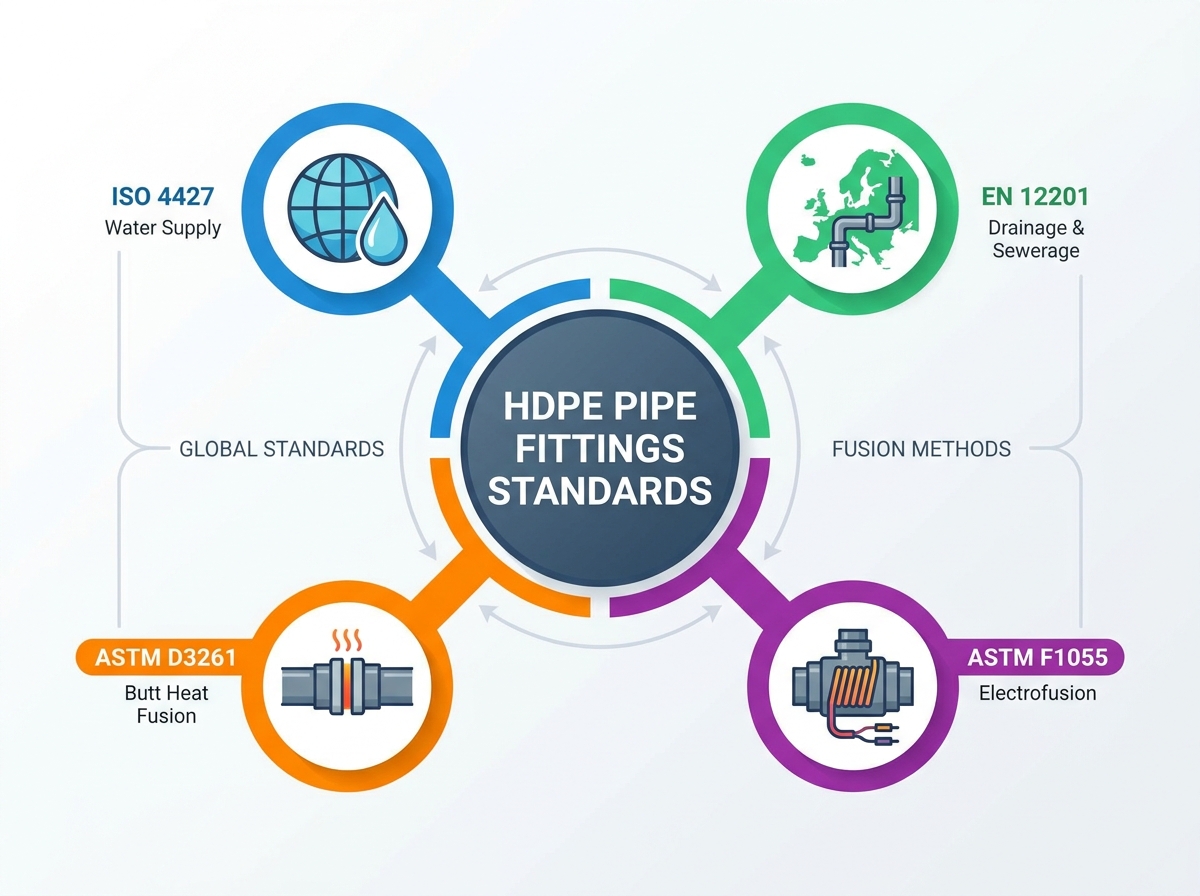
Regional & Application Alignment: ISO 4427 and EN 12201 serve as the primary global and European benchmarks for metric-sized water supply systems, utilizing PE80 and PE100 designations.
Fusion-Specific ASTM Standards: North American specifications divide strictly by joining method; ASTM D3261 governs butt heat fusion fittings, while ASTM F1055 dictates requirements for electrofusion fittings.
Manufacturing Variations: Standards dictate different testing protocols and pressure derating requirements depending on whether a fitting is injection-molded or custom-fabricated.
Material Equivalence Realities: While PE100 (ISO/EN) and PE4710 (ASTM) offer similar high-density performance characteristics, their dimensional sizing systems (Metric vs. IPS/DIPS) are not natively interchangeable without specialized transition fittings.
Risk Mitigation: Verifying third-party certification (e.g., NSF, WRAS, AWWA) against these standards is mandatory to prevent the integration of counterfeit or substandard resin fittings.
Table of Contents
Toggle
Why HDPE Pipe Fittings Standards Matter
Defining Success Criteria for Piping Procurement
Standards dictate the absolute baseline for material purity and performance. They define strict cell classifications for raw resin quality. They also establish tight dimensional tolerances and long-term hydrostatic strength requirements. Compliance directly impacts your operational outcomes. It reduces liability and ensures predictable lifecycle performance. Proper adherence streamlines inspection approvals during final commissioning. Fitting standards exist within a much broader polyethylene ecosystem. They must interlock flawlessly with pipe manufacturing standards. Examples include ASTM F714 for large diameter pipes and D3035 for smaller diameters. They also rely heavily on material classification standards such as ASTM D3350. Ignoring these interconnected requirements guarantees premature system failure. You must evaluate the entire system holistically. Fittings cannot compensate for substandard pipe materials. Likewise, premium pipe will fail if connected with non-compliant fittings.
Field verification remains your primary defense against substandard materials. Inspectors and site foremen must execute specific checks before any fusion takes place:
Verify the cell classification printed on the fitting matches the approved project submittal documents.
Measure the wall thickness at the fusion face using digital calipers before mounting the component in the machine jaws.
Confirm the Standard Dimension Ratio (SDR) rating aligns perfectly with the adjacent pipe to prevent internal flow restriction and stress concentrators.
Check the manufacturing date code to ensure the fitting has not degraded from excessive UV exposure during prolonged yard storage.
Regional vs. Application-Specific Compliance Frameworks
Geographical dominance heavily shapes standard selection. ISO and EN frameworks dominate global, European, and Asian infrastructure markets. ASTM specifications govern North America and the Middle East oil and gas sectors. Some standards focus heavily on the specific end-use application. Specific codes govern pressurized municipal mains versus non-pressure underground drainage. Other standards focus strictly on manufacturing and joining methodologies regardless of application. Understanding this distinction prevents major specification errors. You must match the framework to both the region and the fluid transport application. Mixing regional frameworks without proper transition planning invites disaster. Local regulatory bodies will reject non-conforming materials during site inspections. Always verify local municipal codes before finalizing your procurement list.
Why HDPE Pipe Fittings Standards Matter
ISO 4427: Specifications for Polyethylene Piping Systems
ISO 4427 Part 3 governs polyethylene fittings specifically. It targets the conveyance of water intended for human consumption. This includes both primary municipal mains and residential service pipes. The standard evaluates components across several physical dimensions. It uses the SDR to define wall thickness accurately. It utilizes Nominal Pressure (PN) ratings to establish system capacity. ISO 4427 mandates the use of PE80 or PE100 compound designations. These specific compounds provide long-term resistance to environmental stress cracking. They also deliver excellent resistance to rapid crack propagation. The standard requires manufacturers to use virgin resin materials. Recycled materials are strictly prohibited for pressure-rated potable water applications. This mandate ensures maximum material purity and structural integrity.
EN 12201: European Standards for Water and Wastewater
EN 12201 shares significant technical overlap with ISO 4427. However, it includes distinct additions for broader utility applications across Europe. EN 12201 specifically includes pressurized drainage and sewerage applications. It does not cover non-pressure gravity systems. The standard mandates highly stringent testing protocols for manufacturers. Manufacturers must prove resistance to internal pressure over extended periods. Testing includes rigorous tensile strength evaluations for butt-fused joints. It also requires specific oxidation induction time (OIT) results. OIT testing verifies the thermal stability of the polymer during the extrusion and molding processes. High OIT values indicate strong resistance to oxidative degradation over time. This guarantees the fitting will survive decades underground in aggressive soil conditions.
Table: ISO 4427 vs. EN 12201 Application Parameters
Parameter
ISO 4427
EN 12201
Primary Fluid Application
Potable Water Supply
Water Supply, Pressurized Drainage, Sewerage
Sizing System
Metric
Metric
Material Designations
PE80, PE100
PE80, PE100
Testing Rigor
Standard Global Baseline
Enhanced European Requirements (OIT, Tensile)
Evaluation Dimensions for ISO/EN Compliance
Strict adherence to ISO and EN metric sizing ensures precise alignment. This alignment guarantees zero-leakage fusion in global infrastructure projects. Consistent metric dimensions eliminate guesswork during field installation. Multinational infrastructure portfolios benefit greatly from this standardization. Sourcing ISO-compliant fittings allows for immense scalability across borders. Procurement teams can secure interchangeable components from various global manufacturers. This flexibility prevents supply chain bottlenecks during large-scale municipal deployments. It also simplifies inventory management for international contractors. Standardized metric components reduce the need for custom fabrication. They streamline maintenance and repair operations across diverse geographical locations.
ASTM D3261 Requirements for HDPE Butt Fusion Fittings
Scope and Application of ASTM D3261
ASTM D3261 focuses entirely on polyethylene fittings intended for butt fusion joints. It covers Iron Pipe Size (IPS) and Ductile Iron Pipe Size (DIPS). It also includes Outside Diameter Controlled sizing systems. The standard differentiates clearly between injection-molded and fabricated fittings. It applies specific manufacturing guidelines to each distinct type. Molded fittings undergo different stress evaluations than fabricated components. This ensures both types can withstand continuous internal pressure without yielding. The standard applies to elbows, tees, reducers, and stub ends. It dictates the exact geometry required for successful heater plate contact. Proper geometry ensures an even melt pool during the fusion process.
Material Requirements and Cell Classifications
D3261 relies heavily on the ASTM D3350 cell classification system. This system categorizes resins like PE3608 and PE4710 based on physical properties. These classifications dictate the density, melt index, and flexural modulus of the raw material. Slow crack growth (SCG) resistance is a primary evaluation metric. Rapid crack propagation (RCP) resistance is equally critical for high-pressure systems. High performance in these metrics prevents catastrophic pipeline ruptures. Selecting the correct cell classification ensures the fitting matches the pipe's longevity. You must verify the cell class matches your project specifications exactly. Mismatched cell classes can lead to uneven melting during butt fusion. This creates weak joints prone to premature failure.
Field crews frequently encounter joint failures when manufacturers ignore D3261 tolerances. Common field issues include:
Out-of-roundness exceeding standard limits, causing high-low misalignment in the fusion machine jaws.
Inadequate wall thickness at the fusion face, leading to insufficient melt bead formation during the heating cycle.
Incorrect cell classification resulting in incompatible melt flow rates between the pipe and the fitting.
Improperly machined stub ends that fail to seat correctly against the backing ring, causing flange leaks.
Dimensional Tolerances and Testing Criteria
Flush butt fusion alignment requires extreme manufacturing precision. D3261 details specific manufacturing tolerances for wall thickness. It sets strict limits on out-of-roundness and concentricity. Any deviation compromises the fusion joint's structural integrity. The standard outlines mandatory quality control tests for all manufacturers. Manufacturers must perform sustained pressure testing on random samples. They must also execute elevated temperature sustained pressure testing. These tests confirm the fitting will not fail under extreme operational stress. The elevated temperature test simulates decades of wear in a condensed timeframe. It proves the polymer matrix remains stable under thermal and hydraulic load.
ASTM F1055 Requirements for HDPE Electrofusion Fittings
Understanding ASTM F1055 Requirements
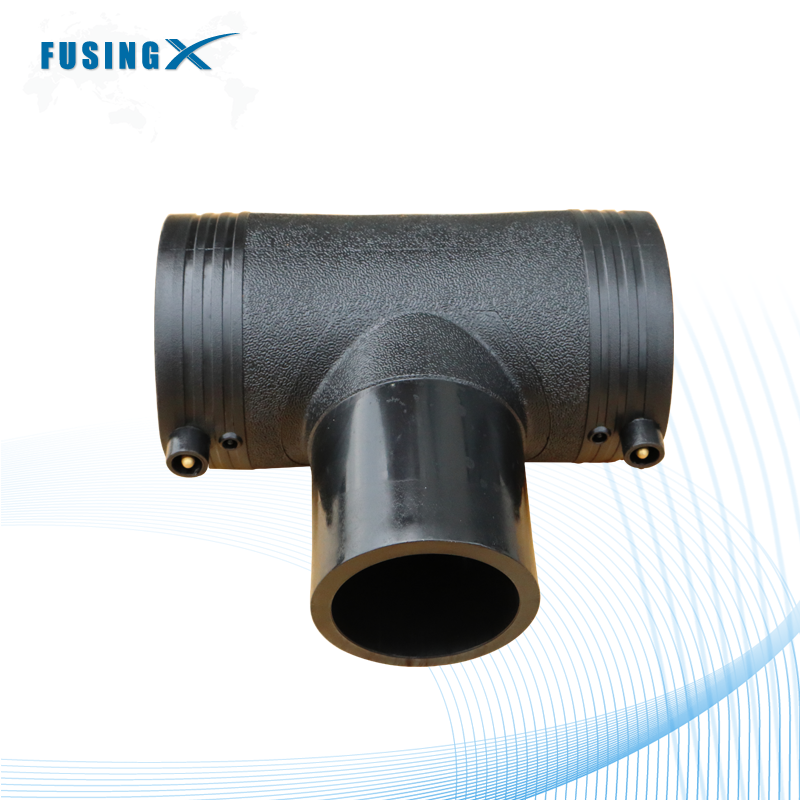
ASTM F1055 covers polyethylene electrofusion fittings comprehensively. This includes electrofusion couplings, tees, and tapping saddles. The standard applies to IPS, DIPS, and metric pipe sizing systems. Electrofusion fittings integrate embedded copper heating elements. F1055 dictates strict requirements for electrical resistance tolerances within these coils. It also regulates the exact fusion energy input required for a secure weld. Precise energy control melts the polymer without degrading its structural properties. The standard defines the required cold zones at the edges of the fitting. These cold zones contain the expanding melt pool during the fusion cycle. They prevent molten polymer from escaping the joint area.
Performance Testing for Electrofusion Joints
F1055 mandates rigorous joint-integrity testing for all certified components. Assemblies must pass minimum hydraulic burst pressure thresholds before approval. Technicians must perform macroscopic examinations of the fusion zone cross-section. This visual inspection identifies voids, contamination, or incomplete bonding. The standard also includes severe crush test requirements. Crush tests verify the ductility of the fused joint. The fitting is squeezed in a vise to a specific percentage of its original diameter. If the fusion zone separates or cracks during this deformation, the component fails the certification. They prove the structural integrity of the entire electrofusion assembly under heavy soil loads. The fitting must deform significantly without the fusion interface cracking or separating. This proves the joint is stronger than the surrounding pipe material.
Conceptual Trade-offs: Butt Fusion (D3261) vs. Electrofusion (F1055)
Engineers must evaluate operational scenarios when choosing between these methods. ASTM F1055 fittings excel in tight trench conditions where machines cannot fit. They are absolutely necessary for repairs and joining dissimilar pipe thicknesses. ASTM D3261 butt fusion offers superior efficiency for long, unobstructed pipeline runs. Project managers must evaluate lifecycle efficiency and operational constraints carefully. Consider heavy equipment rental constraints and specific operator training requirements. Electrofusion requires meticulous pipe scraping and chemical cleaning. Butt fusion requires heavy hydraulic machinery and facing tools. Your site conditions dictate the correct standard application.
How to Choose the Right HDPE Fitting Standard
Matching Standards to Project Requirements
Selecting the governing standard requires a strict decision framework. You must base this on project location and fluid type. Potable water, wastewater, and industrial chemicals all demand different specifications. Operating pressure dictates the required wall thickness and material grade. Evaluate the primary fitting families for your specific application. Align molded butt fusion, fabricated, or electrofusion components with the correct governing standard. Address requirements for secondary certifications immediately during the design phase. AWWA C906 and NSF/ANSI 61 for potable water run parallel to manufacturing standards. A fitting may meet ASTM D3261 but fail NSF 61 due to resin additives. You must verify both structural and health-safety certifications simultaneously.
Dimensional Compatibility: Metric vs. IPS/DIPS
Pipe sizing is a critical evaluation dimension for any project. It is physically impossible to directly fuse an ISO metric pipe to an ASTM IPS fitting. You must use a dedicated transition adapter to bridge the gap. Ignoring this reality leads to immediate joint failure and project delays. Retrofit projects often require cross-standard integration when replacing old infrastructure. Engineering workarounds exist, but they require careful planning and execution. Always specify mechanical transition fittings or custom-machined flange adapters when crossing dimensional systems. Never attempt to shave or stretch a pipe to force a fit. This destroys the structural integrity of the polyethylene and guarantees a leak.
Executing a cross-standard transition in the field requires strict adherence to mechanical principles:
Identify the exact outside diameter of both the metric and IPS pipes using a Pi tape.
Select a mechanical transition fitting rated for the maximum system operating pressure.
Install internal stainless steel stiffeners inside both pipe ends to prevent deformation under mechanical compression.
Torque the flange bolts to the manufacturer's specified limit using a calibrated torque wrench in a star pattern.
Material Grade Alignment: PE100 vs. PE4710
The European PE100 designation mirrors the North American PE4710 designation in many ways. Both represent high-performance, bimodal polyethylene resins. They offer exceptional resistance to slow crack growth and point loading. However, engineers must carefully review their respective design factors. PE100 typically utilizes a 0.50 design factor for water applications. PE4710 utilizes a 0.63 design factor under AWWA guidelines. You must account for these differences when calculating maximum allowable pressure ratings. A PE4710 pipe will have a different pressure rating than a PE100 pipe of the same thickness. Always run hydraulic calculations based on the specific resin designation.
Table: Comparison of Primary Polyethylene Fitting Specifications
Standard
Primary Region
Joining Method
Sizing System
Key Application
ISO 4427
Global / Europe / Asia
Multiple (Butt, Electrofusion)
Metric
Potable Water Supply
EN 12201
Europe
Multiple (Butt, Electrofusion)
Metric
Water and Pressurized Sewer
ASTM D3261
North America / Middle East
Butt Heat Fusion
IPS / DIPS / OD
General Fluid Transport
ASTM F1055
North America / Middle East
Electrofusion
IPS / DIPS / Metric
Repairs and Tight Trenches
Common HDPE Fitting Standards Mistakes and How to Avoid Them
Mixing Standards and Dimensional Mismatches
Procurement errors frequently lead to severe dimensional mismatches on site. Delivering metric fittings for an IPS pipeline causes immediate project delays. Field-modification attempts inevitably lead to catastrophic joint failures. Contractors cannot force incompatible components together safely. You must mitigate this risk during the initial bidding phase. Mandate strict submittal reviews for every single component. Utilize standardized procurement templates that lock in the exact standard. Specify requirements clearly, such as "Fittings shall conform to ASTM D3261, IPS sizing." Reject any submittals that offer equivalent standards without thorough engineering review. Train your receiving personnel to verify markings on the fittings upon delivery. Catching a mismatch at the loading dock saves thousands in rework costs.
Fabricated vs. Molded Pressure Derating Oversights
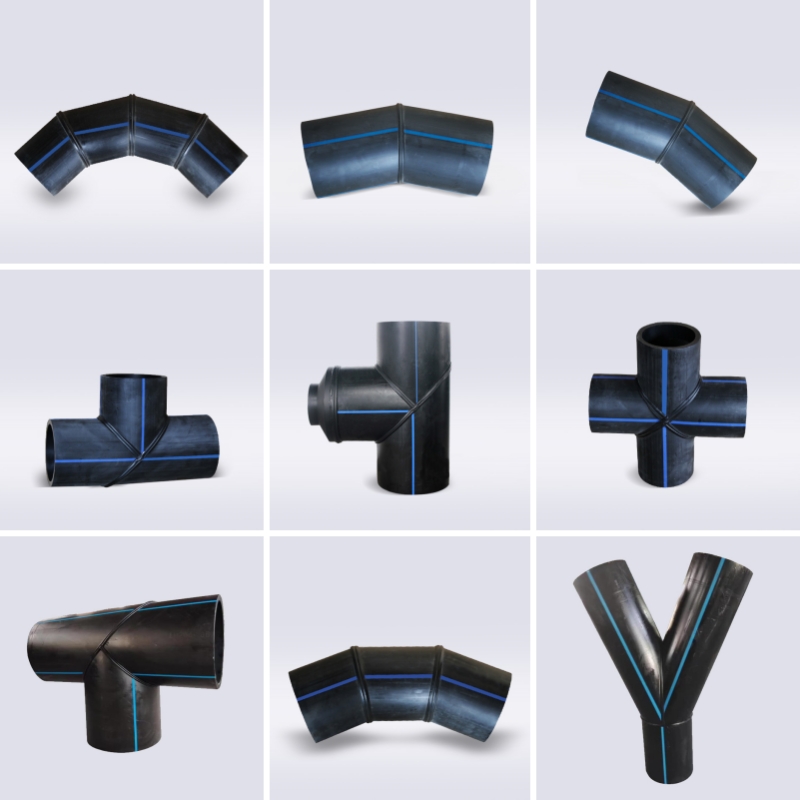
Engineers often assume fabricated fittings share the exact pressure rating of the corresponding pipe. This is a highly dangerous oversight. Custom-fabricated components like mitered elbows or fabricated tees require pressure derating. The manufacturing process introduces stress points not found in injection-molded fittings. Cutting and fusing pipe segments alters the structural geometry of the system. You must apply the necessary derating factors to prevent blowouts. Strict adherence to ASTM and ISO derating guidelines is mandatory for fabricated parts. For example, a 3-segment mitered elbow might require a 0.75 derating factor. If the pipe handles 100 psi, the fitting only handles 75 psi safely. Always verify the manufacturer's derated pressure class before installation. If the derated fitting cannot handle the system pressure, you must increase the wall thickness. Alternatively, you must source a fully molded fitting for that specific junction.
Conclusion
Audit your current procurement templates to lock in exact standard and sizing system alignments before issuing purchase orders.
Mandate third-party certification documents for all incoming fitting shipments prior to site acceptance and installation.
Implement fusion operator training specific to the chosen ASTM or ISO standard requirements to eliminate field errors.
Apply correct pressure derating factors to all fabricated components during the initial hydraulic design phase.
Established in 2005, Fusing X integrates the R&D, manufacturing, and sales of HDPE pipe fittings, supporting applications that require butt fusion, electrofusion, threaded, drainage, and customized fitting solutions. With a 20,000 m² production facility, around 300 employees, and exports to more than 20 countries, Fusing X combines manufacturing capacity with material control and production expertise to support reliable polyethylene piping projects across different markets.
FAQ
Q: What is the main difference between ISO 4427 and EN 12201?
A: ISO 4427 primarily focuses on polyethylene piping systems for water supply. EN 12201 covers water supply but also explicitly includes pressurized drainage and sewerage applications. Both utilize metric sizing and PE80/PE100 material designations, but EN 12201 features slightly more rigorous testing protocols for European compliance.
Q: Can I fuse an ASTM D3261 fitting to an ISO 4427 pipe?
A: No. ASTM D3261 fittings typically use IPS or DIPS sizing, while ISO 4427 pipes use metric sizing. Direct fusion is impossible due to the dimensional mismatch. You must use a specialized mechanical transition adapter or a custom-machined flange to connect them safely.
Q: Why do fabricated fittings require pressure derating?
A: Fabricated fittings, such as mitered elbows, are constructed by cutting and fusing pipe segments together. This process alters the structural geometry and introduces stress concentrations at the welds. Derating reduces the maximum allowable operating pressure to ensure the fitting does not fail under long-term hydraulic stress.
Q: What does ASTM F1055 regulate?
A: ASTM F1055 is the standard specification for polyethylene electrofusion fittings. It dictates the requirements for electrical resistance tolerances, fusion energy input, and rigorous joint-integrity testing, including hydraulic burst pressure and crush tests, ensuring secure connections across IPS, DIPS, and metric sizes.
Q: Are PE100 and PE4710 materials interchangeable?
A: While both are high-performance, bimodal resins with excellent crack resistance, they are not strictly interchangeable without engineering review. PE100 (European) and PE4710 (North American) use different design factors (0.50 vs. 0.63) for calculating pressure ratings. Always verify the specific standard requirements of your project before substituting materials.

 English
  العربية
  Français
  Русский
  Español
  Português
  Deutsch
  italiano
  日本語
日本語  한국어
한국어  Nederlands
  Tiếng Việt
  ไทย
ไทย  Polski
  Türkçe
  አማርኛ
አማርኛ  ພາສາລາວ
  ភាសាខ្មែរ
  Bahasa Melayu
  ဗမာစာ
ဗမာစာ  தமிழ்
தமிழ்  Filipino
  Bahasa Indonesia
  magyar
  Română
  Čeština
  Монгол
  қазақ
қазақ  Српски
  हिन्दी
  فارسی
فارسی  Kiswahili
  Slovenčina
  Slovenščina
  Norsk
Norsk  Svenska
  українська
  Ελληνικά
  Suomi
Suomi  Հայերեն
  עברית
עברית  Latine
  Dansk
Dansk  اردو
اردو  Shqip
Shqip  বাংলা
বাংলা  Hrvatski
  Afrikaans
  Gaeilge
  Eesti keel
  Māori
Māori