High-Density Polyethylene (HDPE) delivers exceptional durability and flexibility for fluid systems. However, its unique molecular structure makes joining it to dissimilar and rigid materials a frequent point of failure in mixed-material infrastructure. Knowing exactly how to connect HDPE pipe to other materials dictates the overall system integrity. Utilizing improper connection methods—such as attempting to use chemical solvents or mismatched thermal fusion—results in catastrophic leaks, compromised pressure ratings, and severe code violations. This guide provides a technical evaluation of the methods required to join HDPE to steel, PVC, PPR, and mechanical valves. You will learn the specific fittings, mechanical adapters, and implementation frameworks necessary to build leak-proof, scalable piping networks.
Key Takeaways
Chemical Adhesion is Impossible: HDPE cannot be joined using PVC cement, Tangit, epoxies, or glues; all connections to dissimilar materials must be mechanical or utilize factory-machined transition fittings.
Internal Stiffeners are Mandatory: When connecting HDPE to mechanical joints (like ductile iron or steel), stainless steel internal stiffeners must be inserted into the HDPE pipe to prevent the plastic from collapsing under compression.
Flanging is the Industrial Standard: For high-pressure, large-diameter connections to valves, pumps, and steel pipes, HDPE flange adapters with metal backing rings provide the most reliable, non-destructive joint.
Thermal Incompatibility: HDPE cannot be directly heat-welded to PPR or PVC due to differing polymer structures and melting points; threaded or flanged mechanical transitions are required.
Table of Contents
Toggle
Key Rules for Connecting HDPE to Different Materials
Problem Framing (Success Criteria)
Establishing a reliable connection across different piping materials demands strict mechanical compliance. You must maintain the system's overall pressure rating, defined by the Standard Dimension Ratio (SDR). The joint must also accommodate the high coefficient of thermal expansion inherent to polyethylene. A successful transition joint absorbs longitudinal stress without shearing or compromising the seal. Engineers select fittings that bridge the gap between flexible plastics and rigid metals without creating a weak link in the fluid network. When a pipeline transitions from a buried plastic main to an exposed steel manifold, the connection point experiences massive shear forces. If the transition fitting cannot handle the pressure class or the physical movement, the system fails.
The Molecular Barrier & The Solvent Myth
Field technicians often attempt to glue polyethylene using standard plumbing adhesives. This approach fails entirely. Polyethylene possesses an extremely low surface energy, typically measuring around 31 dynes/cm. It remains chemically inert and resists bonding with external agents. Traditional solvents like Tangit or standard PVC cement rely on chemically melting the pipe surface to form a weld. Because solvents cannot dissolve the polyethylene molecular chain, the glue simply dries on the surface and flakes off under minimal pressure. You must abandon chemical adhesion completely when working with this material. Any contractor applying primer and glue to a polyethylene pipe demonstrates a fundamental misunderstanding of polymer science.
Expansion and Contraction Dynamics
Polyethylene expands and contracts significantly more than steel, iron, or PVC when exposed to temperature fluctuations. A long run of plastic pipe grows several inches during peak summer heat and shrinks during winter freezes. Rigid connections bear the brunt of this movement. If you anchor a flexible pipe directly to a rigid steel line without accounting for thermal movement, the resulting shear forces fracture the transition point. Mechanical joints must allow for slight deflection. Alternatively, the system requires engineered expansion loops to mitigate direct stress on the fittings.
Thermal Expansion Rates of Common Piping Materials
Material
Expansion Rate (in/100ft/10°F)
Flexibility Rating
High-Density Polyethylene
0.80 - 1.20
High
Polyvinyl Chloride (PVC)
0.30 - 0.40
Low
Carbon Steel
0.07 - 0.08
Rigid
Ductile Iron
0.07 - 0.08
Rigid
Best Connection Methods for HDPE Pipe
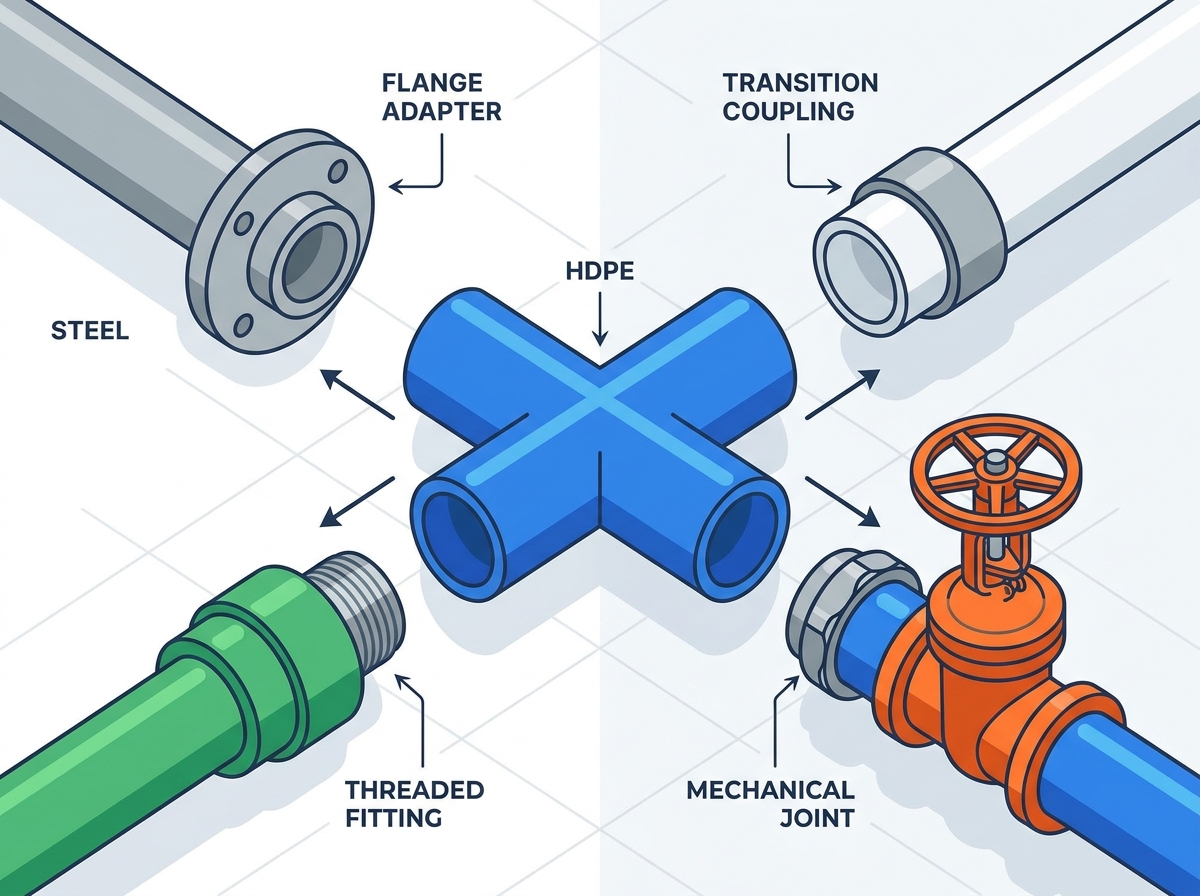
Flange Connections
Flanging remains the most robust method for industrial transitions. This approach utilizes a flange adapter, commonly called a stub end. You fuse the stub end directly to the main pipe using standard thermal fusion. A slip-on metal backing ring sits behind the plastic face. This metal ring bolts directly to standard ANSI or DIN flanges on the opposing material. The plastic face acts as its own gasket against the mating surface, though elastomeric gaskets are often added for high-pressure applications. Flanges provide a secure, easily removable joint for maintenance. They dominate water treatment plants, mining operations, and heavy industrial facilities where large-diameter pipes intersect with heavy machinery. Backing rings come in convoluted ductile iron for standard applications or flat stainless steel for highly corrosive environments.
Mechanical Compression Fittings
For small to medium diameter pipes, mechanical compression fittings offer rapid, tool-free installation. These fittings rely on a combination of internal components to secure the joint. An O-ring provides the watertight seal against the pipe wall. A specialized grip ring, often made of polyacetal or stainless steel teeth, bites into the outer surface of the plastic to prevent pull-out. As you tighten the outer compression nut, it forces the internal components together, locking the pipe in place. These fittings work exceptionally well for underground repairs and municipal service lines. Field crews favor them because they require no electricity or heavy fusion equipment in wet, muddy trenches.
Transition Fittings
Factory-assembled transition fittings provide a permanent, zero-leak solution. Manufacturers machine these components in a controlled environment, often using an overmolding process. One end features a standard polyethylene spigot ready for butt fusion or electrofusion. The opposite end features a threaded, grooved, or welded metal or PVC connection. Because the transition between the plastic and the dissimilar material happens at the factory under high pressure and heat, the risk of field failure drops near zero. These fittings undergo rigorous pull-out resistance testing before shipping. They serve critical infrastructure where future access remains limited, such as under roadways or encased in concrete vaults.
Electrofusion and Butt Fusion (The Baseline)
Thermal fusion stands as the absolute standard for joining polyethylene to itself. Butt fusion melts the ends of two pipes and presses them together to form a monolithic joint. Electrofusion uses a fitting with embedded heating coils to melt the pipe exterior and fitting interior simultaneously. This requires scraping the pipe to remove the oxidation layer before fusion. While these methods create joints stronger than the pipe itself, they cannot cross over to dissimilar materials. You cannot fuse polyethylene to steel, PVC, or PPR. Fusion techniques only serve to attach the necessary transition adapters to the main line.
How to Connect HDPE Pipe to Steel or Ductile Iron
Evaluation Dimensions
Connecting flexible plastic to heavy metal demands evaluating the specific application environment. High-pressure industrial applications require rigid, bolted connections that withstand severe vibration and water hammer. Municipal water lines often prioritize speed of installation and soil settlement flexibility. Your choice between flanging and mechanical jointing depends heavily on pipe diameter, operating pressure, and whether the joint sits above ground or buried in a trench.
Flange Adapters and Backing Rings
Fusing a flange adapter to polyethylene requires precision. Follow these exact steps for a secure steel-to-plastic connection:
Slide the metal backing ring onto the pipe before beginning the fusion process.
Clean the pipe ends and the stub end with 90% isopropyl alcohol.
Fuse the stub end to the pipe using a calibrated butt fusion machine.
Allow the joint to cool completely under pressure according to manufacturer guidelines.
Align the bolt holes of the backing ring with the mating steel flange, checking gap tolerances.
Insert a compatible EPDM or Nitrile gasket between the plastic face and the steel face.
Apply bolts, washers, and nuts, hand-tightening them initially.
Torque the bolts to specification using a calibrated torque wrench in a star pattern.
Torque specifications dictate the success of the joint. You must tighten the bolts using a cross-tightening sequence. This ensures even pressure distribution across the plastic face. Uneven torque causes micro-fractures in the stub end and leads to immediate leaks under pressure.
Standard Torque Guidelines for Polyethylene Flanges
Nominal Pipe Size (Inches)
Bolt Diameter (Inches)
Recommended Torque (ft-lbs)
2" - 4"
5/8"
25 - 40
6" - 8"
3/4"
60 - 90
10" - 12"
7/8"
90 - 120
Mechanical Joint (MJ) Adapters and Internal Stiffeners
When connecting to ductile iron using a mechanical joint under AWWA C906 standards, you face a unique physical challenge. The heavy iron gland compresses a rubber gasket against the outside of the plastic pipe. Over time, the constant compression causes the plastic to creep or collapse inward. You must insert a stainless steel internal stiffener into the Inside Diameter (ID) of the pipe before assembling the joint. The stiffener provides rigid internal support, allowing the mechanical gland to compress the gasket without crushing the pipe wall. Skipping this step guarantees a future blowout. The stiffener must match the exact SDR of the pipe to fit correctly.
Threaded Transition Fittings
For smaller diameter applications under four inches, threaded transitions offer a practical solution. These factory-machined fittings feature a steel threaded end and a plastic spigot end. You fuse the spigot to your main line and thread the steel end into the existing metal infrastructure. Always apply heavy-duty PTFE tape or an approved thread sealant to the metal threads. Pay attention to NPT versus BSPT thread standards to ensure compatibility. Avoid over-tightening, as excessive torque damages the internal factory seal of the transition fitting. Use two wrenches: one to hold the transition fitting body steady, and one to turn the mating metal pipe.
Implementation Risks
Joining metal and plastic introduces specific risks. Galvanic corrosion threatens the steel side if moisture and dissimilar metals interact. Use coated backing rings or stainless steel hardware in corrosive environments. Thermal expansion presents another major risk. As the plastic expands and pushes against the rigid steel anchor point, shearing forces multiply. Install the transition joint in a location that allows for slight movement, or utilize engineered pipe guides to direct the expansion away from the connection.
How to Connect HDPE Pipe to PVC
Problem Framing
Joining flexible, non-glueable polyethylene to rigid, solvent-welded PVC presents a common challenge in underground irrigation and municipal water systems. You cannot rely on chemical bonds. The connection bridges two entirely different manufacturing standards and material properties. The solution requires mechanical gripping mechanisms that account for slight variations in outer dimensions while maintaining a watertight seal under fluctuating soil pressures.
Mechanical Couplings (Dresser-style Couplings)
Bolted mechanical couplings, often referred to as Dresser-style couplings, provide an excellent method for joining these dissimilar plastics. These couplings feature a central sleeve and two bolted end rings that compress rubber gaskets against the pipe walls. When using these couplings, you must verify outside diameter (OD) compatibility. PVC often follows Iron Pipe Size (IPS) standards, while some polyethylene lines follow Copper Tube Size (CTS) or metric sizing. Ensure the coupling you select accommodates the specific OD of both pipes. If the dimensions differ significantly, you must use a stepped transition coupling. Always torque the follower glands to the manufacturer's exact specifications to prevent gasket extrusion.
Flanged Connections for PVC-to-HDPE
For secure, high-pressure, and removable joints, flanging remains highly effective. You install a solvent-welded Class 150 PVC flange on the rigid side of the system. On the flexible side, you fuse a standard stub end and backing ring. Bolt the two flanges together with a suitable elastomeric gasket in between. This method eliminates the risk of pull-out forces separating the pipes and provides a clean transition point inside pump houses or valve vaults.
Threaded Connections
Threaded connections work well for small-diameter irrigation and residential water lines. The most reliable approach utilizes a male threaded Schedule 80 PVC fitting threading into a female threaded transition fitting on the polyethylene side. The transition fitting should feature a reinforced metal ring around the female threads to prevent expansion. Apply heavy-duty PTFE tape to the PVC threads. Thread sealants must be chemically compatible with both plastics to avoid degrading the material.
Implementation Risks
Over-tightening remains the primary cause of failure in threaded plastic joints. Forcing a rigid PVC male thread too deeply into a softer plastic female thread deforms the connection. Conversely, threading a metal male fitting into a PVC female fitting often cracks the rigid PVC. Always hand-tighten the joint first, then apply no more than one to two full turns with a strap wrench. Never use serrated pipe wrenches on plastic fittings, as the teeth gouge the material and create stress risers.
How to Connect HDPE Pipe to PPR
Addressing the Welding Machine Misconception
A persistent misconception in the field is that technicians can use a standard PPR socket welding machine to heat-fuse polyethylene and PPR together. This is fundamentally incorrect. While both materials are thermoplastics, they possess vastly different polymer structures, melting points, and melt flow indexes. PPR melts around 260°C, while polyethylene melts between 200°C and 220°C. Attempting to melt them together creates a superficial bond that shatters under minimal pressure. You cannot weld these two materials directly. All connections between them must be mechanical.
Threaded Mechanical Transitions
The standard approach for joining these systems relies on threaded transition fittings. On the PPR side, you socket-weld a standard PPR-to-metal threaded adapter, typically featuring a brass insert. On the polyethylene side, you fuse a corresponding transition fitting. You then thread the two metal inserts together using PTFE tape. This method isolates the two plastics, relying entirely on the mechanical strength of the brass or stainless steel threads to maintain the system's integrity.
Flange Connections for PPR Systems
Commercial plumbing systems often require larger diameter transitions where threaded fittings become impractical. In these scenarios, flanged joints provide the necessary scale. You weld a PPR flange adapter to the hot water side and a polyethylene flange adapter to the cold water side. Bolting them together with a high-quality EPDM gasket ensures a leak-proof transition that handles the volumetric flow demands of commercial boiler rooms and chiller plants.
Evaluation Dimensions (Temperature Ratings)
Temperature gradients dictate the success of this transition. PPR is engineered specifically for high-temperature hot water applications. Standard polyethylene degrades rapidly when exposed to sustained high temperatures. Unless you are using Polyethylene of Raised Temperature (PE-RT), the connection point must account for thermal degradation. Ensure the transition occurs at a point in the system where water temperatures fall within the safe operating limits of the polyethylene pipe.
How to Connect HDPE Pipe to Valves and Pumps
Problem Framing
Connecting dynamic, vibrating mechanical equipment to a flexible piping system introduces severe mechanical stress. Pumps generate high-frequency vibrations, and large valves create sudden pressure spikes during operation. The connection must isolate the plastic pipe from these destructive forces without causing flange distortion or joint fatigue. Improper valve connections lead to sheared stub ends and catastrophic flooding in mechanical rooms.
Flange Adapters for Industrial Valves
Flange adapters serve as the industry standard for connecting flexible piping to butterfly valves, gate valves, and centrifugal pumps. However, the thick wall of polyethylene pipe often creates a clearance issue. When a wafer or lug style butterfly valve opens, the internal disc swings outward. If the pipe wall is too thick, the disc strikes the plastic, preventing the valve from opening fully and damaging the disc edge. To mitigate this, you must install a butterfly valve spacer or use a specially beveled flange adapter that provides the necessary internal clearance for the valve mechanism.
Installing Double-Threaded Water Valves
Light commercial and residential applications frequently utilize double-threaded brass or stainless steel valves. To connect these to a flexible plastic line, use compression-to-thread adapters. Follow these practical steps:
Cut the pipe square and deburr the edges to ensure a smooth insertion.
Slide the compression nut and grip ring onto the pipe.
Push the pipe firmly into the compression fitting until it seats against the internal stop.
Tighten the compression nut to the manufacturer's specified torque using a strap wrench.
Apply PTFE tape to the threaded end of the adapter.
Carefully thread the valve onto the adapter, ensuring you do not cross-thread the metal onto the plastic.
Implementation Risks/Mitigation
Valve anchoring represents the most severe implementation risk. Polyethylene pipe must never bear the weight or operational torque of heavy metal valves. When a technician turns a large handwheel on an unanchored valve, the torque transfers directly to the plastic flange, leading to stress fractures. You must provide independent concrete thrust blocks or steel supports for all heavy mechanical equipment. The piping should only carry the fluid, never the structural load of the system components.
How to Choose the Right HDPE Pipe Connection Method
Features-to-Outcomes
Selecting the correct connection method requires aligning the physical features of the fitting with your desired operational outcomes. If your system requires frequent maintenance, component replacement, or removability, choose flanged connections. If you are conducting rapid underground repairs in a wet trench where fusion equipment cannot operate, choose mechanical compression fittings with internal stiffeners. If you require an absolute zero-leak transition in an inaccessible location or active seismic zone, choose factory-machined transition fittings.
Scalability and Tooling Costs
Project budgets and equipment availability heavily influence the connection strategy. Flange adapters and factory transition fittings require expensive capital equipment, including calibrated butt fusion machines, electrofusion processors, and on-site generators. They also require trained, certified operators. Mechanical compression fittings eliminate tooling costs entirely. They require only standard hand tools for installation. However, the per-unit cost of large-diameter mechanical fittings far exceeds the cost of a simple plastic stub end. Engineers balance upfront tooling costs against long-term material expenses.
Compliance and SDR Compatibility
Every connection must comply with the system's required pressure rating. Mechanical fittings are manufactured to accommodate specific Standard Dimension Ratios (SDR). A fitting designed for SDR 11 pipe (rated for 160 psi) will not properly seal on SDR 17 pipe (rated for 100 psi) due to the difference in wall thickness. Always verify that the grip rings, stiffeners, and compression nuts match the exact SDR and operating pressure requirements of your specific piping network.
Comparison of Connection Methods
Connection Method
Best Use Case
Required Tooling
Primary Advantage
Flange Adapters
Industrial valves, steel pipe transitions
Fusion machine, torque wrench
High pressure rating, easily removable
Mechanical Compression
Underground repairs, municipal water
Standard hand tools
Fast installation, no power required
Factory Transition Fittings
Critical infrastructure, inaccessible areas
Fusion machine
Zero-leak permanent seal
Threaded Transitions
Small diameter plumbing, residential
Fusion machine, pipe wrenches
Cost-effective for small lines
Conclusion
Measure the exact Outside Diameter (OD) and verify the Standard Dimension Ratio (SDR) of your existing pipe before ordering transition fittings.
Procure stainless steel internal stiffeners for any mechanical compression joints to prevent pipe wall collapse under heavy gland pressure.
Install independent concrete or steel supports for all heavy valves and pumps to isolate mechanical stress from the plastic flanges.
Calibrate your torque wrenches and apply a strict star-pattern tightening sequence for all flanged connections to ensure even gasket compression.
Founded in 2005, Fusing X integrates the R&D, manufacturing, and sales of HDPE fittings, supported by a 20,000 m² production facility and a team of approximately 300 employees serving customers across more than 20 countries. Its product capabilities cover butt fusion fittings, electrofusion fittings, PE threaded fittings, PPR piping systems, and customized fittings, providing diversified connection options for municipal, industrial, and infrastructure piping projects.
FAQ
Q: Can you glue HDPE pipe to PVC using Tangit or PVC cement?
A: No. Polyethylene has a very low surface energy and chemically resists all solvents, epoxies, and glues. Standard PVC cement will not melt the plastic to form a bond. You must connect it to PVC using mechanical couplings, flanged joints, or threaded transition fittings.
Q: Do I need an internal stiffener for HDPE pipe?
A: Yes. Whenever you connect polyethylene using a mechanical compression joint, such as an MJ adapter tying into ductile iron or steel, you must insert a stainless steel internal stiffener into the Inside Diameter. This prevents the pipe wall from creeping or collapsing under the pressure of the mechanical gland.
Q: Can I use a PPR welding machine to join HDPE and PPR?
A: No. These are entirely different polymers with distinct melting points and melt flow indexes. Attempting to heat-fuse them together with a socket welder results in a weak, non-compliant joint that fails under pressure. You must use threaded or flanged mechanical transitions.
Q: What is the best way to connect HDPE pipe to steel pipe?
A: For high-pressure or large-diameter applications, fusing a flange adapter to the plastic pipe and bolting it to a corresponding steel flange with a metal backing ring is the most reliable method. This provides a secure, removable joint that handles high operational stress.
Q: How do you connect HDPE pipe to a double-threaded valve?
A: Use a factory transition fitting featuring a brass or stainless steel threaded insert, or utilize a mechanical compression fitting that terminates in matching threads. Always apply PTFE tape to the threads and avoid over-tightening to prevent cracking the plastic components.
Q: Why do HDPE flange connections leak?
A: Leaks typically occur due to uneven bolt torquing during installation, failure to use a proper metal backing ring, or omitting a valve spacer when the thick plastic pipe wall interferes with the operation of a butterfly valve disc.

 English
  العربية
  Français
  Русский
  Español
  Português
  Deutsch
  italiano
  日本語
日本語  한국어
한국어  Nederlands
  Tiếng Việt
  ไทย
ไทย  Polski
  Türkçe
  አማርኛ
አማርኛ  ພາສາລາວ
  ភាសាខ្មែរ
  Bahasa Melayu
  ဗမာစာ
ဗမာစာ  தமிழ்
தமிழ்  Filipino
  Bahasa Indonesia
  magyar
  Română
  Čeština
  Монгол
  қазақ
қазақ  Српски
  हिन्दी
  فارسی
فارسی  Kiswahili
  Slovenčina
  Slovenščina
  Norsk
Norsk  Svenska
  українська
  Ελληνικά
  Suomi
Suomi  Հայերեն
  עברית
עברית  Latine
  Dansk
Dansk  اردو
اردو  Shqip
Shqip  বাংলা
বাংলা  Hrvatski
  Afrikaans
  Gaeilge
  Eesti keel
  Māori
Māori