Selecting components for High-Density Polyethylene (HDPE) piping systems dictates network reliability. Fittings represent vulnerable points for pressure loss, structural failure, or reduced service life. Choosing an incorrect fitting type introduces severe engineering challenges. System over-pressurization, budget overruns from unnecessary custom tooling, and project delays from incompatible sizing routinely plague poorly planned installations. You must objectively evaluate molded vs fabricated HDPE fittings based on strict technical criteria. Assessing pressure ratings, standard dimension ratio (SDR) requirements, diameter limits, and material yield limits ensures system integrity. Proper selection aligns physical performance with project constraints, keeping infrastructure safe and compliant. We see contractors struggle when they assume all fittings behave identically under stress. By understanding the manufacturing differences, you can prevent catastrophic blowouts and streamline your procurement schedule.
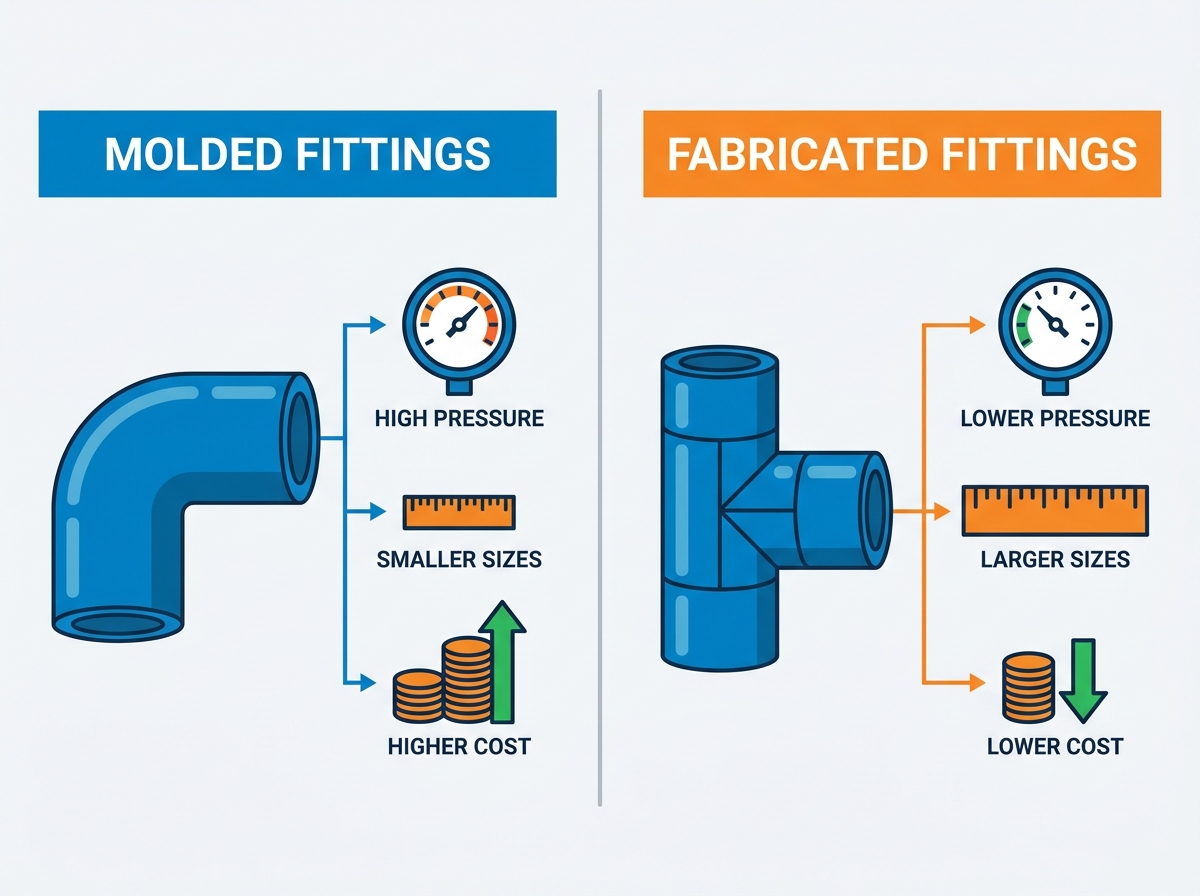
Pressure Integrity: Molded fittings generally maintain the full pressure rating of the corresponding HDPE pipe, whereas fabricated fittings require specific pressure derating calculations based on geometry and industry standards.
Size and Scalability: Molded fittings are typically restricted to standard sizes (often starting at 2 inches) and smaller diameters due to high tooling costs, while fabricated fittings offer virtually infinite scalability for large-diameter and custom-angle applications.
Cost Dynamics: Injection molded fittings offer lower per-unit costs for high-volume, standard applications, but fabricated fittings eliminate the exorbitant upfront costs of custom molds for specialized or low-volume runs.
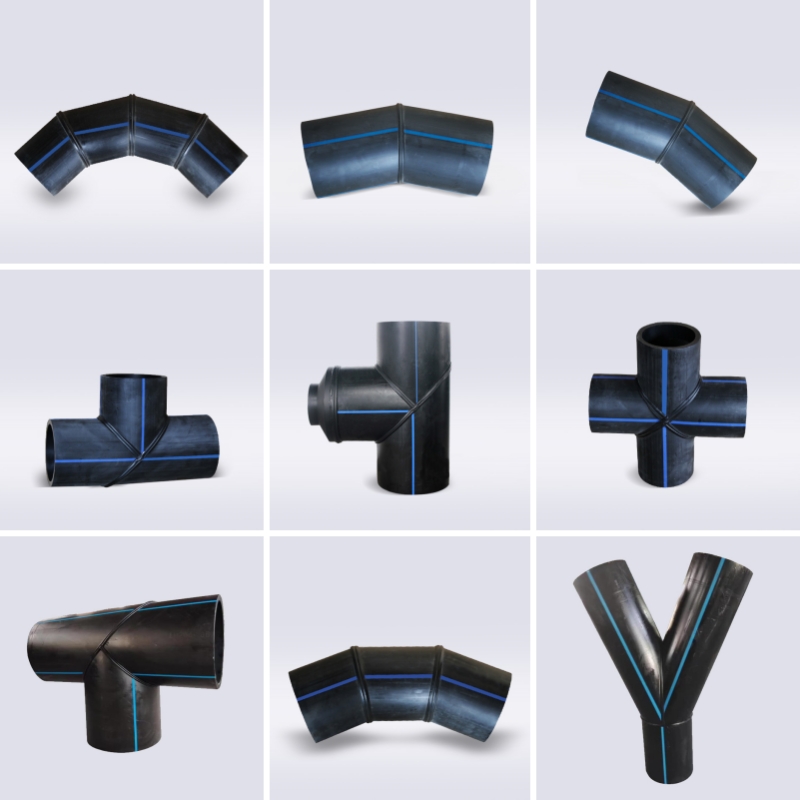
Visual Identification: Fabricated fittings are easily identified by visible fusion seams and often carry an "F" designation in part numbers, whereas molded fittings feature a seamless, uniform construction.
Table of Contents
Toggle
How Molded and Fabricated HDPE Fittings Are Made
Injection Molded HDPE Fittings
The injection molding process begins by feeding raw high-density polyethylene pellets into a heated barrel. A rotating screw melts the polymer into a highly viscous liquid and forces it forward. Industrial machines then inject this molten plastic into precision-engineered steel mold cavities under extreme clamping pressure. The mold contains internal cooling channels that circulate water, rapidly dropping the temperature of the plastic so it solidifies into the desired shape. Once cooled, the machine opens the mold and ejects the finished component.
This manufacturing method produces parts featuring completely seamless construction and highly uniform wall thickness. The absence of joints or fusion seams provides exceptional long-term performance and high consistency across massive production batches. Engineers rely on molded components when structural uniformity remains non-negotiable. The smooth internal radii of molded fittings also optimize fluid dynamics, reducing friction and preventing material buildup inside the pipeline.
However, injection molding carries a significant limitation regarding capital expenditure. Engineering and machining the heavy steel molds requires massive upfront investment. This financial barrier restricts manufacturers to producing only standard sizes and common geometries. You will easily find molded 45-degree elbows, 90-degree elbows, and standard equal tees. Custom angles or highly specialized configurations rarely exist in molded formats because the low market demand cannot justify the heavy mold creation costs.
Fabricated HDPE Fittings
Fabrication takes a completely different mechanical approach. Instead of melting raw resin, fabricators start with pre-manufactured, standard HDPE pipe. Technicians cut these straight pipes into specific segments using precise miter saws. They then join these angled segments together using thermal butt fusion. The fusion process involves facing the pipe ends to ensure they are perfectly flat, heating them against a PTFE-coated heater plate until the plastic reaches a molten state, removing the plate, and pressing the ends together under controlled hydraulic pressure.
The resulting joint cools into a permanent, monolithic bond characterized by a visible double roll-back bead on both the inside and outside of the pipe. This method offers unparalleled geometric flexibility. Fabricators can create complex wyes, custom sweeps, and non-standard angles without requiring any new tooling. If a pipeline route requires an unusual 14-degree bend to avoid an existing underground utility line, a fabricator simply adjusts the miter saw angle. This adaptability makes fabrication indispensable for complex infrastructure routing where standard off-the-shelf parts fail to align.
Machined Fittings (The Third Alternative)
Machined fittings serve as a specialized third alternative, bridging the gap between molding and fabrication. Manufacturers create these components by carving them directly from a solid block or billet of extruded HDPE using CNC routers and lathes. Before machining begins, the solid billets undergo a rigorous annealing process to relieve internal stresses, ensuring the final part does not warp or deform after the material is removed.
Unlike molding, machining requires no hollow steel cavity. Unlike fabrication, machining involves no thermal fusion joints. Engineers position machined fittings as the ultimate solution for thick-walled, extreme high-pressure applications. Systems operating under SDR 7 or SDR 9 parameters often exceed the pressure capacities of fabricated joints. Simultaneously, the market lacks injection molds for these ultra-thick dimensions. Machining a solid block preserves the structural integrity required to handle intense internal pressures while delivering the exact geometry needed for the pipeline.
Molded vs Fabricated HDPE Fittings: Key Differences
Pressure Ratings, Yield Resistance, and the Derating Factor
Molded fittings inherently carry the full pressure rating of the corresponding straight pipe. A molded tee installed on a 200 PSI-rated pipeline maintains that exact 200 PSI capacity. The seamless injection process maximizes the inherent material yield resistance of the polymer. Molded geometries feature smooth, sweeping internal radii that distribute internal forces evenly across the fitting body. This prevents localized stress concentrations, allowing the fitting to handle the same hoop stress as the straight pipe.
Fabricated fittings operate under different physical constraints due to their geometry. Mitered cuts alter internal fluid dynamics. When high-velocity fluid strikes the sharp internal angle of a mitered joint, it creates turbulence and concentrates mechanical stress directly on the fusion seam. This localized stress necessitates a pressure derating factor. You cannot operate a fabricated fitting at the maximum pressure rating of the source pipe without risking a blowout.
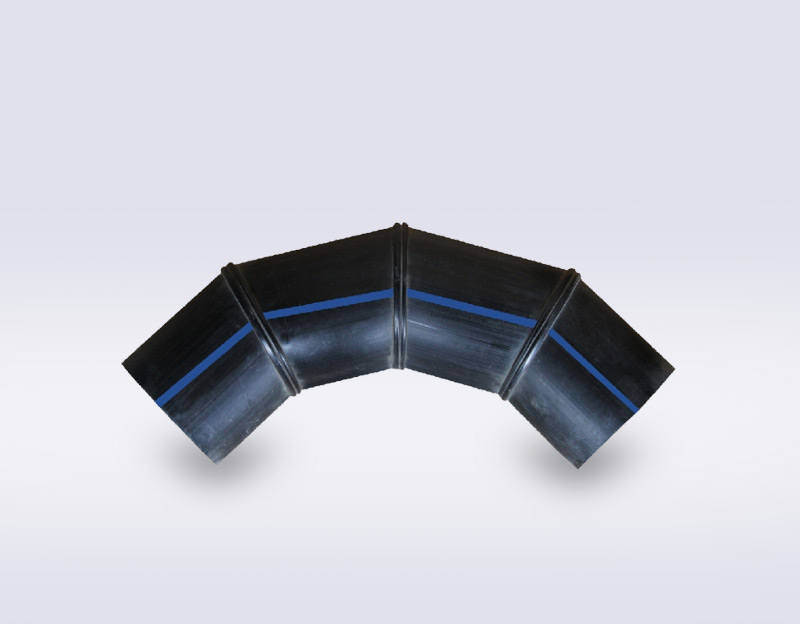
Industry standards strictly govern these derating calculations. Guidelines published by the Plastics Pipe Institute (PPI) and standards like AWWA C906 dictate how engineers must calculate the reduced pressure capacity for fabricated wyes, tees, and elbows. The derating factor depends heavily on the angle of the miter cut and the number of segments used. For example, a 3-segment 90-degree elbow requires a more severe derating factor than a 5-segment 90-degree elbow because the sharper angles in the 3-segment design create higher stress concentrations. Depending on the geometry, a fabricated fitting might require a 25% to 40% reduction in allowable operating pressure. If your system requires 150 PSI, you may need to fabricate the fitting from thicker SDR 9 pipe just to meet the pressure demands of an SDR 11 pipeline.
Size and Diameter Limitations
Procurement teams often fall into the standardization trap when specifying molded components. Molded options remain readily available and highly economical for smaller diameters. Most manufacturers stock vast inventories ranging from 2 inches up to 12 inches. Some specialized facilities push this limit to 24 inches. Beyond this threshold, injection molding becomes commercially unviable. The physical size of the steel mold, the massive clamping tonnage required by the injection machine to keep the mold closed during injection, and the extended cooling time for massive polymer masses make large-diameter molding physically and economically impossible.
Fabrication stands as the mandatory, exclusive choice for large-diameter pipelines. Massive infrastructure projects utilizing 36-inch, 48-inch, or even 65-inch mains rely entirely on fabricated components. Thermal butt fusion scales infinitely. As long as fusion machines exist large enough to clamp the pipe and heater plates exist large enough to melt the faces, fabricators can build the fitting. This scalability ensures that municipal water mains and heavy industrial outfalls can maintain continuous HDPE construction regardless of their massive dimensions.
Structural Footprint and Trench Requirements
Physical dimensions heavily influence installation logistics. Molded fittings feature highly compact designs with short lay lengths. The injection process allows manufacturers to keep the transition zones tight and space-efficient. This compact structural footprint proves invaluable in congested urban environments where trench space remains severely limited. Contractors can easily maneuver molded fittings into tight mechanical rooms, concrete vaults, or narrow utility corridors.
Fabricated fittings demand significantly more physical space. The manufacturing process dictates this larger footprint. Thermal butt fusion equipment requires sufficient straight pipe length—often called "pup pieces"—on each side of the mitered joint to physically clamp and align the segments during heating and pressing. Consequently, fabricated elbows and tees feature much longer lay lengths.
This extended geometry directly impacts trench design. Contractors must excavate wider and longer connection pits to accommodate the bulky fabricated components. Larger excavations require more extensive OSHA-compliant shoring systems, increased volumes of imported bedding material, and more time spent on backfill compaction. Failing to account for the massive footprint of a fabricated 48-inch tee can bring a pipeline installation to a grinding halt when the fitting physically cannot drop into the prepared trench.
HDPE Fitting Selection Matrix
Feature
Injection Molded
Fabricated
Machined
Pressure Rating
Full pipe rating (No derating)
Derated based on geometry
Full pipe rating (High pressure)
Size Availability
2" to 24" (Standard)
Unlimited (Up to 65"+)
Custom based on billet size
Geometric Flexibility
Standard angles only (45°, 90°)
Infinite custom angles
Highly customizable
Structural Footprint
Compact, short lay length
Large, extended lay length
Variable, generally compact
Tooling Requirement
Heavy capital investment
Zero mold requirement
CNC programming only
Molded vs Fabricated HDPE Fittings: Cost and Lead Time
Initial Tooling vs. Per-Unit Costs
The economic models driving molded and fabricated components sit at opposite ends of the manufacturing spectrum. Molded fittings require heavy upfront capital. Engineering a single multi-cavity steel mold represents a massive financial commitment for the manufacturer. However, once the mold exists, the per-unit production cost drops drastically. The injection machine cycles rapidly, producing hundreds of parts per shift with minimal labor intervention. This dynamic makes molded parts highly cost-effective for standard, high-volume applications.
Fabricated fittings eliminate tooling costs entirely. You need zero custom molds to build a fabricated tee. The expense shifts directly to skilled labor and machine time. Cutting, facing, heating, fusing, and cooling each individual joint requires dedicated technician hours. Therefore, the per-unit cost remains consistently higher. The break-even point for procurement becomes clear: specify molded parts for high-volume standard runs to amortize tooling costs. Specify fabricated parts for low-volume or custom runs where mold creation would destroy the project budget.
Production Speed and Availability
Lead times heavily influence project schedules. Molded standard fittings typically exist as off-the-shelf inventory. Distributors warehouse thousands of standard elbows, tees, and reducers. When a contractor orders a 6-inch SDR 11 molded elbow, it ships immediately. This rapid availability accelerates construction timelines and simplifies emergency repairs when a line breaks and requires immediate replacement.
Fabricated fittings operate on a built-to-order model. You cannot pull a custom 14-degree, 36-inch elbow from a warehouse shelf. The manufacturer must draft the geometry, cut the source pipe, execute the thermal fusion, and perform required quality assurance testing. This multi-step process introduces inherent lead times. Project managers must account for fabrication schedules and potential production queue delays. Furthermore, shipping logistics for large fabricated spools often require flatbed trucks, wide-load permits, and specialized rigging equipment to safely unload the awkward geometries at the job site.
When to Choose Molded or Fabricated HDPE Fittings
Ideal Use Cases for Molded Fittings
Engineers should specify molded fittings when system parameters demand maximum material yield resistance and long-term pressure sustainability. High-pressure force mains, mining slurry lines, and industrial chemical networks benefit greatly from the seamless construction and lack of derating factors. Molded components excel in standard municipal water and gas distribution networks utilizing common wall thicknesses like SDR 11 or SDR 17.
Furthermore, projects facing strict spatial constraints require molded geometries. Vault installations, pump station interiors, and congested underground utility corridors rarely offer the physical room required for long-lay fabricated fittings. The compact nature of molded parts allows contractors to execute tight directional changes without expanding excavation footprints or modifying concrete structures.
Ideal Use Cases for Fabricated Fittings
Fabricated fittings dominate large-scale infrastructure. Engineers specify them for massive water mains, municipal storm drains, and regional sewer interceptors exceeding standard mold capacities. When pipe diameters surpass 24 inches, fabrication transitions from an option to an absolute necessity.
Gravity-flow and low-pressure systems also represent ideal use cases. Because these networks operate well below the material's maximum yield resistance, the required pressure derating factor does not impact operational safety. Additionally, complex tie-ins rely on fabrication. Navigating existing underground utilities often requires non-standard angles. A fabricator can easily produce a 22.5-degree or 11-degree bend to match precise field conditions, ensuring a stress-free alignment during installation.
Follow this step-by-step logic when selecting your components:
Identify the required pipe outside diameter (OD) for the specific pipeline segment.
Determine the maximum system operating pressure, including allowances for surge events.
Calculate the required SDR for the straight pipe based on internal pressure demands.
Check manufacturer catalogs to see if a molded fitting exists for that specific OD and SDR combination.
If a molded fitting is unavailable, calculate the derated pressure capacity for a fabricated alternative using AWWA C906 guidelines.
Increase the wall thickness (lower the SDR) of the fabricated fitting if the derated capacity falls below your system requirements.
Common HDPE Fitting Selection Risks and How to Avoid Them
Navigating Non-Standard SDR Requirements
Specifying components for rare or extreme wall thicknesses introduces significant procurement risk. If an engineer specifies a molded fitting for an SDR 9 or SDR 7 pipeline, they will likely discover that no manufacturer produces that specific mold. Forcing a mismatched SDR 11 fitting into an SDR 9 system compromises internal flow dynamics. The difference in wall thickness creates an internal step at the joint, which causes turbulence, accelerates wear, and creates a weak point susceptible to pressure surges.
To mitigate this risk, engineers must plan alternative solutions during the design phase. If the required molded size does not exist, transition to machined fittings carved from solid billets. Alternatively, utilize heavily transition-fused fabricated fittings. In this scenario, the fabricator steps down the wall thickness gradually across multiple pup pieces to match the main pipeline without creating severe internal flow restrictions or sharp internal steps.
Quality Control in Fabricated Joints
Fabricated fittings rely entirely on the integrity of the thermal butt fusion joint. This reliance introduces the inherent risk of human error or environmental contamination. Improper heater plate temperatures, inadequate hydraulic drag pressure calculations, or dust contamination during the fusion process will create a weak joint susceptible to premature failure. A cold joint might look fine on the outside but will snap under operational stress.
Mitigating this risk requires mandating strict quality assurance and quality control (QA/QC) protocols. Procurement specifications must require fabricators to use automated data logging equipment on their fusion machines. These loggers record exact fusion temperatures, pressures, and heat soak times for every single joint, providing a verifiable digital record. Inspectors must perform rigorous visual evaluations of the fusion beads, ensuring proper double roll-back, uniform size, and the absence of v-notches.
For critical high-pressure applications, mandate destructive testing on sample welds, such as strap bending tests, to verify material bonding. Additionally, require non-destructive testing like Time of Flight Diffraction (TOFD) ultrasonics to verify the internal solidity of the fusion seam before the fitting leaves the manufacturing facility.
Conclusion
In the engineering debate of molded versus fabricated components, neither manufacturing method proves inherently superior. The optimal choice remains strictly dictated by the intersection of system pressure requirements, pipeline diameter, and geometric complexity. Understanding the physical limitations, derating requirements, and economic realities of each type ensures resilient infrastructure design. Engineers and procurement teams must filter their requirements by diameter and pressure first, defaulting to fabricated components for large or custom geometries, and molded components for high-pressure standard dimensions.
For projects requiring both standard and customized HDPE fitting solutions, Fusing X has specialized in the production, R&D, and sales of HDPE fittings since 2005. With manufacturing capabilities covering butt fusion fittings, electrofusion fittings, PE threaded fittings, and customized fittings, the company can support different pipeline requirements from standard connections to project-specific configurations.
Execute the following next steps to ensure successful procurement:
Verify exact operating pressures against AWWA C906 derating tables before approving any fabricated fitting submittals.
Audit the available trench space or vault dimensions to confirm the site can accommodate the longer lay lengths of fabricated components.
Consult with a certified HDPE manufacturer early in the design phase to align specified SDRs with actual market availability.
Require comprehensive fusion data logs and ultrasonic testing reports for all critical fabricated joints prior to site delivery.
FAQ
Q: How do you visually tell the difference between molded and fabricated HDPE fittings?
A: You can easily identify fabricated fittings by looking for visible thermal fusion seams or rolled beads where the pipe segments join. Additionally, fabricated parts often feature an "F" designation in their manufacturer part number. Molded fittings feature a completely smooth, seamless construction with uniform walls and no visible joint lines.
Q: Do fabricated HDPE fittings have a lower pressure rating than the pipe?
A: Yes. Because the geometry of mitered cuts alters internal fluid dynamics and concentrates mechanical stress at the joints, fabricated fittings require a specific pressure derating factor. Their maximum safe operating pressure will always be lower than the straight HDPE pipe they are manufactured from.
Q: What is the maximum size for injection molded HDPE fittings?
A: While exact limits vary by manufacturer, molded fittings typically start around 2 inches and max out between 12 and 24 inches. Producing massive steel molds for larger diameters involves extreme capital costs and physical manufacturing limitations, making them commercially unviable for massive infrastructure.
Q: Are machined HDPE fittings the same as molded fittings?
A: No. Manufacturers create molded fittings by injecting melted liquid plastic into a hollow steel mold. Machined fittings are carved directly out of a solid block or billet of extruded HDPE using CNC equipment. Machining is usually reserved for very high-pressure, thick-walled applications where standard molds do not exist.
Q: Why are molded HDPE fittings limited to standard angles?
A: Creating custom steel molds requires massive upfront capital investment. Manufacturers cannot recover that heavy expenditure on low-volume custom orders. Therefore, they only produce molds for high-demand, standard geometries like 45-degree and 90-degree elbows, leaving custom angles to fabricators.

 English
  العربية
  Français
  Русский
  Español
  Português
  Deutsch
  italiano
  日本語
日本語  한국어
한국어  Nederlands
  Tiếng Việt
  ไทย
ไทย  Polski
  Türkçe
  አማርኛ
አማርኛ  ພາສາລາວ
  ភាសាខ្មែរ
  Bahasa Melayu
  ဗမာစာ
ဗမာစာ  தமிழ்
தமிழ்  Filipino
  Bahasa Indonesia
  magyar
  Română
  Čeština
  Монгол
  қазақ
қазақ  Српски
  हिन्दी
  فارسی
فارسی  Kiswahili
  Slovenčina
  Slovenščina
  Norsk
Norsk  Svenska
  українська
  Ελληνικά
  Suomi
Suomi  Հայերեն
  עברית
עברית  Latine
  Dansk
Dansk  اردو
اردو  Shqip
Shqip  বাংলা
বাংলা  Hrvatski
  Afrikaans
  Gaeilge
  Eesti keel
  Māori
Māori