The structural integrity of a high-density polyethylene pipeline depends entirely on the precision of the fusion process. Marginal deviations in parameters compromise the entire system. Operators must execute every step with exact precision so polymer chains entangle properly across the joint interface. When field technicians ignore established protocols, the resulting pipeline becomes a severe liability.
Rushed cooling times, incorrect heat soak durations, and uncalibrated heater plates lead directly to cold welds. These errors cause material degradation and catastrophic blowouts under pressure. Joint failure brings immense financial and operational risks. Excavating and replacing a failed fusion joint disrupts service and damages property.
Standardizing operating procedures is the only way to guarantee leak-free, compliant pipe networks. You must strictly control the HDPE fusion temperature, make calculated environmental adjustments, and utilize verifiable data logging to eliminate guesswork. Executing every fusion joint according to strict engineering standards ensures the pipeline performs flawlessly for its intended lifespan.
Key Takeaways
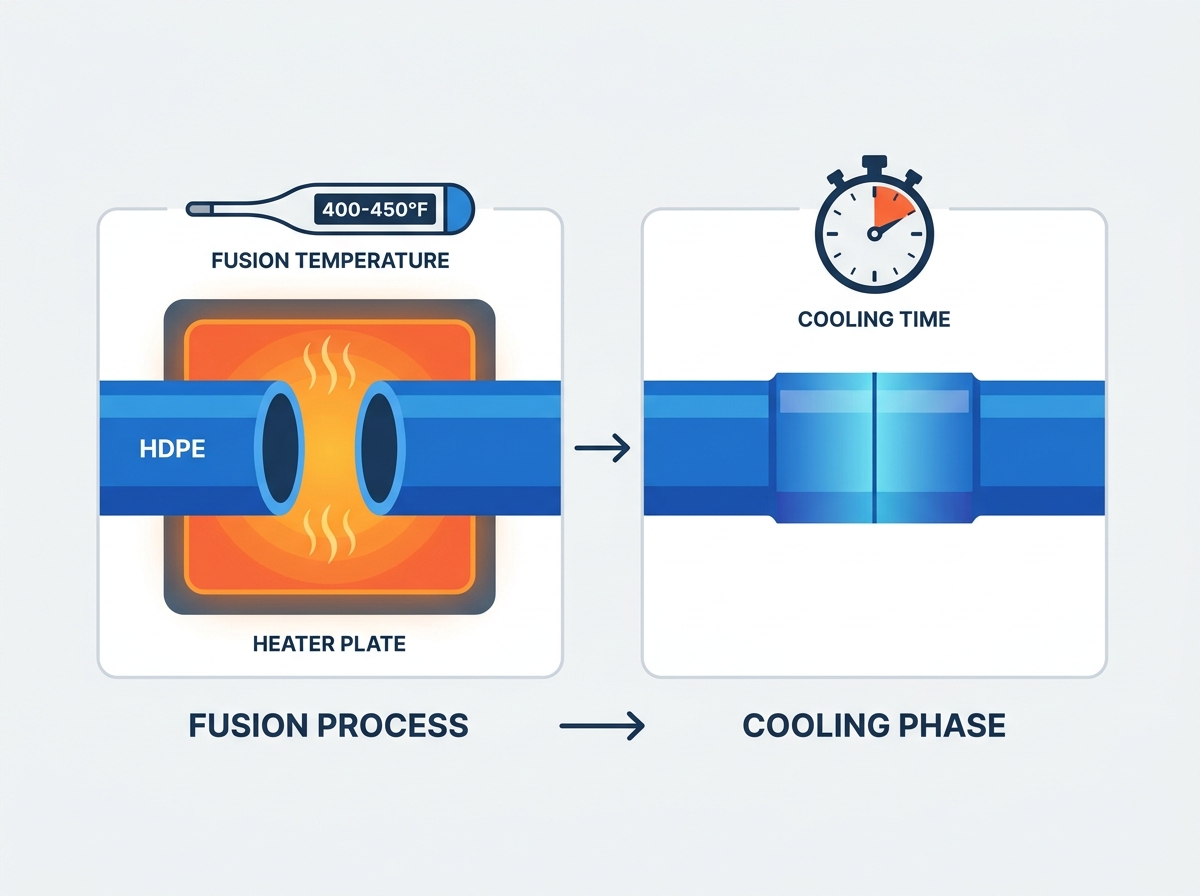
Standardized Temperature Windows: The industry-standard surface temperature for HDPE butt fusion typically ranges between 400°F and 450°F (204°C–232°C), governed by strict standards like ASTM F2620 and PPI TR-33.
Preparation is a Prerequisite for Heat Transfer: Achieving the correct HDPE fusion temperature profile requires perfectly faced, aligned, and oxidized-free pipe ends to ensure 100% contact with the heater plate.
Cooling Time is Non-Negotiable: Joints must remain clamped under fusion force until structurally solidified; rushing this mandatory window is the leading cause of premature joint failure.
Environmental Adjustments: Ambient temperatures (especially those exceeding 100°F), wind chill, and precipitation require calculated adjustments to heat soak times and cooling durations to maintain polymer integrity.
Equipment Evaluation: Modern fusion operations require machines with automated data logging and precise hydraulic controls to ensure verifiable QA/QC and compliance with engineering specifications.
Table of Contents
Toggle
How to Prepare HDPE Pipe Before Butt Fusion Heating
The Foundation of Thermal Transfer
Applying the correct heat profile is useless if the pipe ends lack uniform contact with the heater plate. Thermal transfer relies on absolute surface-to-surface mating. Any gap between the pipe end and the heating element creates cold spots. These cold spots prevent the polymer from reaching the necessary viscoelastic state. A successful joint begins long before the heater plate enters the carriage. Field crews often battle pipe ovality, especially on coiled pipe or large diameter sticks that have been stacked in a yard. You must correct this ovality using the machine clamps before attempting to face or heat the pipe.
Clamping and Alignment
Properly securing the pipe prevents slippage during the application of fusion force. Operators must load the pipe into the machine jaws and tighten the clamps evenly. High-low alignment must meet strict industry tolerances. If one pipe sits higher than the other, the resulting joint will suffer from reduced wall thickness at the interface. This misalignment concentrates stress and severely weakens the pipeline.
Technicians must adjust the jaw inserts to match the specific outside diameter of the pipe. Drag pressure must be measured accurately while the carriage moves. High drag indicates binding in the machine or excessive pipe weight dragging on the ground. You must place pipe rollers under the pipe string to reduce drag and ensure smooth carriage movement. Follow these steps for proper clamping:
Clean the inside of the machine jaws and the outside of the pipe to remove mud, snow, or debris.
Install the correct size inserts for the pipe diameter being fused.
Load the pipe into the jaws, leaving enough material protruding to allow for facing.
Tighten the inner clamps first to grip the pipe, then tighten the outer clamps to correct any ovality.
Bring the pipe ends together under manual pressure to check for high-low misalignment.
Adjust the clamps as necessary until the pipe walls are perfectly flush.
The Facing Process
Mechanical planing, known as facing, prepares the pipe ends for heating. The facer removes oxidation, dirt, and uneven cuts from the pipe surfaces. Polyethylene oxidizes when exposed to air and UV light. This oxidized layer prevents proper molecular entanglement during fusion. Facing exposes virgin polymer material.
Continuous ribbons must be shaved from both ends simultaneously. Operators lock the carriage against the spinning facer until long, unbroken strands of polyethylene emerge from both sides. This guarantees perfectly parallel surfaces. Once facing is complete, operators must never touch the shaved pipe ends. Contaminating the faced surfaces with skin oils or dirt ruins the potential for optimal heat absorption. If a technician accidentally touches the faced pipe, they must repeat the facing process to remove the contaminated layer.
HDPE Fusion Temperature and Heat Soak Guidelines
Problem Framing
Operators often rely on visual cues rather than calibrated metrics. Judging a melt bead solely by eye leads to inconsistent melt patterns. When technicians guess the heat soak duration, they compromise molecular bonding. Visual indicators are subjective and vary heavily depending on lighting conditions and operator experience. Strict reliance on calibrated instruments is mandatory for reliable fusion. A pyrometer is not optional equipment; it is a mandatory tool for verifying the thermal output of the heater plate.
Standard Temperature Ranges and Tolerances
The universally accepted HDPE fusion temperature range for butt fusion sits between 400°F and 450°F (204°C–232°C). This specific window allows the polyethylene to transition from a solid to a viscoelastic state without burning. In this state, the polymer chains become mobile. When forced together, these chains entangle across the interface, creating a monolithic structure.
Industry standards like ASTM F2620 and ISO 21307 serve as the authoritative baseline for these parameters. These standards dictate exact heating requirements based on material properties. Deviating from these established ranges guarantees a substandard joint. Operators must verify the heater plate surface with a calibrated pyrometer before starting the fusion process. Checking the built-in thermometer on the machine is insufficient, as internal sensors often fail to reflect the actual surface temperature of the Teflon-coated plate.
Calculating Heat Soak Times
Heat soak is the time the pipe ends remain pressed against the heater plate at near-zero pressure. This phase allows heat to penetrate deeply into the pipe wall. The duration depends entirely on the pipe's wall thickness, known as the Standard Dimension Ratio (SDR), and its outside diameter.
Small diameter pipes require very brief heating periods. For example, a 1/2” CTS pipe may only need 8 to 10 seconds of heat soak time. Conversely, large diameter mains require exponentially longer, mathematically calculated soak times. A heavy-wall 24-inch pipe might require several minutes of heat soak to ensure the thermal profile reaches the necessary depth. Operators must consult the specific fusion time charts provided by the pipe manufacturer.
Baseline Heat Soak Guidelines by Pipe Size
Pipe Size (IPS)
SDR Rating
Approximate Heat Soak Time
Minimum Melt Bead Size
2 inch
SDR 11
30 - 45 seconds
1/16 inch
4 inch
SDR 11
1.5 - 2 minutes
1/8 inch
8 inch
SDR 11
3 - 4 minutes
3/16 inch
12 inch
SDR 11
5 - 7 minutes
1/4 inch
24 inch
SDR 11
12 - 15 minutes
7/16 inch
Evaluation Dimensions: Overheating vs. Underheating
Underheating causes cold welds. This occurs when the pipe ends do not absorb enough thermal energy. The polymer chains fail to achieve sufficient mobility, resulting in poor entanglement. Cold welds look normal on the outside but are extremely brittle. They fail catastrophically under tensile stress or internal pressure. A cold weld might pass a visual inspection but will snap immediately during a reverse bend test.
Overheating causes thermal degradation of the polymer chains. Exceeding the optimal temperature window destroys the material properties of the polyethylene. The plastic burns, oxidizes, and loses its structural integrity. Overheating also results in excessive melt bead rollback, pushing too much material out of the joint interface and weakening the connection. If the melt bead appears pockmarked, discolored, or excessively large, the operator has likely overheated the pipe.
HDPE Butt Fusion Cooling Time: Why It Matters
Success Criteria
A successful joint requires the polymer chains to recrystallize and solidify uniformly. This recrystallization must occur while the joint remains under continuous, calculated fusion force. Removing the pressure before the material fully solidifies disrupts the molecular bonds. The joint must return to a stable solid state before it can withstand handling or operational stress.
The Mechanics of Structural Solidification
The transition from the melt state back to a solid state dictates the final strength of the joint. Once the heater plate is removed and the pipe ends are joined, the cooling process begins. The surface of the pipe cools rapidly due to ambient air exposure. However, polyethylene is a thermal insulator.
The core of the pipe wall cools much slower than the surface. Even if the outside of the melt bead feels cool to the touch, the center of the pipe wall remains molten. This thermal gradient necessitates strict time minimums based on the SDR. Thicker walls trap heat longer, requiring significantly extended cooling durations to ensure the entire cross-section solidifies properly. Rushing this process by releasing the clamps early allows the contracting polymer to pull away from the center of the weld, creating internal voids.
Cooling Under Pressure vs. Ambient Cooling
You must differentiate between cooling under pressure and ambient cooling. Cooling under pressure is the mandatory time the pipe spends clamped in the machine under full fusion force. This phase prevents the contracting polymer from pulling apart as it cools. Releasing the hydraulic pressure prematurely induces stress fractures and creates micro-voids within the joint interface.
Ambient cooling occurs after the pipe is removed from the machine. The joint must rest without rough handling, pulling, or pressure testing for an additional period. Moving a newly fused pipe string too aggressively during the ambient cooling phase can still damage the internal structure of the weld. Heavy equipment operators must wait until the ambient cooling period expires before dragging the pipe string down the right-of-way.
Implementation Realities and Time Matrices
Determining exact cooling times requires strict adherence to reference methodologies. Operators cannot guess when a joint is finished. You must use a timer for every single fusion. The required time scales directly with the pipe size and wall thickness.
Maintain fusion force for 30 seconds on a 1/2” CTS pipe.
Hold pressure for 5 minutes on a 1-1/4” IPS pipe.
Apply continuous force for 10 to 20 minutes for mid-sized mains.
Scale up to 45 minutes or more for massive, heavy-wall industrial piping.
Allow an additional 30 to 60 minutes of ambient cooling before pressure testing any line.
How Weather Affects HDPE Butt Fusion Parameters
Implementation Risks
Factory parameters fail in field conditions if operators ignore weather variables. The environment directly impacts the thermal transfer and cooling rates of polyethylene. Failing to adapt to extreme ambient temperatures, wind, or moisture guarantees joint failure. Field technicians must actively manage the microclimate around the fusion machine.
Adjusting for Extreme Ambient Temperatures
Cold weather operations present severe challenges. Rapid heat loss occurs during the open/close window, which is the time it takes to remove the heater plate and bring the pipe ends together. Operators must minimize this transition time. Using heating tents around the fusion machine is highly recommended. You may also need longer heat soak times to reach the target HDPE fusion temperature profile in freezing conditions. Never apply a direct flame to the pipe to warm it up, as this degrades the polymer.
Hot weather operations, especially those exceeding 100°F, require different adjustments. High ambient temperatures significantly slow the polymer recrystallization process. The strict requirement here is extended cooling times. The pipe retains heat much longer in the summer sun. Operators must leave the pipe clamped under pressure well beyond the standard minimums to ensure full structural solidification. Shielding the fusion machine with a canopy helps regulate the temperature of the black pipe, which absorbs massive amounts of solar radiation.
Mitigating Wind and Moisture
Wind causes uneven cooling on the heater plate and the exposed pipe ends. A strong breeze strips heat from the windward side of the pipe while the leeward side remains hot. This temperature differential leads to asymmetrical melt beads and uneven bonding. Operators must set up windbreaks or fusion tents to shield the fusion zone completely. If you cannot block the wind, you must halt fusion operations.
Absolute dryness is mandatory. Moisture on the pipe ends or the heater plate boils instantly upon contact. This creates steam pockets within the molten polymer. These steam pockets form porous, sponge-like voids inside the weld, destroying its strength. Technicians must wipe the pipe ends with clean, lint-free cloths and ensure no rain or snow enters the fusion area. If frost is present on the pipe, use 90% isopropyl alcohol to clean and dry the surface before facing.
How to Choose HDPE Fusion Equipment for Better Parameter Control
Solution Categories
Contractors must choose between manual hydraulic fusion machines and automated or CNC fusion machines. Manual machines require the operator to calculate drag, adjust pressure valves, and monitor timers manually. While effective in skilled hands, they leave room for human error. Automated machines control the pressure and timing sequences based on programmed parameters, drastically reducing the risk of operator mistakes. Automated systems lock out the operator if the heater plate drops below the required temperature threshold.
Heater Plate Calibration and Surface Uniformity
The heater plate is the most critical component of the fusion machine. It must deliver uniform heat across its entire surface. Operators must evaluate heater plates daily using a calibrated surface pyrometer. Testing multiple points on both sides of the plate ensures it maintains the required 400°F–450°F range without cold spots.
The surface coating integrity is equally important. Heater plates use Teflon coatings to prevent the molten polyethylene from sticking. Scratches, gouges, or worn areas on the Teflon coating cause the polymer to adhere to the plate. This tears the melt bead during plate removal and ruins the joint. Damaged heater plates must be replaced immediately. Never use metal tools to scrape melted plastic off a heater plate; use a wooden stick or a clean cotton rag while the plate is hot.
Hydraulic Pressure Control and Drag Calculation
Accurate drag pressure calculation is necessary to ensure the actual interfacial pressure meets standard requirements. Interfacial pressure typically ranges from 60 to 90 psi for standard butt fusion. However, this is not the gauge pressure on the machine. Gauge pressure must account for the specific piston area of the machine and the drag resistance of the pipe.
The fusion phase requires the precise combination of the designated heat profile and the calculated application of force. If the hydraulic system leaks or the pressure relief valves are faulty, the machine cannot maintain the required force during the cooling cycle. Regular maintenance and calibration of the hydraulic manifold are essential. Follow this procedure to calculate drag:
Load and clamp the pipe into the machine.
Open the carriage completely.
Slowly increase the hydraulic pressure while moving the carriage forward.
Record the exact pressure reading on the gauge at the moment the carriage begins to move smoothly.
Add this drag pressure value to the theoretical fusion pressure provided by the pipe manufacturer.
Set the machine's main pressure relief valve to this combined total.
Overall Value Influencing Factors: Automated Data Logging
Utilizing data loggers provides an immense return on investment. Devices like the McElroy DataLogger record every variable of the fusion process in real-time. They capture the exact heating time, the applied pressure, the shift times, and the cooling duration. This data is uploaded to a cloud database for immediate review.
Automated logging protects contractors from liability. If a pipeline fails, the contractor can produce a digital report proving the joint was fused according to strict engineering specifications. This verifiable QA/QC satisfies inspectors, project owners, and municipal engineers. It transforms the fusion process from a subjective craft into a documented, scientific procedure.
HDPE Butt Fusion Quality Control and Inspection
Risk Mitigation
Verifying that temperature, pressure, and cooling parameters were successfully applied requires strict field protocols. You cannot assume a joint is sound just because the machine completed its cycle. Field supervisors must implement continuous quality assurance and quality control measures to catch errors before the pipe is buried. A robust QA/QC program includes daily machine inspections, operator qualification tracking, and mandatory destructive testing.
Visual Inspection Criteria
Visual inspection is the first line of defense against poor fusion. Every joint must be examined immediately after the cooling cycle. An acceptable melt bead exhibits specific characteristics. It must be uniform in size around the entire circumference of the pipe. The bead must roll back completely to the pipe surface.
Inspectors look for specific defects. A V-notch between the two beads indicates insufficient fusion pressure or a cold heater plate. Uneven bead sizes suggest misalignment or wind chill affecting one side of the pipe. A bubbly or pockmarked bead indicates moisture contamination during the heating phase. Any joint failing visual inspection must be cut out and refused. You cannot repair a bad fusion joint; you must remove it entirely.
HDPE Butt Fusion Parameter Troubleshooting Guide
Observed Defect
Probable Cause
Required Corrective Action
V-Notch in Melt Bead
Insufficient fusion pressure or inadequate heat soak.
Replace heater plate or apply new anti-stick coating.
Destructive Testing Methods
Visual inspection cannot guarantee the internal strength of the weld. Destructive testing provides definitive proof of joint integrity. Contractors must perform test welds at the beginning of each shift or when environmental conditions change significantly. These test joints are cut out and subjected to rigorous physical stress.
The reverse bend test is a common field method. Technicians cut straps from the fused joint and bend them backward, forcing the inner wall of the pipe outward. If the joint snaps or separates along the fusion line, the parameters were incorrect. Laboratory tensile tests pull the joint apart mechanically to measure its yield strength. A proper fusion joint will always yield in the parent pipe material before the weld interface fails. If the weld breaks first, the fusion process is flawed and must be corrected immediately.
Conclusion
Mastering the fusion process requires strict adherence to technical standards and a refusal to cut corners. Protect your infrastructure by treating every joint as a critical structural component. Implement the following steps to ensure flawless pipeline construction:
Mandate the use of calibrated surface pyrometers to verify heater plate temperatures before every shift.
Equip all fusion machines with automated data loggers to capture and store verifiable pressure and time metrics.
Establish strict environmental protocols, requiring tents and windbreaks whenever weather conditions deviate from optimal baselines.
Enforce mandatory destructive testing for the first joint of every day to validate machine settings and operator technique.
Train all technicians to calculate precise drag pressures rather than relying on generic gauge estimates.
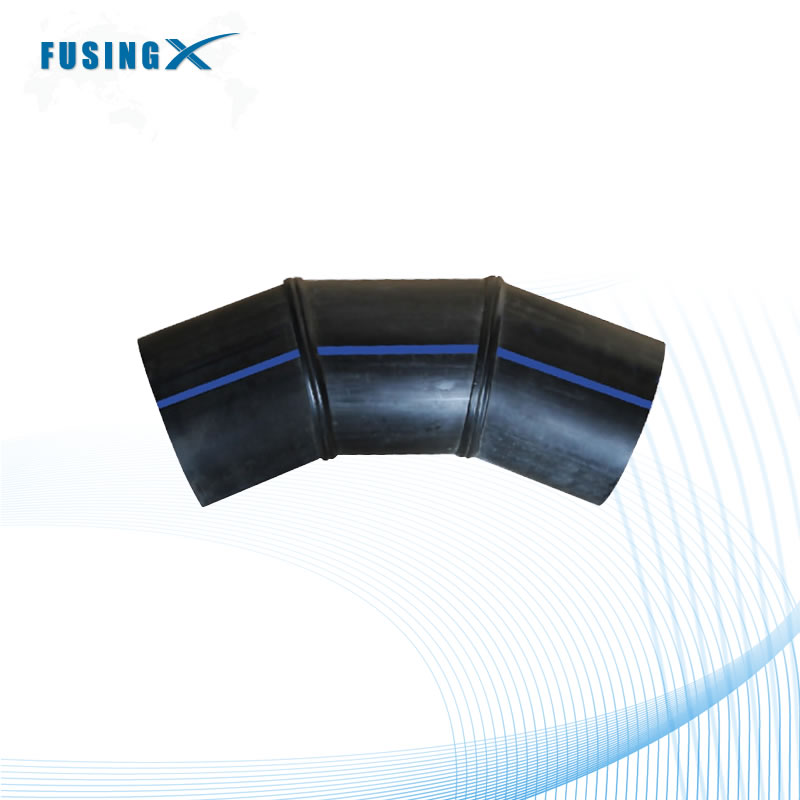
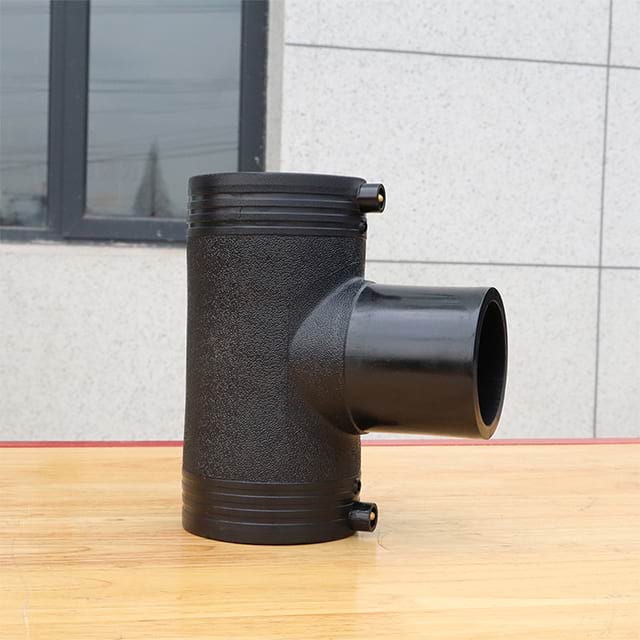
Reliable fusion also depends on using fittings engineered for compatible and consistent HDPE pipeline connections. Established in 2005, Fusing X integrates the R&D, manufacturing, and sales of HDPE fittings, with a product portfolio covering butt fusion fittings, electrofusion fittings, PE threaded fittings, and customized piping solutions for a wide range of pipeline applications.
FAQ
Q: What happens if the heater plate is too hot during fusion?
A: Exceeding the optimal temperature range causes thermal degradation of the polyethylene. The polymer chains burn and lose their structural integrity, resulting in a brittle joint. Overheating also causes excessive melt bead rollback, which pushes critical material out of the fusion zone and weakens the connection.
Q: Can I reduce cooling time if I spray the pipe with cold water?
A: No. Spraying water on a fused joint causes rapid, uneven cooling. This induces severe thermal stress fractures within the polymer structure. The pipe must cool naturally under continuous hydraulic pressure to allow the core wall to solidify at the correct molecular rate.
Q: Why is facing the pipe ends absolutely necessary?
A: Facing removes the oxidized layer of polyethylene that forms when exposed to air and UV light. It also eliminates dirt and creates perfectly parallel surfaces. Without facing, the oxidized layer prevents polymer chain entanglement, and uneven surfaces create cold spots that ruin the weld.
Q: How do I adjust fusion parameters for freezing weather?
A: In freezing conditions, you must minimize the open/close window to prevent rapid heat loss. You should use a heated fusion tent to stabilize the ambient environment. You may also need to increase the heat soak time slightly to ensure the pipe wall reaches the correct thermal profile.
Q: What does a V-notch in the melt bead indicate?
A: A V-notch—a deep groove between the two rolled-back beads—indicates that insufficient pressure was applied during the fusion phase, or the heater plate was too cold. This defect means the pipe ends were not forced together adequately, resulting in a weak, unacceptable joint.
Q: Why must I measure drag pressure for every joint?
A: Drag pressure represents the frictional resistance of the pipe moving across the ground and through the machine. You must add this drag value to the theoretical fusion pressure. Failing to account for drag means the actual interfacial pressure applied to the joint will be far too low.

 English
  العربية
  Français
  Русский
  Español
  Português
  Deutsch
  italiano
  日本語
日本語  한국어
한국어  Nederlands
  Tiếng Việt
  ไทย
ไทย  Polski
  Türkçe
  አማርኛ
አማርኛ  ພາສາລາວ
  ភាសាខ្មែរ
  Bahasa Melayu
  ဗမာစာ
ဗမာစာ  தமிழ்
தமிழ்  Filipino
  Bahasa Indonesia
  magyar
  Română
  Čeština
  Монгол
  қазақ
қазақ  Српски
  हिन्दी
  فارسی
فارسی  Kiswahili
  Slovenčina
  Slovenščina
  Norsk
Norsk  Svenska
  українська
  Ελληνικά
  Suomi
Suomi  Հայերեն
  עברית
עברית  Latine
  Dansk
Dansk  اردو
اردو  Shqip
Shqip  বাংলা
বাংলা  Hrvatski
  Afrikaans
  Gaeilge
  Eesti keel
  Māori
Māori