Pipeline failure caused by mismatched High-Density Polyethylene (HDPE) components carries severe operational and financial consequences. When conveying high-pressure water, volatile natural gas, or abrasive industrial slurries, system integrity relies entirely on the weakest link. In thermoplastic piping networks, joint integrity is the single most vulnerable failure point. A compromised fusion joint or an improperly sized mechanical connection leads to blowouts, environmental contamination, and extended system downtime.
Engineers, contractors, and procurement teams face significant complexity when specifying materials for a project. The HDPE market utilizes overlapping sizing systems, including Iron Pipe Size (IPS) and Ductile Iron Pipe Size (DIPS), which possess completely different outside diameters. Varying wall thicknesses dictated by Standard Dimension Ratios (SDR) and evolving resin generations like PE3608 versus PE4710 create a matrix of potential specification errors. Relying on nominal sizing assumptions frequently results in un-weldable components arriving at the job site.
To ensure safe, leak-free, and ASTM-compliant system integration, project stakeholders need a systematic, evidence-based framework. Verifying HDPE fitting compatibility requires rigorous evaluation of outside diameters, dimension ratios, material grades, and pressure classes before procurement begins.
Key Takeaways
Size and OD Match: Butt fusion requires an exact Outside Diameter (OD) match; understanding the difference between IPS (Iron Pipe Size) and DIPS (Ductile Iron Pipe Size) is non-negotiable.
SDR Alignment and Constant Pressure: Standard Dimension Ratio (SDR) dictates wall thickness and pressure rating. A specific SDR yields the exact same pressure rating regardless of the pipe's nominal size. Mixing different SDRs requires specific transition protocols.
Material Grade Rules: While modern PE4710 is the industry standard, cross-fusing with legacy PE3608 is possible but requires strict adherence to specific temperature and pressure derating guidelines.
Pressure Class Hierarchy: The overall system pressure rating is always dictated by the weakest component; fittings must meet or exceed the pressure class of the adjoining pipe based on the specific application (e.g., water, gas, or industrial slurry).
Table of Contents
Toggle
What Determines HDPE Fitting Compatibility?
Achieving true compatibility means the fitting and the adjoining pipe act as a singular, monolithic structure under maximum design pressure and environmental stress. When properly fused, an HDPE joint is as strong as, or stronger than, the pipe itself. This monolithic behavior prevents leak paths, resists ground movement, and withstands internal pressure surges. If any specification variable is misaligned, the joint introduces a stress concentration point, increasing the probability of premature failure.
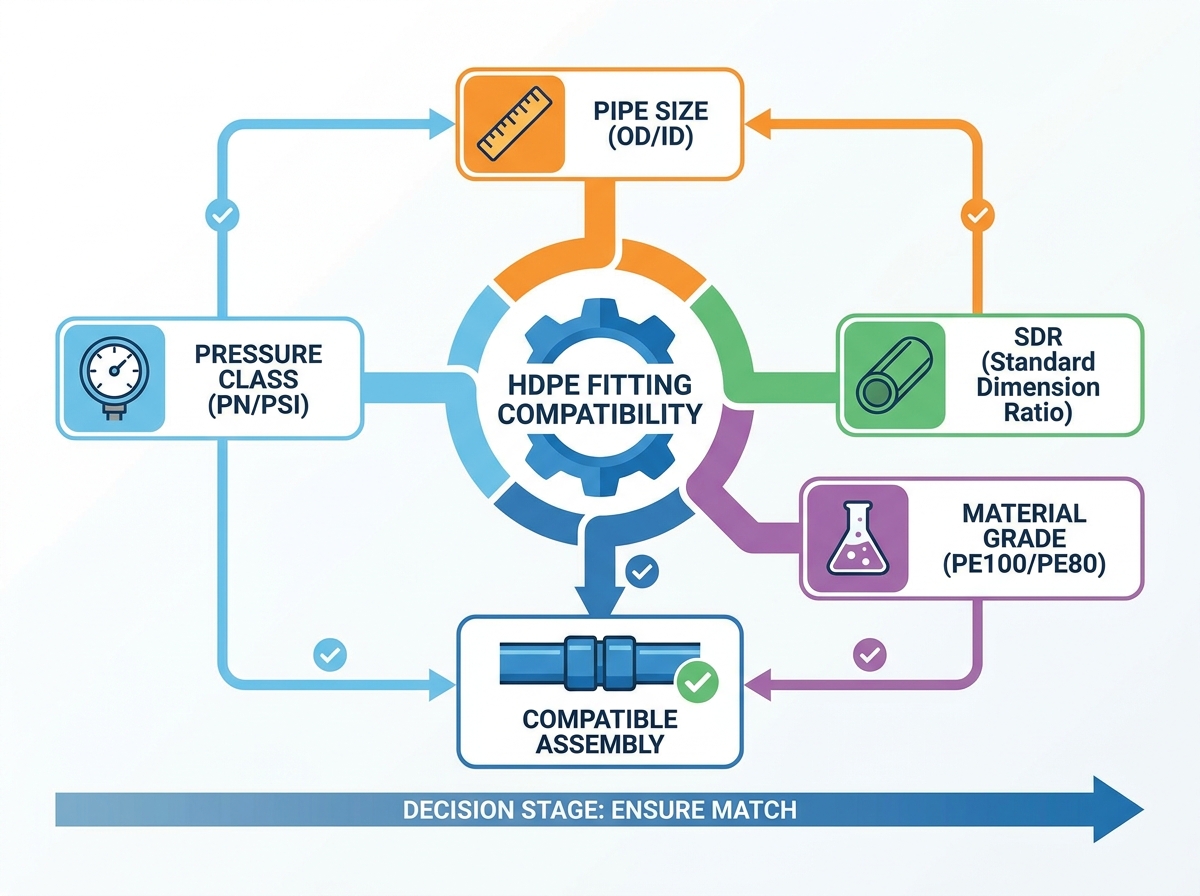
Specification requires strict adherence to four interdependent variables. First, the Pipe Sizing System dictates the physical outside diameter. Second, the Dimension Ratio (SDR/DR) controls the wall thickness and internal flow characteristics. Third, the Material Grade determines the chemical resistance, density, and hydrostatic design basis. Finally, the Pressure Class synthesizes the previous three variables to establish the maximum safe operating pressure for the specific application.
The greatest implementation risk arises from relying solely on nominal sizes. Assuming that any 6-inch fitting will weld directly to any 6-inch pipe ignores the fundamental differences between sizing standards. A 6-inch IPS pipe has an outside diameter of 6.625 inches, while a 6-inch DIPS pipe has an outside diameter of 6.900 inches. Attempting to butt fuse these two components is physically impossible and highly dangerous. Ignoring ASTM standards during the selection process transfers immense liability to the design engineer and the installation contractor.
HDPE Pipe Size and Outside Diameter (OD) Compatibility
The thermoplastic piping industry inherited multiple sizing standards from legacy materials, requiring engineers to navigate a variety of outside diameters. Iron Pipe Size (IPS) was originally developed for wrought iron pipe and remains the most prevalent standard for industrial and natural gas applications. Ductile Iron Pipe Size (DIPS) was established to match the dimensions of cast and ductile iron pipes, making it the dominant standard in municipal water and wastewater infrastructure. Copper Tube Size (CTS) is utilized primarily for smaller diameter potable water service lines.
These sizing systems are not interchangeable. Because butt fusion requires the pipe and fitting to share the exact same outside diameter, crossing sizing systems without specialized adapters guarantees failure. A 6-inch IPS fitting cannot be butt-fused to a 6-inch DIPS pipe. The 0.275-inch difference in outside diameter prevents proper alignment in the fusion machine, making it impossible to achieve the necessary interfacial pressure during the heating and cooling cycles. Transitioning between IPS and DIPS requires specialized mechanical transition fittings or custom-machined flange adapters.
Common Outside Diameter (OD) Differences: IPS vs. DIPS
Nominal Pipe Size
IPS Outside Diameter (inches)
DIPS Outside Diameter (inches)
OD Variance (inches)
4-inch
4.500
4.800
0.300
6-inch
6.625
6.900
0.275
8-inch
8.625
9.050
0.425
10-inch
10.750
11.100
0.350
12-inch
12.750
13.200
0.450
Exact OD matching is the foundational physics of butt fusion. During the fusion process, the pipe and fitting ends are faced, heated against a PTFE-coated heater plate, and pressed together under specific force. If the outside diameters do not match perfectly, the melt beads will not roll over symmetrically. An asymmetrical melt bead indicates uneven pressure distribution across the joint interface, creating a weak bond susceptible to brittle failure under operational stress.
Manufacturing tolerances also play a role in OD matching. Standards such as ASTM F714 for large diameter pipe and ASTM D3035 for smaller diameters dictate the allowable variance in outside diameter and out-of-roundness. High-quality fittings are manufactured to the tighter end of these tolerances to ensure exact alignment in the field. When procuring materials, verifying that both the pipe and the fittings adhere to the same ASTM dimensional specifications is a mandatory quality control step.
How SDR and Wall Thickness Affect HDPE Fitting Compatibility
Understanding the relationship between outside diameter and wall thickness is necessary for specifying pressure-rated components. Dimension Ratio (DR) is the simple mathematical ratio of the pipe's nominal outside diameter to its minimum wall thickness. Standard Dimension Ratio (SDR) is a specific type of DR that utilizes the ANSI preferred number series. This mathematical progression ensures a consistent step-change in pressure ratings across the product line.
The standard SDR scale includes values such as SDR 9, 11, 13.5, 17, 21, 26, and 32.5. A lower SDR number indicates a thicker pipe wall relative to the outside diameter, resulting in a higher pressure rating. Between each standard SDR step, there is an approximate 20% difference in minimum wall thickness. This standardized stepping allows engineers to precisely match the piping system's strength to the required hydraulic design without over-specifying material.
Standard Dimension Ratio (SDR) Wall Thickness Comparison (8-inch IPS)
SDR Rating
Outside Diameter (inches)
Minimum Wall Thickness (inches)
Pressure Rating (PE4710 Water @ 73.4°F)
SDR 9
8.625
0.958
250 psi
SDR 11
8.625
0.784
200 psi
SDR 13.5
8.625
0.639
160 psi
SDR 17
8.625
0.507
125 psi
The most important engineering principle associated with SDR is the constant pressure rule. Because SDR is a proportional ratio, a specific SDR yields the exact same pressure rating regardless of the pipe's nominal size, assuming the material grade remains constant. A 4-inch SDR 11 pipe and a 24-inch SDR 11 pipe made from PE4710 resin both carry a working pressure rating of 200 psi for water at 73.4°F. The wall thickness scales proportionally with the outside diameter to maintain the exact same hoop stress capacity.
Technically, fusing different SDRs together is possible, but it introduces significant trade-offs and realities in the field. Direct butt fusion of mismatched wall thicknesses creates high-low misalignment on the internal diameter. This misalignment acts as a stress riser, concentrating mechanical forces at the joint interface and reducing the overall fatigue life of the pipeline. Furthermore, the exposed edge of the thicker wall can create turbulence and cavitation in high-velocity fluid applications.
To mitigate these risks, industry standards dictate specific transition protocols. When joining mismatched wall thicknesses, contractors should utilize ID-controlled transition fittings that feature a gradual internal taper, smoothing the flow path and eliminating the stress riser. Alternatively, electrofusion couplings can be used to join different SDRs, as electrofusion relies entirely on the outside diameter and does not create an internal melt bead.
Specifying SDR also directly impacts the internal diameter (ID) and system flow rates. Because the outside diameter is strictly controlled for fusion compatibility, any increase in wall thickness subtracts directly from the internal diameter. Specifying an unnecessarily heavy wall fitting to act as a safety factor will reduce the cross-sectional flow area, potentially introducing flow restrictions, increasing head loss, and requiring higher pump energy to maintain system volume.
PE4710 vs. PE3608: Can They Be Fused Together?
The evolution of polyethylene resins has significantly improved the performance and longevity of thermoplastic piping systems. Legacy systems were primarily constructed using PE3408 or PE3608 resins. Modern infrastructure has almost entirely transitioned to PE4710, which represents the current industry standard for high-performance bimodal polyethylene.
PE4710 offers superior Environmental Stress Crack Resistance (ESCR) and a higher hydrostatic design basis (HDB) compared to PE3608. The bimodal molecular structure of PE4710 allows for a higher density and greater tensile strength without sacrificing flexibility or slow crack growth resistance. This allows PE4710 systems to operate at higher pressures or utilize thinner walls to achieve the same pressure rating as thicker PE3608 pipes, thereby improving flow capacity and reducing material weight.
A common field scenario involves tying new PE4710 fittings and pipe into existing PE3608 infrastructure. Cross-welding different PE grades is entirely feasible, but it requires strict adherence to established fusion protocols. The Plastics Pipe Institute (PPI) TR-33 provides the definitive guidelines for cross-fusing different resin grades. The molecular compatibility between PE3608 and PE4710 allows for strong fusion joints, provided the heating times, interfacial pressures, and cooling cycles align with the fitting manufacturer's specific recommendations.
However, cross-welding introduces unavoidable performance trade-offs. When mixing materials, the system's overall performance defaults to the capabilities of the lower-grade material. If a PE4710 SDR 11 fitting is fused to a PE3608 SDR 11 pipe, the maximum allowable operating pressure of that specific pipeline segment must be calculated using the hydrostatic design stress of the PE3608 resin. The superior pressure capacity of the PE4710 component cannot compensate for the lower strength of the legacy pipe.
HDPE Pressure Class and Working Pressure Ratings Explained
System pressure capacity is not an arbitrary number; it is a calculated metric derived from the combination of the Dimension Ratio, the material grade, and the application's specific design factor. The Hydrostatic Design Basis (HDB) of the resin is multiplied by a design factor to determine the Hydrostatic Design Stress (HDS). The HDS is then applied to the SDR using the ISO equation to establish the baseline working pressure rating.
Pressure Class Derating Factors for HDPE Systems
Operating Condition
Impact on Pressure Rating
Typical Derating Multiplier
Base Water Temperature (73.4°F / 23°C)
Baseline standard for all ASTM pressure calculations.
1.00
Elevated Temperature (100°F / 38°C)
Thermoplastics lose tensile strength as temperature increases.
0.78
Elevated Temperature (140°F / 60°C)
Significant reduction in hoop stress capacity.
0.50
Natural Gas Distribution
Requires higher safety factors due to volatile and compressible fluids.
0.32 (Design Factor)
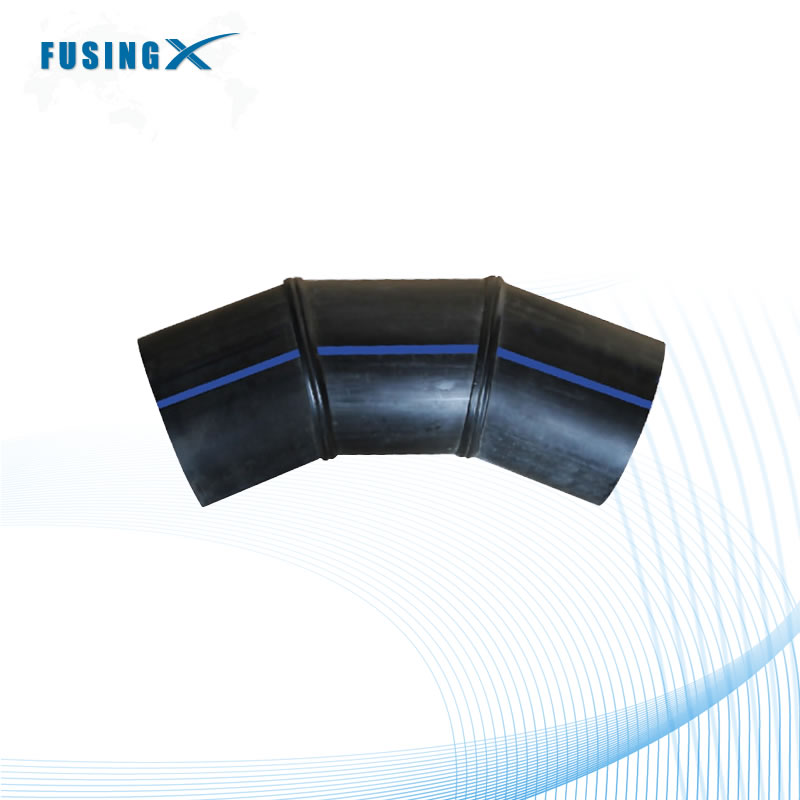
The fundamental procurement rule for system integrity is that the fitting pressure class must be greater than or equal to the pipe pressure class. Evaluating this requires understanding the difference between molded and fabricated fittings. Molded fittings are injection-molded as a single, homogenous piece and typically carry the full pressure rating of their designated SDR. Fabricated fittings, constructed by miter-cutting and butt-fusing segments of pipe, introduce complex stress geometries.
Because of these stress geometries, fabricated fittings often require pressure derating. A fabricated SDR 11 tee may only carry a pressure rating equivalent to an SDR 17 pipe. If the pipeline requires a full SDR 11 pressure rating, the fabricated fitting must be constructed from heavier-wall pipe and then machined down at the ends to match the SDR 11 pipe for fusion. Verifying the manufacturer's specific pressure rating for fabricated components is a mandatory step in the procurement process.
Baseline pressure classes must also be adjusted for application, temperature, and chemical exposure. Elevated operating temperatures significantly impact thermoplastic strength. If a system operates above 80°F (27°C), derating multipliers must be applied to the fitting's baseline pressure class. Furthermore, conveying specific chemicals or abrasive mining slurries requires applying additional safety factors to account for accelerated wear and chemical degradation over the pipeline's design life.
HDPE Fitting Types and Compatible Joining Methods
The method used to join HDPE components dictates specific compatibility requirements. Butt fusion is the most common and reliable joining method, but it is also the most unforgiving regarding dimensional tolerances. Butt fusion fittings demand an identical outside diameter, a matching SDR, and chemically compatible polyethylene materials. If these three criteria are not met, butt fusion should not be attempted.
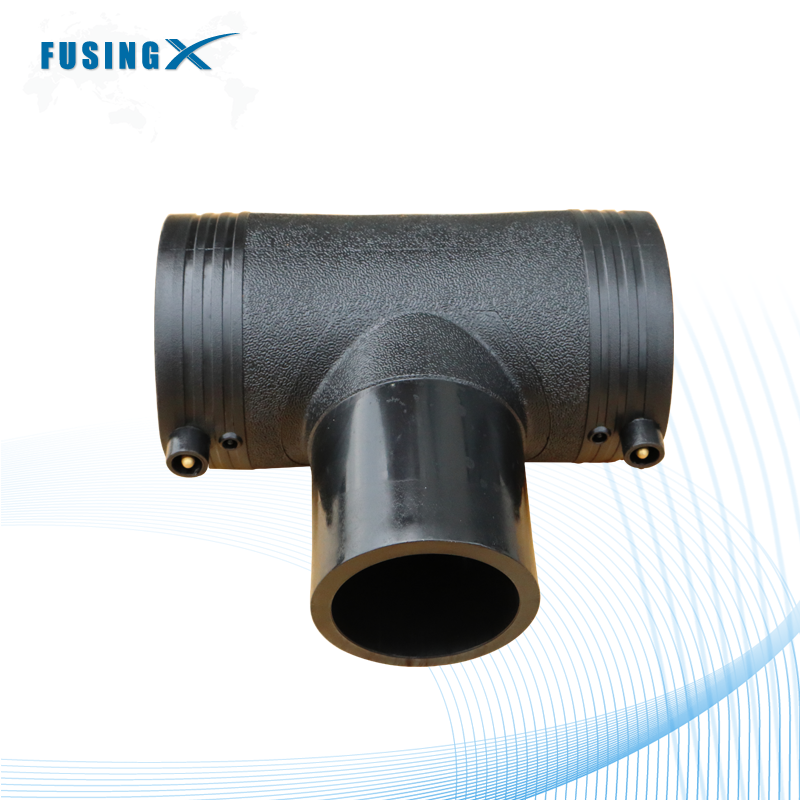
Electrofusion fittings offer a highly reliable alternative, particularly in tight trenches where butt fusion machines cannot operate, or when joining pipes with slight SDR mismatches. Electrofusion couplings contain embedded heating coils that melt the fitting and the pipe surface simultaneously. While electrofusion is more forgiving of wall thickness variations, it requires exact pipe preparation. The pipe surface must be scraped or peeled to remove the oxidized layer, exposing virgin polyethylene. Installers must use mechanical peeling tools rather than hand scrapers to ensure a uniform peeling depth of 0.007 to 0.010 inches. Failure to properly scrape the pipe is the leading cause of electrofusion joint failure. The oxidized layer prevents molecular entanglement during the melt phase, resulting in a joint that may pass an initial hydrostatic pressure test but will inevitably fail under long-term operational stress.
When environmental conditions prohibit welding, or when transitioning to dissimilar materials like carbon steel, ductile iron, or PVC, fusion must be abandoned in favor of mechanical fittings and flange adapters. Mechanical joints utilize compression glands, grip rings, or bolted flanges to create a watertight seal.
Using mechanical compression fittings on HDPE introduces a unique challenge known as polymer creep. Under continuous mechanical pressure, polyethylene will slowly deform or cold flow away from the compression zone, eventually leading to a loose joint and a catastrophic pull-out. To prevent this, mechanical fittings installed on HDPE must always incorporate an internal stiffener. When installing mechanical compression fittings on HDPE, field crews must follow a specific sequence. First, cut the pipe square and deburr the edges. Second, insert the internal stiffener fully into the pipe end until the flange sits flush against the pipe face. Third, slide the compression ring and gland over the pipe. Finally, torque the bolts in a star pattern to the manufacturer's specified foot-pounds. The stiffener supports the internal diameter of the pipe, providing a rigid backing for the external compression ring to grip against, ensuring long-term joint stability.
Common HDPE Fitting Compatibility Mistakes and Quality Checks
Procurement errors routinely derail project timelines and compromise system safety. One of the most frequent specification errors is confusing DR with SDR. While all SDRs are DRs, not all DRs are SDRs. Ordering a custom DR fitting when a standard SDR is required can lead to massive cost overruns and lead time delays. Another common mistake is assuming pressure ratings are identical across different pipe sizes without checking the SDR, or accidentally ordering metric ISO fittings for an imperial IPS pipe system.
Field verification and traceability are the final lines of defense against incompatible components. Every piece of HDPE pipe and every molded fitting features a continuous print line or embossed stamp. Installers must be trained to read this print line before making a single cut or weld. The print line contains the manufacturer's name, nominal size, sizing system, SDR, material designation code, and the relevant ASTM manufacturing standard.
Material delivery inspections must validate compliance with specific manufacturing standards. Butt fusion fittings must conform to ASTM D3261, which governs the dimensions, materials, and testing requirements for molded components. Electrofusion fittings must comply with ASTM F1055. If a fitting arrives on site without clear traceability to these ASTM standards, it should be rejected immediately, regardless of project schedule pressures.
Conclusion
Consult with a qualified piping engineer to verify all hydraulic calculations and pressure class derating factors for your specific application before finalizing designs.
Request comprehensive submittal data, including dimensional drawings and ASTM compliance certificates, from the fitting manufacturer prior to issuing purchase orders.
Obtain and review the specific fusion procedures and heating/cooling times recommended by the manufacturer for the exact resin grades being joined on site.
Implement a mandatory field inspection protocol to verify print lines, sizing systems, and dimensional tolerances immediately upon material delivery.
For project teams seeking an experienced HDPE fitting manufacturing partner, Fusing X has specialized in the R&D, manufacturing, and sales of HDPE fittings since 2005, with capabilities covering butt fusion fittings, electrofusion fittings, PE threaded fittings, siphonic drainage fittings, and customized solutions. Backed by a 20,000 m² production facility, approximately 300 employees, and international supply experience across more than 20 countries, Fusing X supports pipeline projects with integrated manufacturing, product development, and fitting customization capabilities.
FAQ
Q: Does a larger HDPE pipe with the same SDR have a lower pressure rating?
A: No. Because SDR is a proportional ratio of the outside diameter to the minimum wall thickness, the pressure rating remains constant across all pipe sizes. A 4-inch SDR 11 pipe and a 24-inch SDR 11 pipe manufactured from the exact same polyethylene material will have the exact same maximum working pressure.
Q: Can you butt fuse SDR 11 to SDR 17?
A: Direct butt fusion of significantly different wall thicknesses is not recommended. The internal high-low misalignment creates a severe stress concentration point at the joint interface and introduces flow turbulence. To join mismatched SDRs safely, contractors should use electrofusion couplings or machined ID-controlled transition fittings.
Q: What is the difference between IPS and DIPS in HDPE pipe?
A: IPS (Iron Pipe Size) and DIPS (Ductile Iron Pipe Size) utilize completely different outside diameter measurements for the same nominal pipe size. For example, a 6-inch IPS pipe is 6.625 inches in diameter, while a 6-inch DIPS pipe is 6.900 inches. They are not directly compatible and require specialized mechanical adapters to connect.
Q: Can I weld PE4710 fittings to PE3608 pipe?
A: Yes, cross-fusing different resin generations is possible following the Plastics Pipe Institute (PPI) TR-33 guidelines. However, the overall system pressure rating and performance capabilities will be strictly limited by the weaker PE3608 component, regardless of the PE4710 fitting's higher strength.
Q: Do molded and fabricated HDPE fittings have the same pressure rating?
A: Not always. Molded fittings generally carry the full pressure rating of their designated SDR. Fabricated or mitered fittings possess complex stress geometries at the weld seams, which often results in a lower pressure rating than a molded fitting of the same SDR. Fabricated fittings frequently require specific derating factors.
Q: Why do I need an internal stiffener with mechanical fittings?
A: Polyethylene is susceptible to polymer creep, meaning it will slowly deform away from continuous mechanical pressure. An internal stiffener supports the inside diameter of the HDPE pipe, providing a rigid surface for the external mechanical compression ring to grip, preventing the pipe from pulling out of the fitting over time.

 English
  العربية
  Français
  Русский
  Español
  Português
  Deutsch
  italiano
  日本語
日本語  한국어
한국어  Nederlands
  Tiếng Việt
  ไทย
ไทย  Polski
  Türkçe
  አማርኛ
አማርኛ  ພາສາລາວ
  ភាសាខ្មែរ
  Bahasa Melayu
  ဗမာစာ
ဗမာစာ  தமிழ்
தமிழ்  Filipino
  Bahasa Indonesia
  magyar
  Română
  Čeština
  Монгол
  қазақ
қазақ  Српски
  हिन्दी
  فارسی
فارسی  Kiswahili
  Slovenčina
  Slovenščina
  Norsk
Norsk  Svenska
  українська
  Ελληνικά
  Suomi
Suomi  Հայերեն
  עברית
עברית  Latine
  Dansk
Dansk  اردو
اردو  Shqip
Shqip  বাংলা
বাংলা  Hrvatski
  Afrikaans
  Gaeilge
  Eesti keel
  Māori
Māori