The stakes of HDPE pipe fusion are incredibly high in modern infrastructure. A single joint failure often leads to catastrophic leaks. These failures trigger costly excavations and cause severe project delays. You simply cannot afford to guess on your joining strategy. We must evaluate these methods based on specific site constraints and pipe diameters. This comparison is never about "good versus bad." It is about matching the right technique to the right environment. Our goal is to provide a rigorous, evidence-based evaluation framework. Project managers and engineers can use this guide to specify the correct fusion method. You will discover the mechanical differences between these techniques. We will explore their unique environmental vulnerabilities and installation costs. By the end, you will confidently select the optimal approach for your next pipeline project.
Key Takeaways
Space dictates method: Butt fusion requires significant horizontal clearance; electrofusion is the standard for tight trenches and vertical repairs.
Cost structures invert: Butt fusion has high initial equipment costs but negligible per-joint material costs. Electrofusion has low equipment costs but higher per-joint material costs.
Operator dependency: Both require certified operators, but butt fusion carries a higher risk of misalignment due to manual facing and pressure calculations.
System transitions: Integrating with valves or existing steel infrastructure requires specific fittings, influencing the primary fusion method chosen.
The Core Mechanics: Integrity and Failure Risks
Understanding the fundamental mechanics of each method helps you predict potential failure points. Both techniques create monolithic joints stronger than the pipe itself. However, they achieve this molecular bond through vastly different physical processes. You must understand these differences to mitigate installation risks.
Butt Fusion Mechanics
Butt fusion relies on simultaneous heating and controlled hydraulic pressure. Operators place the pipe ends into a heavy mechanical carriage. A mechanical planer shaves the pipe ends perfectly flat. Next, a heating plate warms the ends to a precise melting point. The carriage then forces the molten ends together under specific hydraulic pressure.
Success criteria for butt fusion include:
Perfect pipe alignment along the horizontal axis.
Exact temperature control across the entire heating plate.
Precise interfacial pressure calculation based on pipe diameter.
Uninterrupted cooling time under pressure.
Risk profile: This method is highly sensitive to operator error. If the operator miscalculates the drag pressure, the joint will fail. The transition phase between heating and joining is critically vulnerable. Dust or moisture settling on the molten faces during this brief window compromises the molecular bond. Always follow established industry frameworks, such as ASTM F2620, to minimize these risks.
Electrofusion Mechanics
Electrofusion utilizes built-in resistance wires concealed within the fittings. A control box sends a precise electrical current through these wires. The current generates heat, melting the pipe exterior and the fitting interior simultaneously. The molten materials expand and intermix, creating a unified structure.
Success criteria for electrofusion include:
Aggressive pipe scraping to completely remove the surface oxidation layer.
Rigid clamping to prevent any movement during the heating and cooling cycles.
Clean electrical contacts to ensure uninterrupted power delivery.
Risk profile: Electrofusion presents a unique danger of hidden failures. If the pipe is poorly scraped, the oxidized layer acts as a barrier. If the pipe ovality is high, gaps remain between the pipe and the fitting. The joint will fail under subsequent pressure testing, despite looking absolutely perfect on the outside. Peeling the pipe surface using a mechanical rotary tool is mandatory. Hand scraping frequently causes cold joints and catastrophic field failures.
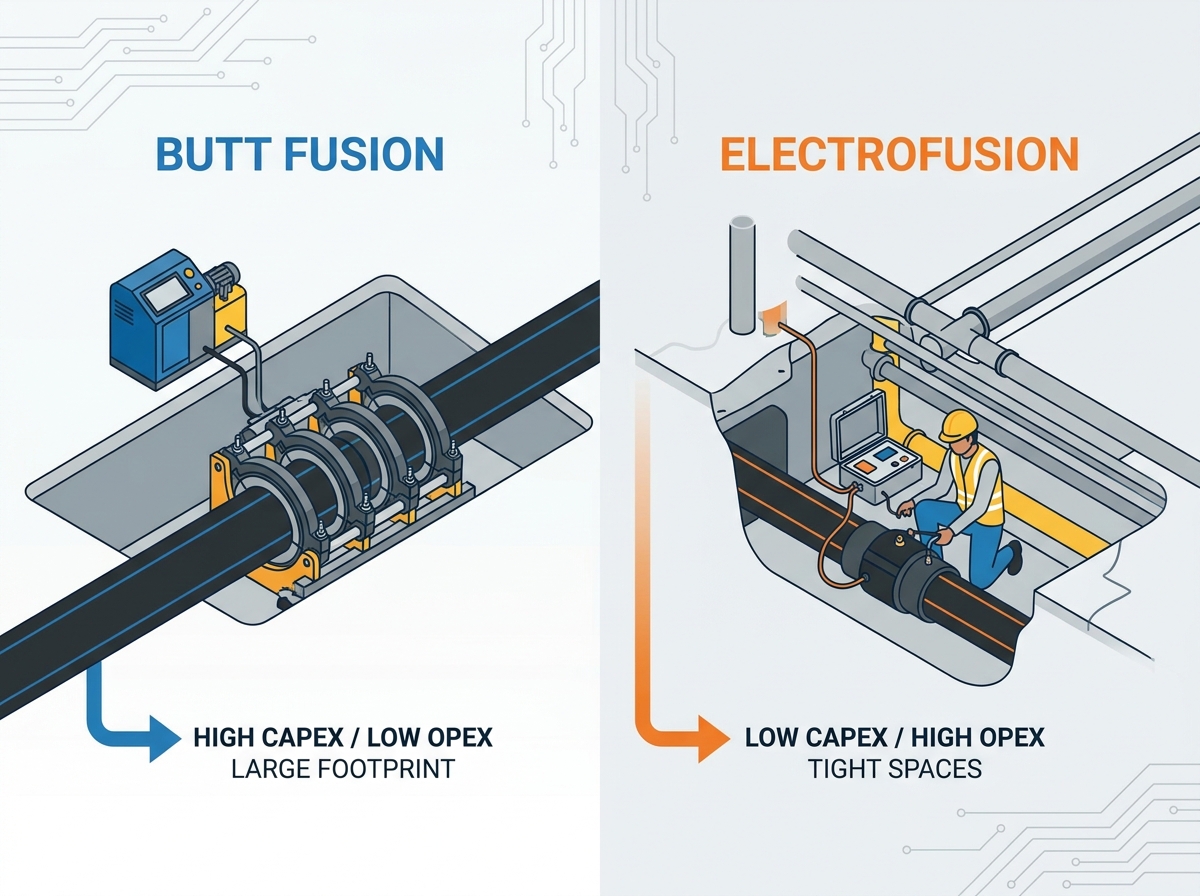
Site Constraints and Environmental Realities
Real-world conditions dictate your joining strategy far more often than engineering preferences. Pipeline projects rarely occur in perfectly controlled environments. You must evaluate the physical space and weather conditions before selecting a method.
Trench Footprint & Excavation Costs
Butt fusion machines require long, continuous horizontal space. They also demand a highly stable, level footprint. The equipment carriage is heavy and unwieldy. Excavating a trench wide enough to accommodate these machines significantly increases your earthwork budget. You must also factor in the logistical challenge of lowering heavy equipment into deep excavations.
Electrofusion requires minimal clearance. The operator only needs enough room to access the pipe circumference for scraping and clamping. This minimal footprint makes it strictly necessary for in-trench tie-ins. It is the only viable option for densely packed urban utility corridors. When you encounter vertical drops or tight angles, electrofusion is generally your only practical choice.
Weather and Contamination Control
Both methods require rigorous shielding from rain, snow, and extreme cold. Moisture instantly destroys any HDPE fusion bond. You must use welding tents during adverse weather conditions. Temperature extremes also alter cooling times, requiring careful operator monitoring.
Electrofusion is marginally more vulnerable to wind-blown dust. The scraped zone remains exposed before the fitting is sleeved over the pipe end. If dust contaminates this prepared surface, the resulting bond will weaken. Operators must clean the scraped area using isopropyl alcohol immediately before assembly.
Total Cost of Installation: Equipment vs. Materials
Financial considerations play a massive role in project planning. You cannot simply look at the price of a single weld. You must evaluate the broader expenditure structures associated with each technique.
Capital Expenditure (CapEx)
Butt fusion rigs are heavy, expensive capital assets. A large-diameter machine requires a massive upfront investment. Contractors often need specialized transport trailers and high-capacity generators to run them. The barrier to entry for performing large butt welds is substantial. Many contractors opt to rent this heavy equipment to offset capital drain.
Electrofusion control boxes are highly portable. They are lightweight and relatively inexpensive. A single operator can carry the control unit by hand. The power requirements are also significantly lower. This lower equipment cost creates a very accessible barrier to entry for smaller plumbing and utility contractors.
Operational Expenditure (OpEx) & Per-Joint Costs
Butt fusion costs roughly nothing per joint in raw materials. The process only consumes labor hours and generator fuel. Once you deploy the machine, you can weld pipe continuously without buying extra components. It remains the superior financial choice for long, straight runs of new pipe.
Electrofusion relies entirely on consumable fittings. Every single joint requires a new, engineered component. High-quality Electrofusion Couplers scale up in price significantly as pipe diameter increases. A standard coupler for a two-inch pipe is inexpensive. A similar coupler for a twenty-four-inch main is a major line-item expense. This escalating material cost makes the method cost-prohibitive for miles of straight-line installation.
Common Mistake: Project managers often focus solely on the low rental cost of an electrofusion box. They fail to calculate the cumulative cost of consumable fittings across a long pipeline. Always run a break-even analysis before finalizing your procurement strategy.
Transition Connections and System Architecture
Infrastructure systems rarely exist in isolation. New HDPE pipelines eventually connect to legacy systems. You must navigate transitions between different materials, varying pressure ratings, and mechanical hardware.
Connecting Dissimilar SDRs
Standard Dimension Ratio (SDR) defines the wall thickness of an HDPE pipe. Projects often require joining pipes featuring slightly varying wall thicknesses. Electrofusion can often bridge these dissimilar SDRs successfully. The fitting sleeves over the outside diameter, forgiving slight internal variations. Butt fusion strictly requires matching wall thicknesses. If you attempt to butt fuse dissimilar SDRs, the surface area alignment fails. This mismatch creates a weak, stepped internal lip causing turbulence and eventual joint failure.
Mechanical and Valve Transitions
Pipelines must eventually interact with valves, pumps, and ductile iron networks. These components utilize flanged connections rather than fused joints. When transitioning from HDPE to flanged mechanical valves, contractors typically fuse a Butt Fusion Flange Adapter to the pipe end. They pair this adapter with a metal backing ring. This assembly creates a highly secure, bolt-ready connection. You can seamlessly bolt the HDPE line directly into heavy municipal water infrastructure.
Repair Scenarios
Emergency pipeline repairs operate under extreme constraints. Cut-and-replace repairs almost exclusively mandate electrofusion. When you excavate a damaged pipe segment, the remaining buried pipes are locked securely in the soil. You possess no ability to move existing buried pipes linearly into a butt fusion machine. You must drop a replacement spool piece into the gap. You then slide electrofusion couplers over the existing ends to finalize the repair without moving the heavy mainline.
The Evaluation Matrix: How to Specify the Right Method
Selecting the optimal fusion strategy requires balancing space, budget, and system architecture. We developed the following practical matrix to guide your daily specification decisions.
Decision Criteria | Butt Fusion | Electrofusion |
Space Availability | Requires wide, long, stable ground. | Requires minimal access space. |
Installation Type | Long, continuous straight runs. | Tie-ins, repairs, tight angles. |
Cost Driver | High equipment CapEx. | High consumable OpEx. |
Wall Thickness (SDR) | Must match exactly. | Can accommodate minor variances. |
Choose Butt Fusion When:
You are installing long, straight runs of new continuous pipe. Typical examples include cross-country water mains and long directional drills.
Sufficient above-ground staging area is freely available.
Your material budget is tight, but heavy equipment access remains completely unrestricted.
You want to eliminate the long-term supply chain risk of sourcing specialized fittings.
Choose Electrofusion When:
You are executing in-trench tie-ins, emergency cut-outs, or live saddle connections.
You are working in congested utility trenches governed by strict excavation limits.
Your pipe diameters and SDR profiles require flexible bridging.
You face severe access restrictions preventing large machinery deployment.
Conclusion
Neither method is universally superior across all infrastructure projects. Their viability is completely determined by the project environment. Butt fusion remains the undisputed champion for cost-effective, long-distance mainline construction. Electrofusion reigns supreme for repairs, complex transitions, and confined spaces. The most resilient infrastructure projects utilize both methods strategically.
We must reiterate the critical nature of operator qualification regardless of the method chosen. Adhering to standards like ASTM F1290 or ISO guidelines is not optional. A poorly trained operator will ruin a joint utilizing either technique. We strongly prompt engineers to review their upcoming site schematics carefully. Consult with your technical sales representatives early in the planning phase. Calculate the distinct breakeven point between heavy equipment rental and consumable fitting costs to protect your project budget.
FAQ
Q: Can you butt fuse pipes with different wall thicknesses (SDR)?
A: No. Butt fusion requires matching wall thicknesses to ensure equal melt and pressure distribution. Mismatched SDRs create weak joints and internal turbulence. You must use transition fittings or electrofusion to join pipes featuring different wall thicknesses.
Q: Are electrofusion joints as strong as butt fusion joints?
A: Yes, when properly prepared. Both joints, if executed to strict industry standards, achieve a molecular bond. They are engineered to be inherently stronger than the pipe itself. Preparation is the deciding factor in joint integrity.
Q: What is the most common cause of electrofusion failure?
A: Inadequate scraping of the pipe surface causes most failures. Failing to mechanically remove the outer oxidized layer prevents true molecular entanglement. The plastic melts but never fuses together, resulting in a disastrous cold joint.
Q: Is cooling time faster for one method over the other?
A: Cooling times are dictated by pipe diameter and wall thickness rather than the fusion method itself. Both techniques strictly require zero mechanical stress on the joint until the plastic has fully cooled to ambient temperature.

 English
  العربية
  Français
  Русский
  Español
  Português
  Deutsch
  italiano
  日本語
日本語  한국어
한국어  Nederlands
  Tiếng Việt
  ไทย
ไทย  Polski
  Türkçe
  አማርኛ
አማርኛ  ພາສາລາວ
  ភាសាខ្មែរ
  Bahasa Melayu
  ဗမာစာ
ဗမာစာ  தமிழ்
தமிழ்  Filipino
  Bahasa Indonesia
  magyar
  Română
  Čeština
  Монгол
  қазақ
қазақ  Српски
  हिन्दी
  فارسی
فارسی  Kiswahili
  Slovenčina
  Slovenščina
  Norsk
Norsk  Svenska
  українська
  Ελληνικά
  Suomi
Suomi  Հայերեն
  עברית
עברית  Latine
  Dansk
Dansk  اردو
اردو  Shqip
Shqip  বাংলা
বাংলা  Hrvatski
  Afrikaans
  Gaeilge
  Eesti keel
  Māori
Māori 


