Specifying the correct high-density polyethylene (HDPE) piping system requires balancing stringent safety margins against escalating material costs and handling complexities. Selecting an inadequate pressure class risks catastrophic system failure, environmental damage, and compliance penalties. Over-speccing inflates project budgets through unnecessary material weight and increased joining difficulty. System designers must navigate varying fluid dynamics, external soil loads, and temperature fluctuations to pinpoint the exact pipe dimensions required for long-term stability.
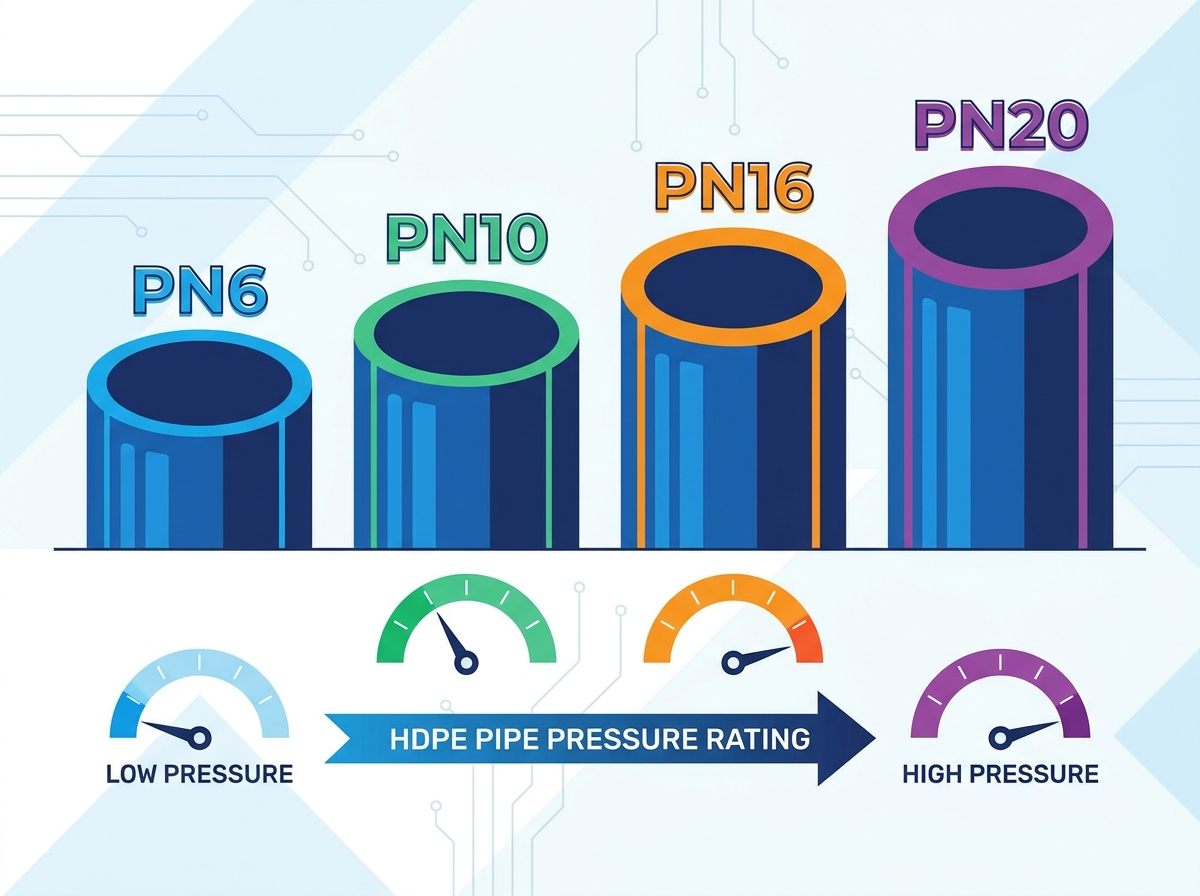
This guide provides a technical evaluation framework for the HDPE pipe pressure rating system. We detail the operational limits of PN6, PN10, PN16, and PN20 classes to ensure precise alignment with project engineering requirements. By understanding the mechanical properties of polyethylene resin and the mathematics behind wall thickness ratios, contractors and engineers can optimize both network performance and installation efficiency.
PN Baseline & Design Life: "PN" (Pressure Nominal) directly correlates to the maximum allowable operating pressure in bars at a base temperature of 20°C, engineered for a standard 50-year design life (e.g., PN10 = 10 bar / 145 psi).
The SDR Relationship: Pressure ratings are inextricably linked to the Standard Dimension Ratio (SDR); a lower SDR indicates a thicker pipe wall and a higher pressure capacity.
Material Dependency: The classification of the raw polyethylene resin (PE80 vs. PE100) dictates the pipe's hydrostatic design stress, meaning a PE100 pipe will achieve higher pressure ratings at thinner wall dimensions than PE80.
Operational Derating: Nominal pressure ratings must be mathematically derated for systems operating at elevated temperatures or those subject to severe cyclical fatigue (water hammer).
Table of Contents
Toggle
How HDPE Pipe Pressure Ratings Work
European standards like ISO 4427 and EN 12201 set the global baseline for polyethylene pressure classes. The Pressure Nominal (PN) number represents the absolute maximum sustained operational pressure in bars. This standardized metric assumes a constant internal fluid temperature of exactly 20°C. It calculates material endurance based on a continuous 50-year operation cycle. American Water Works Association (AWWA) standards utilize similar hydrostatic design bases. They often express limits in PSI. The PN rating serves as the foundational metric for all subsequent engineering calculations on site.
The Standard Dimension Ratio (SDR) dictates the physical pressure capacity of any polyethylene pipe. You calculate the SDR by dividing the nominal outside diameter by the minimum wall thickness. A lower SDR value directly translates to a thicker pipe wall. Thicker walls inherently withstand higher internal hoop stresses generated by pressurized fluids. Engineers evaluate the SDR as the primary physical variable during system design. Selecting an SDR 11 pipe guarantees a thicker wall and higher pressure tolerance than an SDR 17 pipe of the same outside diameter.
Consider a standard 110mm pipe. At SDR 11, the wall thickness measures 10mm. That same 110mm pipe at SDR 17 features a wall thickness of just 6.6mm. This physical difference changes everything from internal pressure capacity to the size of the welding clamps you need on the job site. Field crews must adjust their handling techniques based on these dimensional realities.
Raw material classification heavily influences the final hydrostatic design stress. Older PE80 resin offers a Minimum Required Strength (MRS) of 8.0 MPa. Modern PE100 resin provides an upgraded MRS of 10.0 MPa. Modern high-pressure applications default almost exclusively to PE100. The stronger molecular structure of PE100 allows manufacturers to achieve higher pressure ratings using thinner walls. Thinner walls optimize internal flow rates, reduce overall pipeline weight, and minimize the energy required for fusion welding.
Polyethylene Resin Comparison Matrix
Material Grade
Minimum Required Strength (MRS)
Hydrostatic Design Stress (HDS)
Typical Application Focus
PE80
8.0 MPa
6.3 MPa
Low-pressure gas, legacy water networks, smaller diameters
PE100
10.0 MPa
8.0 MPa
High-pressure water, industrial mains, large diameter infrastructure
HDPE PN Pressure Rating Chart: Bar, PSI, and SDR
Standard HDPE Pressure Conversion Matrix (PE100)
PN Class
Maximum Pressure (Bar)
Maximum Pressure (PSI)
Typical SDR (PE100)
PN4
4 Bar
58 PSI
SDR 41
PN6
6 Bar
87 PSI
SDR 26
PN8
8 Bar
116 PSI
SDR 21
PN10
10 Bar
145 PSI
SDR 17
PN12.5
12.5 Bar
181 PSI
SDR 13.6
PN16
16 Bar
232 PSI
SDR 11
PN20
20 Bar
290 PSI
SDR 9
PN25
25 Bar
362 PSI
SDR 7.4
Interpreting manufacturer charts correctly prevents critical design errors during procurement. Nominal ratings assume steady-state pressure and pure water conveyance. Any deviation from these baseline conditions requires mathematical adjustments. Site engineers must verify whether the stated PN rating applies to PE80 or PE100 material before finalizing orders. A chart specifying PN10 for an SDR 13.6 pipe indicates the use of older PE80 resin. Modern PE100 achieves PN10 at a much lighter SDR 17.
Intermediate pressure classes like PN8 and PN12.5 serve a vital role in pipeline optimization. Utilizing these intermediate ratings prevents costly over-speccing when a system's requirements fall between standard brackets. If a municipal water network requires exactly 11.5 bars of sustained pressure, jumping directly to a PN16 class wastes significant material. Specifying a PN12.5 class provides the necessary safety margin without adding excess weight. This reduces freight costs and accelerates the welding process. Field crews handle SDR 13.6 much easier than SDR 11 when maneuvering 12-meter pipe lengths into a trench.
HDPE PN6, PN10, PN16, and PN20: Key Differences
PN6 (6 Bar / 87 PSI): Gravity-Fed and Low-Pressure Systems
Stormwater management, gravity sewer mains, and low-pressure agricultural irrigation networks frequently utilize PN6 piping. These applications rely on natural elevation drops rather than mechanical pumps to move fluids. The thin walls of PN6 pipe provide an exceptionally high internal flow capacity. This maximized cross-sectional area allows large volumes of water to pass through without generating excessive friction loss.
These thin walls remain highly susceptible to external crushing forces. Deep burial requires meticulous trench bedding and soil compaction to prevent pipe deflection. Contractors must achieve strict compaction densities around the pipe zone. The surrounding soil must bear the structural load, not the pipe itself. PN6 pipe is strictly unsuitable for pump-driven mains. You must avoid using this class in any system with potential pressure surges. The minimal wall thickness cannot absorb kinetic energy spikes.
PN10 (10 Bar / 145 PSI): Standard Municipal and Agricultural Water
Standard municipal potable water distribution relies heavily on PN10 piping. Rural water supply networks and general fluid transport systems also default to this versatile pressure class. PN10 represents the industry sweet spot for general infrastructure. It balances adequate internal pressure containment with manageable material weight. Installation crews can often maneuver smaller diameter PN10 pipes manually. You do not always need heavy excavators for every single lift, which speeds up daily production rates.
Despite its versatility, PN10 networks require careful hydraulic analysis. Rapid valve closures or sudden pump failures cause severe water hammer. Engineers may require surge tanks or specialized air release valves to protect PN10 networks from fatigue failure. The pipe handles 10 bars of steady pressure easily. However, repeated transient spikes exceeding 15 bars will eventually compromise the molecular structure of the polyethylene.
PN16 (16 Bar / 232 PSI): High-Pressure, Industrial, and Long-Distance
High-head pumping mains and industrial process water systems demand the robust containment of PN16 piping. Mining operations frequently use this class for abrasive slurry transport. Horizontal directional drilling (HDD) installations favor PN16 due to the immense tensile stresses exerted during the pullback process. The thicker walls provide significant resistance to external point loading from rocky soils. They handle internal pressure transients with minimal deformation.
The primary limitation of PN16 involves its reduced internal diameter. The thick walls encroach on the flow area. This impacts overall flow rates and increases fluid friction. The heavier weight per meter significantly increases freight costs. On-site contractors require heavy lifting equipment and larger fusion welding machines. Thick-walled joints demand longer heating and cooling times during the butt-fusion process, which lowers the total number of welds a crew can complete in a single shift.
PN20 (20 Bar / 290 PSI): Extreme Stress and Specialized Applications
Deep well extraction and extreme elevation-change pumping systems push the limits of polyethylene technology. These scenarios require PN20 piping. High-pressure industrial chemical transport also utilizes this class to maximize safety margins. PN20 offers the maximum standard pressure containment available in typical HDPE manufacturing. The extreme wall thickness ensures absolute stability under severe hydrostatic loads.
Working with PN20 introduces significant logistical and financial challenges. It carries the highest material cost per meter due to the sheer volume of resin required. The internal cross-sectional flow area experiences a massive reduction. Engineers often upsize the outer diameter to maintain required flow rates. Joining PN20 pipe requires specialized butt-fusion parameters. The massive weld bead requires extended soaking and cooling times to solidify correctly. Rushing the cooling phase on an SDR 9 pipe guarantees a failed joint.
How to Choose the Right HDPE Pipe Pressure Rating
Calculating total system pressure requires more than reading the static head. You must combine static elevation pressure with dynamic friction losses generated during peak flow. Anticipate surge pressures resulting from water hammer events. Standard engineering allowances for transient surges often reach 1.5 times the nominal rating. You must differentiate clearly between temporary transient spikes and continuous steady-state operating pressure to avoid catastrophic blowouts.
Follow these sequential steps to determine baseline system pressure requirements:
Calculate the maximum static head based on the highest elevation difference in the pipeline route.
Determine dynamic friction losses using the Hazen-Williams or Darcy-Weisbach equations for your target flow rate.
Calculate potential surge pressure generated by the fastest valve closure time in the network.
Add the static head and dynamic friction loss to establish the continuous operating pressure.
Verify that the continuous operating pressure plus the surge pressure does not exceed the allowable transient limit of the selected PN class.
When a valve closes rapidly in a high-velocity network, the kinetic energy of the moving fluid converts instantly into potential energy. This creates a high-pressure shockwave. Engineers calculate this transient spike using the Joukowsky equation. Because HDPE is a viscoelastic material, it absorbs and dampens these shockwaves much better than rigid metallic pipes. If a PN10 system operates at 8 bars steady-state, a sudden pump trip might generate a 6-bar surge. The total transient pressure hits 14 bars. While HDPE handles occasional surges up to 1.5 times its nominal rating, continuous cyclical surging causes fatigue failure.
Apply strict temperature derating coefficients when fluid or ambient temperatures exceed the 20°C baseline. High temperatures soften polyethylene, reducing its tensile strength. A PN16 pipe may only operate safely at 10 bar when continuous fluid temperatures reach 40°C. Calculate these derating factors using established ISO guidelines before finalizing procurement. Failing to account for high-temperature industrial effluent leads to rapid pipe expansion and eventual rupture.
Standard Temperature Derating Factors for PE100
Continuous Operating Temperature
Derating Coefficient (Multiplier)
Effective Pressure for PN16 Pipe
20°C
1.00
16.0 Bar
30°C
0.87
13.9 Bar
40°C
0.74
11.8 Bar
50°C
0.59
9.4 Bar
Transporting aggressive chemicals or hydrocarbons requires additional safety factors. Certain chemicals permeate the polyethylene matrix over time. This permeation reduces structural integrity and lowers the effective burst pressure. Apply chemical derating factors alongside temperature adjustments. Consult the resin manufacturer's chemical resistance charts to determine the exact multiplier required for your specific fluid composition.
Trench depth, traffic loads, and installation methods exert severe external pressure on buried pipelines. Buried flexible pipes rely on soil-structure interaction to maintain their shape. When you bury a thin-walled PN6 pipe, the vertical earth load attempts to flatten the pipe into an oval. If the trench backfill is loose, the pipe deflects beyond its allowable limit, leading to structural collapse. Field crews must use crushed stone or engineered granular fill in the pipe zone. They must compact this material in 150mm lifts to achieve at least 90% Standard Proctor density. Thicker pipes like PN16 possess higher inherent ring stiffness. They resist deflection naturally, providing a larger margin of error during backfilling operations in poor native soils.
Trenchless installation methods subject the pipe to extreme mechanical stress before it ever sees a drop of water. During an HDD pullback, the drill rig pulls the continuous pipe string through a subterranean borehole. This generates massive tensile loads. The pipe must resist stretching while navigating curved drill paths. Engineers often specify PN16 or PN20 pipe for HDD projects purely for the increased tensile yield strength provided by the thicker walls. A PN10 pipe might handle the internal fluid pressure perfectly fine, but it would deform permanently during a 300-meter pullback through dense clay.
Operating continuously at the absolute maximum HDPE pipe pressure rating impacts longevity. Frequent pressure cycling accelerates material fatigue through microscopic crack propagation. A standard 50-year design life assumes normal operational parameters with built-in safety margins. If a system constantly fluctuates between zero and maximum pressure, engineers must apply fatigue derating factors to ensure the pipeline survives its intended lifespan.
Common HDPE Pressure Rating Mistakes and Cost Considerations
Defaulting to PN16 or PN20 when a PN10 rating suffices wastes critical project capital. Resin costs increase exponentially as wall thickness grows. Freight expenses rise sharply because fewer heavy, thick-walled pipes fit on a standard delivery truck. Heavier pipes lead to slower installation times. Field crews require larger excavators to lift the pipe and extended fusion welding cycles to join it. Over-speccing creates a compounding financial burden that offers no additional operational benefit for low-pressure systems.
Under-speccing introduces severe operational risks that far outweigh initial material savings. Exceeding the nominal rating causes creep rupture. The pipe slowly balloons and eventually bursts under sustained stress. Material fatigue builds up invisibly over time when subjected to repeated over-pressurization. These failures lead to costly emergency excavations, extensive network downtime, and potential environmental remediation costs if hazardous fluids escape the containment zone.
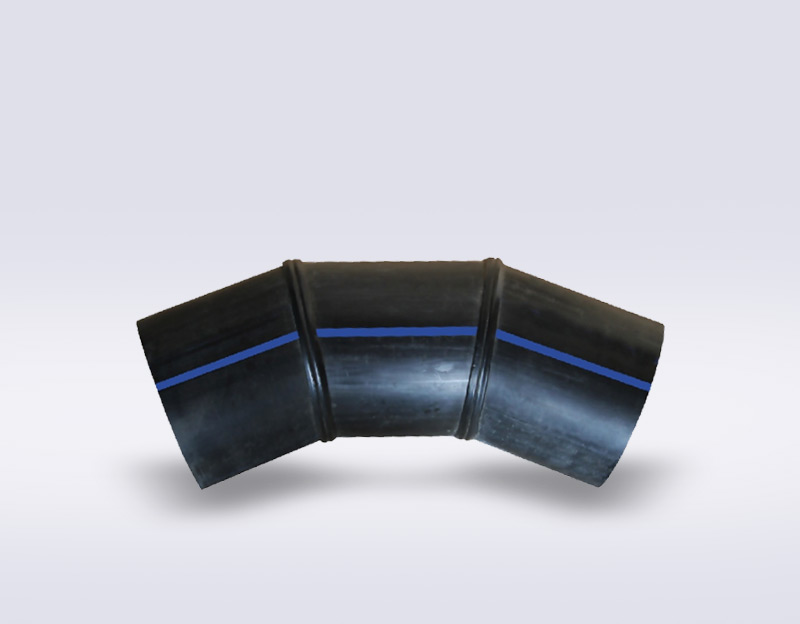
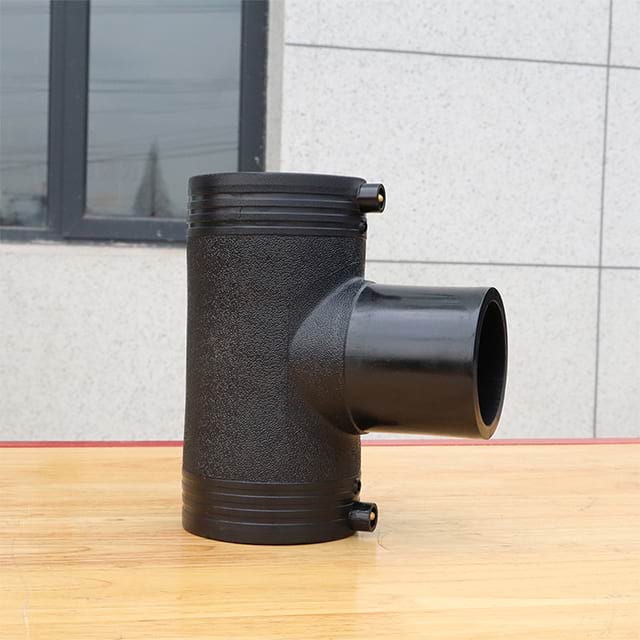
Different PN ratings result in different internal wall thicknesses for pipes with the same outside diameter. You must never butt-weld pipes of different SDRs directly together. The mismatched wall thicknesses create uneven heating zones. This results in weak, stepped joints that disrupt fluid flow and concentrate stress at the weld seam. You must use specialized transition fittings or electrofusion couplers to connect different pressure classes safely. Electrofusion utilizes embedded heating coils to weld the outside of the pipe, bypassing the internal wall mismatch entirely.
Butt fusion welding requires precise control of temperature, pressure, and time. These parameters change drastically depending on the PN rating. Welding an SDR 17 pipe requires less interfacial pressure and shorter heat soak times than an SDR 9 pipe. When the heating plate is removed, the thicker wall of the PN20 pipe retains massive amounts of thermal energy. Crews must leave the pipe clamped under pressure for significantly longer cooling periods. Removing the pipe from the machine too early allows the residual heat to soften the weld zone, causing the joint to pull apart under its own weight.
Conclusion
Calculate the absolute maximum system pressure by combining static head, dynamic friction, and water hammer transients.
Apply temperature and chemical derating multipliers based on actual site conditions to determine the true operational capacity.
Evaluate external trench loads and installation stresses to verify if a thicker wall is structurally necessary.
Specify matching SDR transition fittings or electrofusion couplers when connecting different pressure classes across the network.
For HDPE piping projects that require reliable connections across different pressure classes and installation conditions, Fusing X has specialized in the R&D, manufacturing, and supply of HDPE fittings since 2005. With a product portfolio covering butt fusion fittings, electrofusion fittings, PE threaded fittings, and customized pipeline solutions, Fusing X supports engineers and contractors in building dependable connections for water, industrial, municipal, and infrastructure piping systems.
FAQ
Q: What does PN stand for in HDPE pipes?
A: PN stands for Pressure Nominal. It represents the maximum allowable sustained operating pressure in bars at a standard fluid temperature of 20°C. A PN10 pipe safely handles 10 bars of continuous internal pressure for a 50-year design life.
Q: Can I use PN6 pipe for a pump-based system?
A: No. PN6 pipes feature very thin walls designed primarily for gravity-fed systems like stormwater or low-pressure irrigation. Pump-based systems generate kinetic energy and pressure surges that easily exceed the structural limits of a PN6 pipe, leading to immediate rupture.
Q: How does temperature affect the pressure rating?
A: Polyethylene softens as temperatures rise. The standard PN rating assumes a 20°C environment. If the fluid or ambient temperature exceeds this baseline, you must apply a mathematical derating factor. A pipe rated for 16 bars at 20°C may only safely handle 10 bars at 40°C.
Q: What is the difference between PE80 and PE100?
A: These terms refer to the density and strength of the raw polyethylene resin. PE100 is a modern, stronger material with a higher Minimum Required Strength (10.0 MPa) compared to older PE80 (8.0 MPa). PE100 achieves higher pressure ratings using thinner walls.
Q: Why can't I butt-weld a PN10 pipe to a PN16 pipe?
A: PN10 and PN16 pipes share the same outside diameter but possess different internal wall thicknesses. Butt-welding them directly creates a mismatched, stepped joint. This mismatch causes uneven heat distribution during welding and creates a severe weak point. Use electrofusion fittings instead.
Q: How do I choose between PN10 and PN12.5?
A: Base your choice on the exact maximum calculated pressure, including surge allowances. If your system peaks at 11 bars, PN10 is inadequate. PN12.5 provides the necessary structural safety margin without forcing you to pay for the excessive thickness and weight of a PN16 pipe.

 English
  العربية
  Français
  Русский
  Español
  Português
  Deutsch
  italiano
  日本語
日本語  한국어
한국어  Nederlands
  Tiếng Việt
  ไทย
ไทย  Polski
  Türkçe
  አማርኛ
አማርኛ  ພາສາລາວ
  ភាសាខ្មែរ
  Bahasa Melayu
  ဗမာစာ
ဗမာစာ  தமிழ்
தமிழ்  Filipino
  Bahasa Indonesia
  magyar
  Română
  Čeština
  Монгол
  қазақ
қазақ  Српски
  हिन्दी
  فارسی
فارسی  Kiswahili
  Slovenčina
  Slovenščina
  Norsk
Norsk  Svenska
  українська
  Ελληνικά
  Suomi
Suomi  Հայերեն
  עברית
עברית  Latine
  Dansk
Dansk  اردو
اردو  Shqip
Shqip  বাংলা
বাংলা  Hrvatski
  Afrikaans
  Gaeilge
  Eesti keel
  Māori
Māori