Pipeline leaks destroy project timelines and create immediate safety hazards. High-Density Polyethylene (HDPE) and Polypropylene Random Copolymer (PPR) piping systems offer decades of reliable service on paper. In the trench, unpredictable joint integrity remains a persistent reality. This unpredictability stems directly from deviations in standard operating procedures and inherent equipment limitations. Department of Energy case studies and industry failure analyses confirm that the vast majority of coupling blowouts are not material defects. Bad pipe or faulty fittings rarely cause leaks. Instead, leaks stem directly from improper installation and poor pipe preparation. Human error compromises the molecular bond before the pipe ever goes into service. We must shift our focus from reactive leak repair to proactive root cause analysis. Establishing a strict framework for identifying vulnerabilities across preparation, equipment, environment, and material categories allows you to implement stringent prevention protocols and eliminate electrofusion joint failure entirely.
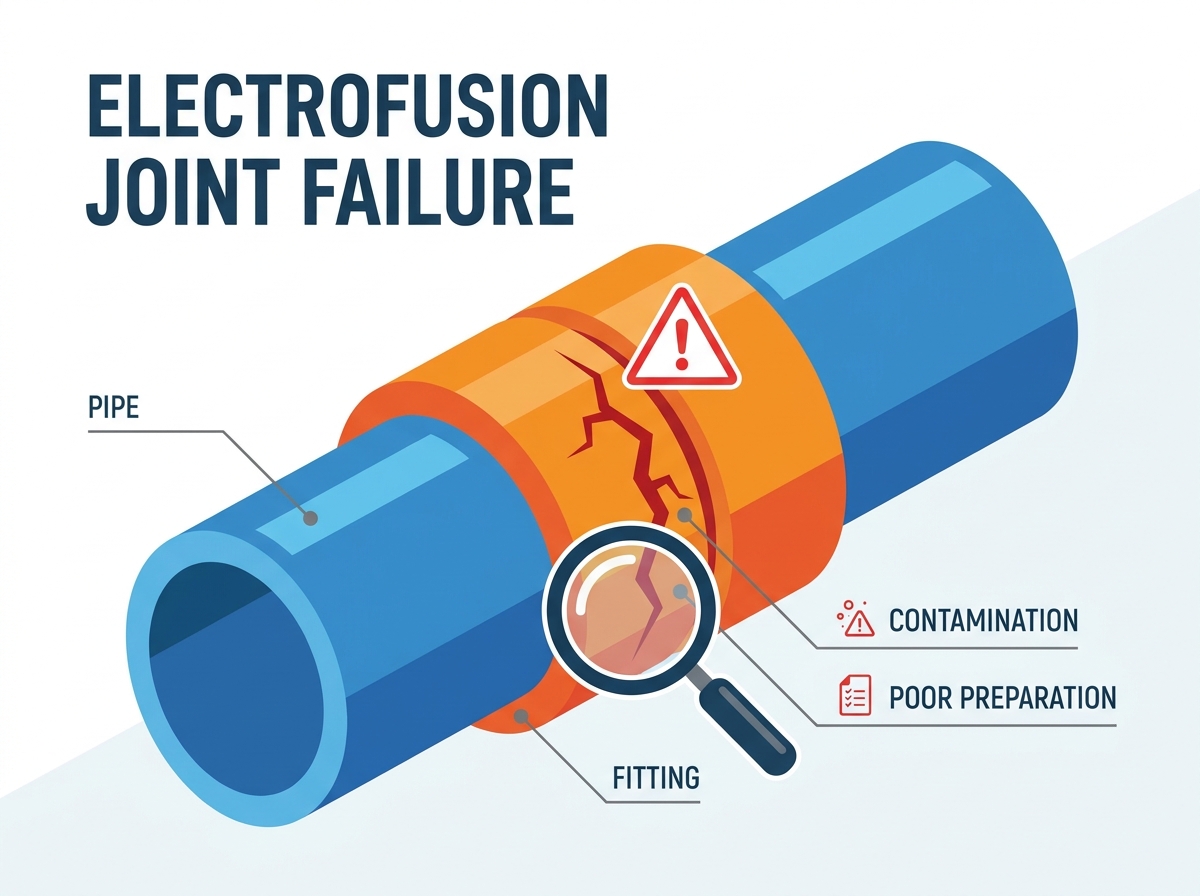
Over 80% of electrofusion joint failures stem from improper pipe preparation, specifically inadequate scraping, lack of cleaning, and contamination.
Relying solely on manual oversight is a critical vulnerability; modern Electrofusion Control Units (ECUs) with automated data logging are essential for verifiable QA/QC.
Preventing failure requires a holistic approach combining certified technician training, calibrated equipment, and rigorous non-destructive or destructive testing protocols.
Table of Contents
Toggle
How Electrofusion Joint Failure Happens
The Mechanics of a Successful Weld
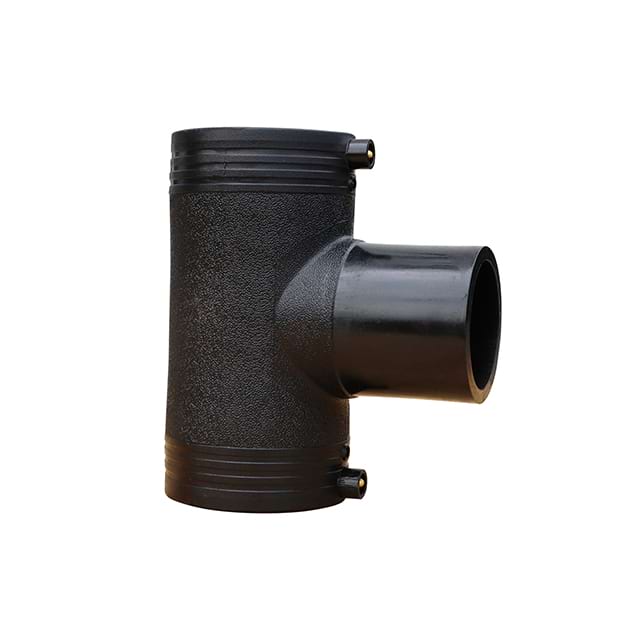
Electrofusion relies on precise electrical resistance heating to fuse thermoplastic materials. Copper coils sit embedded inside the inner surface of the fitting. When you connect the Electrofusion Control Unit (ECU), it sends a specific voltage through these coils. The electrical resistance generates intense heat, typically pushing the polymer interface to temperatures between 200°C and 230°C. This heat melts both the inside of the fitting and the outside surface of the pipe simultaneously.
As the polymers melt, they expand. The outer edges of the electrofusion fitting remain unheated, creating cold zones. These cold zones act as physical barriers that contain the expanding molten plastic. Because the fitting contains this expansion, it creates massive internal melt pressure. This pressure forces the melted polymer chains from the pipe and the fitting to mix and entangle across the fusion interface. Once the heating cycle ends, the joint enters the cooling phase. The polymers crystallize and form a homogenous molecular bond. A successful weld requires optimal melt pressure, correct heat penetration depth, and completely undisturbed cooling phases.
The Cost of Non-Compliance
Failed joints carry heavy financial and operational consequences. When a joint fails a hydrostatic pressure test, operational downtime halts the entire project. You cannot commission the line until you find the leak, excavate the area, cut out the failed section, and splice in a new spool piece. If a joint bursts in service after burial, excavation costs skyrocket. You must secure permits, bring in heavy machinery, set up bypass pumping, and dig through pavement or landscaping.
Regulatory penalties add another layer of financial risk. Environmental agencies issue massive fines for pipeline spills, especially in chemical, mining, or wastewater applications. The cost of a single failed joint far exceeds the cost of proper training and high-quality preparation tools. Cutting corners during installation guarantees expensive rework later.
10 Common Causes of Electrofusion Joint Failure
Preparation and Alignment Deficiencies
1. Inadequate Pipe Scraping and Oxidation Removal
Polymer pipes develop a microscopic layer of oxidation when exposed to UV light and oxygen during storage and transport. You must completely remove this oxidized layer before welding. If you fail to scrape the pipe, the oxidation acts as a physical barrier. The melted polymers cannot entangle, resulting in a weak, brittle bond known as a cold weld. You must remove a continuous ribbon of material, typically 0.2mm to 0.3mm deep, to guarantee a clean surface.
Using a manual hand scraper often leaves un-scraped flat spots and chatter marks. Operators experience hand fatigue and naturally skip the bottom of the pipe. Rotary mechanical scrapers lock onto the pipe and peel a uniform layer across the entire circumference, eliminating the human error associated with manual scraping.
Pipe Preparation Methods Comparison
Preparation Tool
Depth Consistency
Operator Fatigue Risk
Field Reliability
Manual Hand Scraper
Highly Variable
High
Low (Prone to flat spots)
Rotary Mechanical Scraper
Uniform (0.2mm - 0.3mm)
Low
High (Consistent peeling)
Abrasive Sandpaper
Zero (Smears plastic)
High
Zero (Strictly prohibited)
2. Contamination in the Weld Zone
Trenches are dirty environments. Mud, trench water, equipment grease, and dust constantly threaten the weld zone. Even handling the scraped pipe with bare hands deposits sweat, sunscreen, and skin oils onto the surface. These microscopic particulates compromise the molecular bond by preventing polymer chain entanglement. The fusion interface must remain absolutely pristine.
After scraping, you must clean the pipe and the inside of the fitting with approved high-purity, lint-free isopropyl alcohol wipes (minimum 90% concentration). Standard shop rags leave lint and smear grease across the fusion zone. Wipe the pipe in a single direction to lift contaminants off the surface rather than pushing them around. Never touch the prepared surfaces after cleaning.
3. Poor Pipe Alignment and Bending Stress
Pipes must enter the electrofusion fitting perfectly straight and fully inserted. Angular deflection pushes the pipe against one side of the fitting. This creates uneven melt pressure during the heating cycle. The side with heavy contact overheats, while the opposite side fails to build enough pressure for molecular entanglement.
Bending stress also forces the internal heating wires to move. If the wires shift and touch each other, they create an electrical short circuit. This short circuit stops the heating process prematurely or causes localized overheating that burns the plastic. You must always use mechanical alignment clamps to hold the pipes rigid, straight, and stress-free throughout the entire heating and cooling process.
Equipment and Parameter Errors
4. Incorrect Fusion Parameters
Every fitting requires a specific combination of time, temperature, and voltage based on its diameter and wall thickness. Inputting the wrong settings destroys the joint. Manual entry errors happen frequently on busy job sites. A technician might misread a tag and type in a heating time that is too short, causing a cold weld, or too long, causing the polymer to degrade and flow out of the fitting.
Barcode scanning eliminates these manual entry errors. The operator scans the 24-digit ISO barcode attached to the fitting, and the ECU automatically programs the exact voltage and heating time. If a barcode is damaged, the operator must manually enter the 24-digit code, which introduces significant risk. Always verify the ECU display matches the fitting requirements before initiating the weld.
5. Uncalibrated or Faulty Electrofusion Control Units (ECUs)
The ECU controls the entire energy delivery process. Uncalibrated or faulty ECUs deliver inconsistent voltage. Power fluctuations from cheap, undersized site generators cause the ECU to drop the heating cycle. A standard field setup requires a minimum 5kVA continuous output generator to handle the power draw of large-diameter fittings.
Degraded ECU cables or worn terminal ends create electrical resistance outside the fitting. This external resistance reduces the actual energy that reaches the heating coils inside the joint. You must calibrate ECUs annually, inspect all cables for exposed copper, and replace worn terminal ends before every single weld.
Deploy environmental shelters and climate control before proceeding.
6. Inadequate Clamping and Restraint
Tapping tees and branch saddles require specialized clamping mechanisms. You strap these fittings directly onto the side of a main pipe rather than sliding them over the end. Failure to adequately clamp the tapping tee body results in incorrect fusion pressure.
Without tight, uniform clamping, the expanding melted plastic simply extrudes out the sides of the saddle. This melt extrusion leaves voids inside the fusion zone. Conversely, over-tightening the clamp crushes the heating wires, causing a short circuit. Operators must use the exact clamping force specified by the fitting manufacturer, often utilizing torque wrenches to guarantee precise restraint.
Environmental and Material Variables
7. Extreme Ambient Temperatures
Ambient temperature drastically affects the fusion process. Freezing conditions pull heat away from the weld zone, acting as a massive heat sink. This requires more energy to achieve the correct melt depth. Extreme summer heat means the pipe is already hot, requiring less energy to reach the melting point.
If you do not compensate for these extremes, you will over-melt or under-melt the joint. Always use environmental shelters to block wind, rain, and direct sun. Ensure your ECU features automatic temperature compensation sensors. These sensors read the ambient air temperature and adjust the heating cycle time up or down to deliver the perfect amount of energy.
8. Moisture and Condensation
Water destroys electrofusion welds. If moisture exists on the pipe surface during the heating cycle, the 200°C temperatures cause it to boil instantly. Water turning to steam expands to 1600 times its liquid volume. This massive internal pressure creates voids, bubbles, and porosity within the melted polymer.
You cannot see this damage from the outside. The joint will look perfect but will fail under operational pressure. You must dry the pipe completely. In humid environments, heavy morning condensation forms on the pipe surface. Operators must use clean, dry towels and alcohol wipes to remove all moisture immediately before assembling the joint.
9. Material Incompatibility or Out-of-Round Pipes
Fusing dissimilar polymer grades introduces massive risk. PPR and HDPE have completely different melt flow indexes and molecular structures. If you attempt to fuse them without specialized transition fittings, one material will turn to liquid while the other barely softens, resulting in zero molecular entanglement.
Additionally, coiled HDPE pipe retains memory and becomes oval-shaped. Failing to use mechanical re-rounding tools leaves large gaps between the pipe and the fitting. The heating wires cannot bridge these gaps. The energy dissipates into the air gap rather than melting the pipe surface, leading to localized cold zones and inevitable leak paths.
10. Rushed Cooling Phases and Premature Pressurization
The cooling phase dictates the final structural integrity of the joint. As the molten polymers cool, they crystallize and form a strong structural matrix known as spherulites. Removing alignment clamps before the cooling time expires allows the heavy pipe to shift. Even a millimeter of movement tears the forming molecular bonds, permanently weakening the joint.
Applying hydrostatic test pressure prematurely causes catastrophic structural damage. The core of the weld remains soft long after the outside feels cool to the touch. You must follow the manufacturer's exact cooling times printed on the fitting barcode. Never rush the cooling phase to save time on the job site.
Eliminating human error requires investing in modern equipment. Upgrading your Electrofusion Control Units directly improves field outcomes. Look for ECUs equipped with automated ambient temperature compensation. These units read the surrounding air temperature and adjust the heating time automatically, removing the need for operators to calculate manual offsets. GPS tracking logs the exact geographic coordinates of every weld, allowing you to map your entire buried network for future maintenance.
Mandatory barcode scanning eliminates manual parameter entry errors entirely. Beyond the ECU, you must evaluate the tooling used for pipe preparation. Rotary mechanical scrapers provide a massive return on investment. Unlike manual hand scrapers, rotary tools peel a uniform, continuous layer of oxidation from the entire circumference of the pipe. They guarantee correct peeling depth and mitigate the leading cause of joint failure.
Scalability of QA/QC Processes
As pipeline projects scale across multiple crews and miles of trench, manual record-keeping becomes impossible to manage. You need scalable QA/QC processes to maintain oversight. Integrating cloud-based weld data management systems solves this problem. Modern ECUs sync their weld logs directly to the cloud via Bluetooth or cellular connections. This gives project managers real-time visibility into field operations.
Digital traceability allows you to audit contractor performance remotely. You can review the heating time, voltage, ambient temperature, and cooling time for every single joint. If a technician aborts a weld, experiences a power drop, or uses incorrect parameters, the system flags it immediately. You can verify all parameters before the contractor buries the pipe, preventing costly excavation rework down the line.
Compliance and Industry Standards
Evaluating internal SOPs requires a benchmark. You must align your field practices with recognized industry standards. Adhering to these guidelines ensures your contractors follow proven scientific methods for polymer fusion. These standards dictate everything from equipment calibration frequencies to exact scraping depths and cooling times.
Summary of Industry Standards for Electrofusion Welding
Standard Designation
Primary Focus Area
Key Application
ASTM F1290
Standard Practice for Electrofusion Joining
Defines the baseline procedures for preparing and fusing polyolefin pipes and fittings in North America.
ISO 12176
Equipment and Traceability Standards
Specifies the technical requirements for ECUs, barcodes, and data retrieval systems globally.
DVS 2207-1
German Welding Society Guidelines
Provides highly detailed, strict parameters for HDPE welding, widely adopted as the gold standard for industrial applications.
Electrofusion Welding Risks and How to Reduce Them
Training vs. Technology Trade-offs
Pipeline contractors face a constant trade-off between training costs and technology investments. High-end automated equipment reduces human error significantly. Rotary scrapers, alignment clamps, and cloud-connected ECUs force the operator to follow the correct steps. However, this technology requires higher upfront capital expenditure. Smaller contractors often hesitate to make this investment, preferring to rely on basic tools.
Relying on manual equipment and basic ECUs demands continuous, rigorous, and costly technician recertification. Manual scraping requires intense physical effort and high skill to execute perfectly every time. When you factor in the cost of excavating and replacing a single failed joint, the return on investment for automated technology becomes obvious. Mitigate implementation risks by phasing in smart tooling, starting with your most critical large-diameter projects where failure costs are highest.
Testing Protocols: Destructive vs. Non-Destructive
Verifying weld integrity requires strict testing protocols. You should implement destructive testing for initial operator qualification. Before a technician touches a live pipeline, they must fuse sample joints in controlled conditions. You then perform peel tests and crush tests on these samples. Destructive testing physically tears the joint apart to examine the fusion interface. If the pipe breaks before the weld separates, the operator passes the qualification.
For live infrastructure, you cannot destroy the joint to test it. Hydrostatic pressure testing is the standard non-destructive method, but it only tells you if the joint leaks right now. It does not reveal internal weaknesses or cold spots. The emerging role of phased array ultrasonic testing (PAUT) offers a powerful non-destructive mitigation strategy. PAUT uses advanced sound waves to map the internal structure of the electrofusion joint. It identifies hidden voids, cold spots, and contamination without damaging the pipe, providing ultimate peace of mind for critical infrastructure.
Conclusion
Audit your current failure rates against your tooling inventory to prioritize immediate investments in rotary mechanical scrapers and heavy-duty alignment clamps.
Update your site-specific QA/QC checklists to mandate the use of 90% isopropyl alcohol wipes and continuous ribbon scraping for all polymer pipe preparation.
Schedule immediate calibration for all Electrofusion Control Units and inspect all output cables for terminal wear or exposed copper.
Transition to cloud-based data management systems to audit and verify weld parameters remotely before any pipe is buried in the trench.
For pipeline projects that require reliable fusion connections and consistent product quality, Fusing X has specialized in the R&D, production, and supply of HDPE pipe fittings since 2005, with a portfolio covering electrofusion fittings, butt fusion fittings, PE threaded fittings, PP-R piping systems, and customized solutions. Supported by a 20,000 m² production facility and international project experience across more than 20 countries, Fusing X combines manufacturing capability with application-focused support for industrial, municipal, and infrastructure piping projects.
FAQ
Q: What is the most common cause of electrofusion joint failure?
A: The most common cause is inadequate pipe preparation. Failing to remove the UV oxidation layer through proper scraping prevents molecular entanglement. Allowing contamination like dirt, oil, or moisture into the fusion zone also destroys the bond. These preparation errors account for the vast majority of installation failures in the field.
Q: How do you test the integrity of an electrofusion joint?
A: The standard field method is hydrostatic pressure testing, which verifies the line holds operational pressure. Visual inspection of melt indicators confirms energy delivery. For critical applications, advanced non-destructive methods like phased array ultrasonic testing (PAUT) are used to detect internal voids and cold spots without damaging the pipe.
Q: Can you repair a leaking electrofusion joint?
A: No, failed electrofusion joints cannot be re-fused or patched. The standard procedure is to excavate the area and cut out the entire failed section of pipe. You must then replace it using mechanical fittings or splice in a new spool piece with new electrofusion couplings.
Q: What happens if you don't scrape the pipe before electrofusion?
A: Failing to scrape leaves a microscopic layer of UV oxidation on the pipe surface. This oxidation acts as a physical barrier during the heating cycle. It prevents the melted polymers of the pipe and fitting from mixing, resulting in a weak, brittle "cold weld" that will eventually leak.
Q: Are the causes of electrofusion joint failure the same for HDPE and PPR pipes?
A: The core principles of preparation and cleanliness apply to both materials. However, PPR and HDPE have different melt flow indexes and specific scraping depth requirements. Failing to adjust your parameters, tooling, or ECU settings for the specific material type easily leads to joint failure.
Q: How long should an electrofusion joint cool before pressurization?
A: Cooling times vary significantly by pipe diameter, wall thickness, and manufacturer specifications. You must read the barcode or fitting label for exact times. Removing alignment clamps or pressurizing the line prematurely disrupts polymer crystallization, permanently weakening the joint structure and guaranteeing future leaks.
Q: Does ambient temperature affect electrofusion welding?
A: Yes, extreme cold or heat directly impacts the energy required to melt the polymer. Extreme cold acts as a heat sink causing under-melting, while extreme heat causes over-melting. You must use temperature-compensating ECUs and environmental shelters to mitigate these ambient temperature swings during installation.

 English
  العربية
  Français
  Русский
  Español
  Português
  Deutsch
  italiano
  日本語
日本語  한국어
한국어  Nederlands
  Tiếng Việt
  ไทย
ไทย  Polski
  Türkçe
  አማርኛ
አማርኛ  ພາສາລາວ
  ភាសាខ្មែរ
  Bahasa Melayu
  ဗမာစာ
ဗမာစာ  தமிழ்
தமிழ்  Filipino
  Bahasa Indonesia
  magyar
  Română
  Čeština
  Монгол
  қазақ
қазақ  Српски
  हिन्दी
  فارسی
فارسی  Kiswahili
  Slovenčina
  Slovenščina
  Norsk
Norsk  Svenska
  українська
  Ελληνικά
  Suomi
Suomi  Հայերեն
  עברית
עברית  Latine
  Dansk
Dansk  اردو
اردو  Shqip
Shqip  বাংলা
বাংলা  Hrvatski
  Afrikaans
  Gaeilge
  Eesti keel
  Māori
Māori