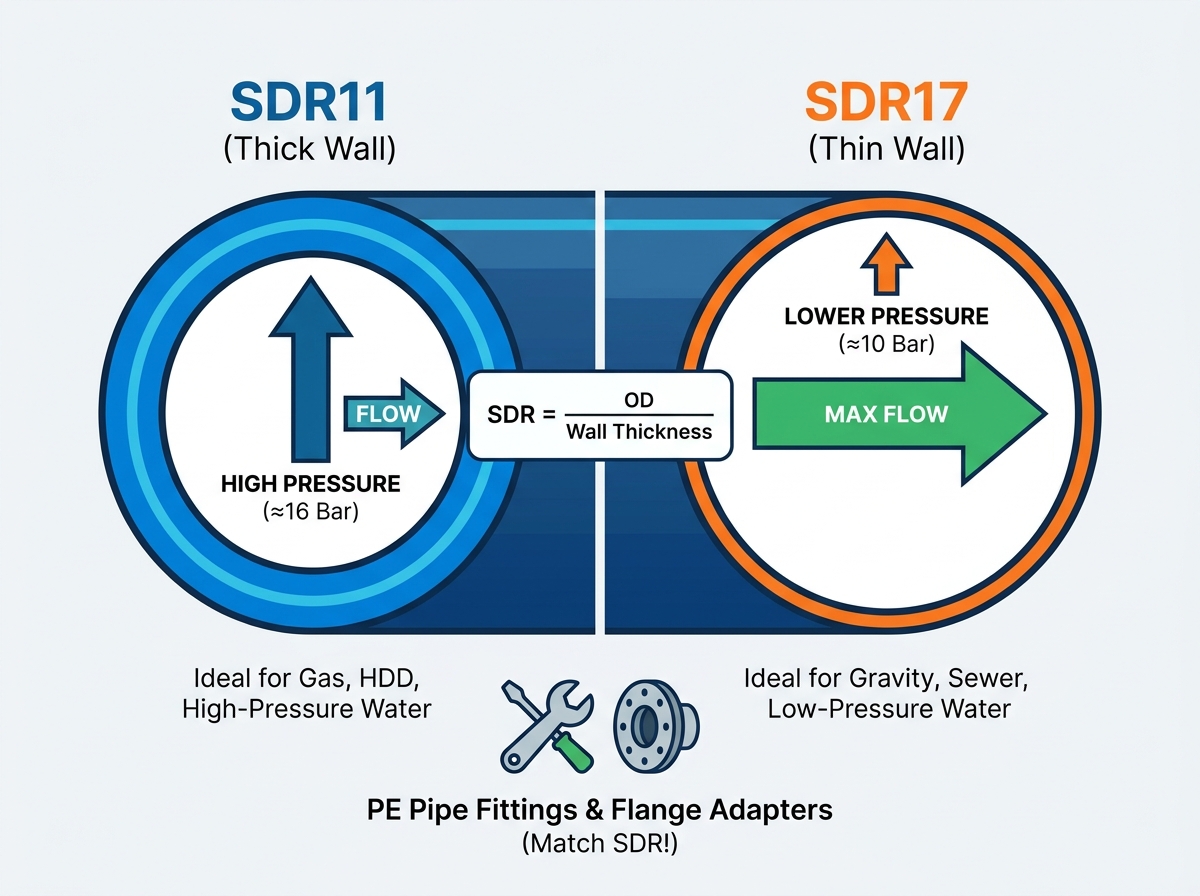
Choosing the wrong Standard Dimension Ratio (SDR) can lead to severe engineering and procurement consequences. Underestimating the pipe specifications may result in catastrophic pressure failures. Conversely, over-specifying materials unnecessarily can waste significant capital budgets. Every infrastructure project relies on precise material specifications.
In high-density polyethylene (HDPE) pipelines, the choice between SDR11 and SDR17 essentially determines the wall thickness. This specific metric directly controls the system's pressure capacity. It also determines physical durability and overall pipe weight. You must balance these structural factors with the realities of underground construction. Engineers cannot rely on guesswork when designing fluid transmission networks.
We will explore a clear framework for evaluating technical limitations, installation realities, and specific application compliance. You will understand exactly how to match pipe specifications with environmental demands. This guide enables engineers and procurement personnel to make highly confident, project-saving purchasing decisions. You will discover how to optimize system safety and hydraulic efficiency.
Key Points
SDR11 has thicker walls, designed for high-pressure applications (e.g., SDR11 PE100 water pipe: PN16 / 16 bar / approx. 232 psi ), gas distribution, and heavy industrial fluid transmission.
SDR17 has thinner walls, maximizing internal flow capacity and reducing material costs, suitable for gravity flow, low-pressure water pipes (SDR17 PE100 water pipe: PN10 / 10 bar / approx. 145 psi), and landfill leachate systems.
Choosing the right pipe directly affects the required PE fittings and compatibility with existing infrastructure.
Cost-effectiveness is not just about pipe prices—consider transport weight, fusion time, and handling equipment.
Business Issue: Balancing Pressure Needs with Hydraulic Capacity
Engineers face ongoing challenges during the pipeline design process. They must balance burst resistance with hydraulic throughput. The Standard Dimension Ratio (SDR) controls this delicate mathematical balance. We use a simple formula to calculate this metric. You divide the outer diameter by the wall thickness.
A lower SDR number always indicates a thicker wall. Consider a pipe with an outer diameter of 11 inches. An SDR11 rating means the wall thickness is exactly 1 inch. Conversely, an SDR17 rating has a wall thickness of about 0.64 inches. You must understand this inverse relationship to accurately select materials. The external profile remains unchanged. The internal profile undergoes significant changes.
Successful procurement requires achieving three distinct goals. First, the pipe safely meets all regulatory pressure standards. Second, it optimizes the internal diameter for maximum flow. Third, the design minimizes unnecessary material waste. Achieving these three goals requires precise engineering data.
Many buyers rely on dangerous assumptions during the planning phase. They often adopt the fallacy of "thicker is better." This mindset unnecessarily increases the project budget. It also severely reduces your hydraulic throughput. Thicker walls narrow the internal diameter. You lose critical flow capacity. Friction losses increase throughout the network. System pumps must work harder to move fluids. You must specify only the exact thickness required by pressure demands.
Technical Evaluation: SDR11 vs. SDR17 Pressure Ratings
Pressure ratings largely depend on specific material grades. Manufacturers typically use PE80 and PE100 polyethylene resins. We focus our technical evaluation on the industry-standard PE100 material. It offers better crack resistance than older generation materials. It also provides superior long-term hydrostatic strength. Engineers worldwide prefer PE100 for modern municipal infrastructure.
Let's examine the operational pressure differences between these two ratios. SDR11 can handle extremely demanding operating conditions. It carries a standard working pressure of about 16 bar in water applications. It provides a substantial safety margin. You can rely on it to absorb sudden pressure surges. It easily mitigates destructive water hammer effects. The thick walls resist outward expansion during pressure peaks.
SDR17 meets entirely different hydraulic needs. It provides a standard working pressure of about 10 bar for water. It perfectly handles stable low-pressure flows. Thinner walls require more gentle operating environments. You cannot subject it to severe pressure transients. However, it performs excellently where static head pressure remains consistently low.
We rely on evidence-based data to drive decisions. Reference standard pressure reduction factors can clarify these physical differences. The table below outlines these capabilities based on established ISO 4427 parameters. It demonstrates the direct correlation between dimension ratios and pressure limits.
ISO 4427 PE100 Water Pipe Pressure Rating Matrix
Standard Dimension Ratio (SDR)
Nominal Pressure (PN)
Maximum Working Pressure (Bar)
Maximum Working Pressure (PSI)
SDR 9
PN 20
20 Bar
290 PSI
SDR 11
PN 16
16 Bar
232 PSI
SDR 13.6
PN 12.5
12.5 Bar
181 PSI
SDR 17
PN 10
10 Bar
145 PSI
You can clearly observe the performance drop from SDR11 to SDR17. Engineers must reference similar tables when determining the size of their distribution networks. Ignoring these standardized limits can lead to catastrophic system failures. Always verify expected maximum working pressure against these established benchmarks.
Matching Solution Categories with On-Site Applications
We must strictly align pipe specifications with actual site conditions. High-pressure infrastructure requires the robust profile of SDR11. You should use it for municipal potable water pipelines experiencing high static head. These critical lines cannot tolerate sudden burst failures.
Natural gas distribution networks also require it. Gas systems demand strict compliance safety margins. The hazardous nature of the fluid requires absolute structural certainty. SDR11 provides the necessary peace of mind.
Horizontal Directional Drilling (HDD) applications heavily rely on SDR11. Trenchless technology drags pipes through underground bores. This process generates enormous pulling forces. Thick walls resist high tensile stress during the pullback phase. You can avoid permanent pipe elongation. Thinner pipes may break or stretch beyond safe limits under these loads.
Low-pressure and high-capacity operations benefit from SDR17. Municipalities often use it to handle sanitary sewer lines. Gravity drainage systems do not require thick walls. They simply guide fluids downward through natural gradients.
Landfill leachate collection systems also heavily favor SDR17. These environments expose pipes to harsh chemical runoff. On-site engineers prefer SDR17 here. It provides adequate structural integrity to resist soil loads. It combines this strength with excellent flow capacity. The wide internal bore prevents debris clogging. Agricultural irrigation networks also extensively use it. The larger internal diameter maximizes water delivery across large farmlands.
Implementation Risks: Joints, Welding, and Component Compatibility
The execution phase reveals site-specific integration realities. Wall thickness directly dictates your machine fusion parameters. You must carefully adjust butt fusion heating plate times. Thicker walls require longer soak times to properly melt the resin. Electrofusion processes also require strict time adjustments based on dimension ratios. Failing to adjust fusion machines results in brittle, unreliable welds.
Cross-SDR welding introduces significant physical risks during assembly. Directly connecting SDR11 to SDR17 faces severe physical misalignment. Outer diameters perfectly match. However, internal walls do not flush. This physical mismatch creates a dangerous internal flange.
This flange acts as a localized stress concentration point. Fluid turbulence constantly strikes this step. Direct butt fusion between different wall thicknesses guarantees weak joints. The pipe will eventually fail at this exact location. You must use appropriate transition techniques to safely bridge the gap.
Standard Dimension Ratios significantly impact your component procurement strategy. You must carefully source PE fittings that match your mainline. Your chosen fittings must perfectly match the pipe pressure ratings. Ideally, they should exceed the pipe's maximum capacity. Purchasing SDR17 fittings for SDR11 pipes jeopardizes the entire system.
Legacy system integration requires engineered structural solutions. You often need to connect new HDPE pipes to old metal valves. You can safely bridge this material gap using HDPE Butt Fusion Flange Adapters.
You must ensure the adapter's SDR perfectly aligns with your pipe ends. Precise alignment prevents internal flow turbulence at connection points. It ensures the internal bore remains smooth and continuous. It also ensures you avoid weak mechanical joints prone to leaks over time. Mismatched flange adapters often fail during routine system pressure tests.
Logistics, Handling, and Screening Logic
Procurement teams must evaluate manufacturing logistics alongside engineering specifications. Thicker walls require substantial polyethylene resin during extrusion. SDR11 directly increases manufacturing costs per foot. You directly pay for the additional raw material volume. Budgeting for miles of SDR11 requires significant capital allocation.
Transport logistics further differentiate these two options. SDR17 significantly reduces weight per foot. This lighter profile positively impacts transport container capacity. You can load more pipe lengths on each flatbed truck. The lighter weight significantly reduces your overall freight expenditure.
On-site handling varies based on pipe weight. SDR17 reduces the need for heavy machinery on-site. You can typically move smaller diameter SDR17 pipes with lighter equipment. Crews experience significantly reduced labor fatigue when handling thinner pipes. Conversely, SDR11 requires heavy excavators for safe positioning.
Buyers need a quick screening checklist to streamline procurement. We developed a rigorous decision matrix for project managers. Use these steps to efficiently complete pipe selection:
Determine Maximum Operating Pressure (MOP): Identify the highest stable pressure the system will experience.
Calculate Surge Allowance: Consider sudden pressure peaks that may occur during valve closures or pump activations.
Evaluate Installation Method: Choose between trenching or trenchless methods. Trenchless methods require thicker walls to withstand pullback forces.
Assess Hydraulic Needs: Compare available project budgets with required flow rates. Do not sacrifice necessary flow for unnecessary pressure ratings.
This matrix immediately clarifies core differences. You can eliminate incorrect options within minutes. Apply this logic to every new infrastructure segment you design.
Conclusion
Choosing the optimal HDPE pipe determines the success of your infrastructure project. SDR11 is the absolute industry standard for high-pressure demands. It guarantees safety in aggressive trenchless installations. It easily absorbs destructive surges.
Meanwhile, SDR17 remains the optimized choice for low-pressure environments. It perfectly dominates gravity systems and agricultural networks. It maintains material logistics highly efficient while maximizing flow capacity.
Engineers and procurement teams must take calculated action immediately. Before purchasing materials, you should follow these actionable next steps:
Thoroughly review your specific project drawings to verify hydraulic loads.
Contact trusted manufacturers for certified technical datasheets.
Verify the exact pressure ratings of your pipes and all compatible fittings.
Never finalize your Bill of Materials (BOM) until SDR matches the installation method.
By respecting the physical principles of dimension ratios, you can construct durable, efficient pipelines.
Frequently Asked Questions
Q: Can you butt fuse SDR 11 to SDR 17?
A: Technically, it is possible but highly inadvisable for high-pressure lines. Wall thickness mismatches create internal flanges. This uneven step forms a dangerous stress concentration point. We strongly recommend using appropriate transition fittings. You can also use specialized electrofusion couplings to safely taper down thickness.
Q: Does SDR determine Outer Diameter (OD) or Inner Diameter (ID)?
A: In standard HDPE sizing formats like IPS or DIPS, the outer diameter remains completely unchanged. SDR only alters wall thickness. Therefore, a lower SDR directly reduces the inner diameter. You must account for this when calculating flow rates.
Q: Which SDR is better for underground water pipes?
A: It entirely depends on system pressure and your installation method. SDR11 is the gold standard for horizontal directional drilling (HDD) and high-pressure lines. However, for trenched, low-pressure rural distribution lines, SDR17 may be entirely sufficient. Assess your specific pressure needs first.

 English
  العربية
  Français
  Русский
  Español
  Português
  Deutsch
  italiano
  日本語
日本語  한국어
한국어  Nederlands
  Tiếng Việt
  ไทย
ไทย  Polski
  Türkçe
  አማርኛ
አማርኛ  ພາສາລາວ
  ភាសាខ្មែរ
  Bahasa Melayu
  ဗမာစာ
ဗမာစာ  தமிழ்
தமிழ்  Filipino
  Bahasa Indonesia
  magyar
  Română
  Čeština
  Монгол
  қазақ
қазақ  Српски
  हिन्दी
  فارسی
فارسی  Kiswahili
  Slovenčina
  Slovenščina
  Norsk
Norsk  Svenska
  українська
  Ελληνικά
  Suomi
Suomi  Հայերեն
  עברית
עברית  Latine
  Dansk
Dansk  اردو
اردو  Shqip
Shqip  বাংলা
বাংলা  Hrvatski
  Afrikaans
  Gaeilge
  Eesti keel
  Māori
Māori